
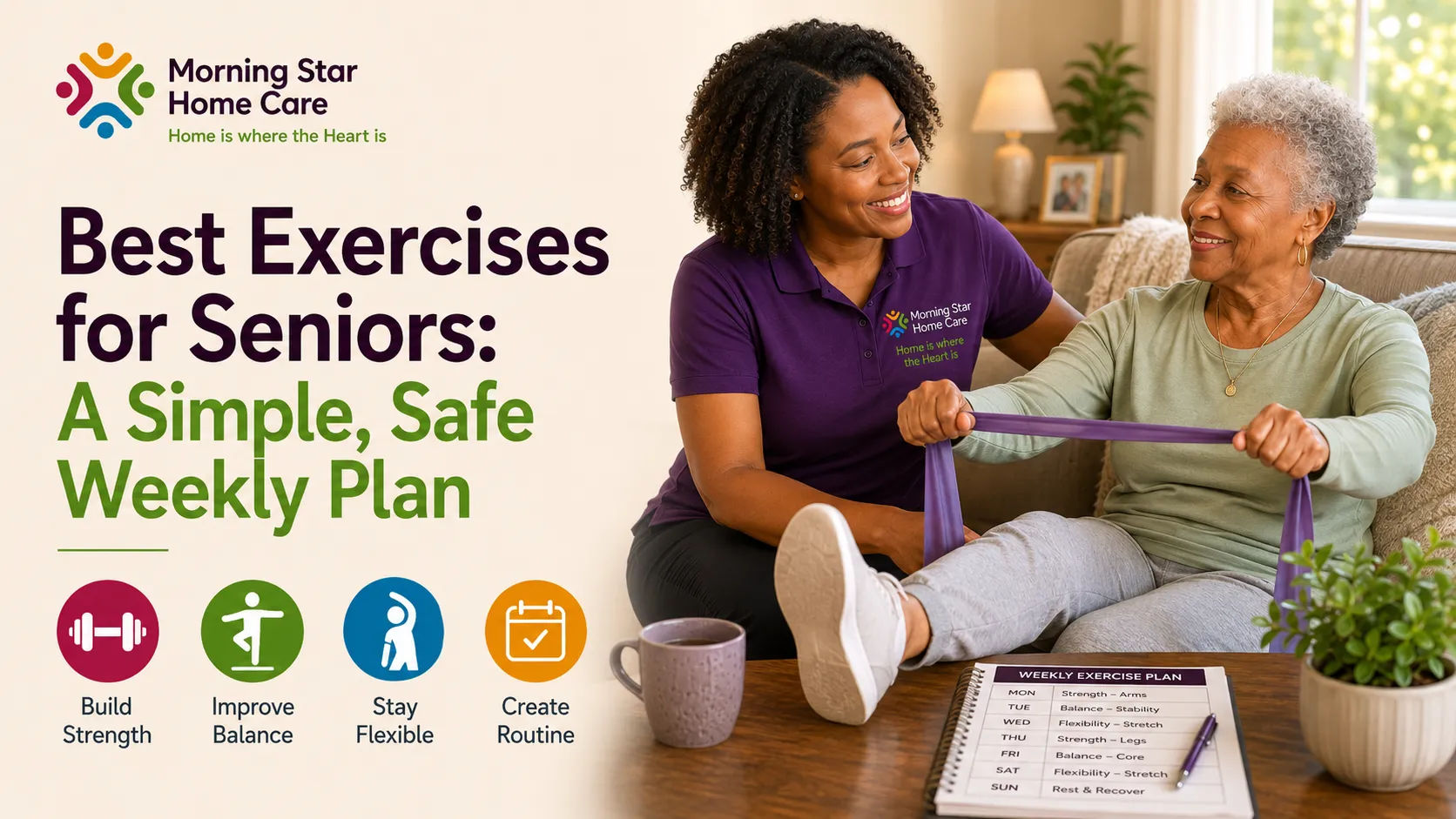
The best exercises for seniors aren't complicated, expensive, or high-intensity — they're simply consistent. The CDC recommends adults 65 and older get at least 150 minutes per week of moderate-intensity aerobic activity, plus muscle-strengthening activity at least two days a week and balance training, and the payoff is substantial: reduced fall risk, better management of chronic conditions like heart disease and diabetes, more years of independent living, and improved brain health.
This guide breaks down exactly which exercises fit each category, how to build a realistic weekly plan, and how to modify each one for limited mobility or a chronic condition.
Key Takeaways
- The CDC recommends 150 minutes of moderate aerobic activity per week for adults 65 and older, plus strength and balance training at least twice a week.
- Balance exercises specifically reduce fall risk, one of the most protective, evidence-backed benefits of regular exercise for older adults.
- Low-impact options work for nearly everyone, including people managing arthritis, limited mobility, or chronic conditions, when started gradually.
- Consistency matters more than intensity — short, regular sessions produce better long-term results than occasional intense workouts.
- A doctor's input before starting is worth getting, especially with an existing heart condition, recent surgery, or balance problems.
The Three Types of Exercise Every Senior Needs
CDC guidelines break weekly activity into three complementary categories, and a well-rounded routine includes all three rather than focusing on just one.
- Aerobic (cardio) activity — 150 minutes per week of moderate intensity (like brisk walking) or 75 minutes of vigorous intensity (like hiking or jogging), spread across the week.
- Muscle-strengthening activity — at least 2 days per week, working all major muscle groups, using bodyweight, resistance bands, light weights, or household items.
- Balance activities — standing on one foot, walking backward, or using a wobble board, which specifically reduce fall risk, a leading cause of injury for older adults.
Dee, Morning Star's founder: "People often think exercise means the gym, and that stops them before they start. The best exercise for a senior is genuinely the one they'll actually do consistently, walking around the block, chair squats while watching TV, standing on one foot while brushing their teeth."
Choosing exercises across all three categories, rather than sticking to just one favorite type of activity, is what produces the full range of protective benefits.
Best Aerobic Exercises for Seniors
Aerobic activity strengthens the heart and lungs and is the foundation of the weekly 150-minute recommendation.
- Brisk walking — the single most accessible option, requiring no equipment and adjustable to any fitness level.
- Water aerobics or swimming — low-impact on joints, ideal for anyone managing arthritis or joint pain.
- Stationary or recumbent cycling — builds cardiovascular fitness with reduced fall risk compared to outdoor walking on uneven surfaces.
- Dancing — a genuinely enjoyable way to meet aerobic goals while also engaging balance and coordination.
Aerobic activity alone, without strength or balance work, leaves real gaps in protection, which is why the CDC frames all three as necessary rather than optional add-ons.
Best Strength Exercises for Seniors
Muscle strength directly supports independence, from carrying groceries to standing up from a chair without assistance, and it can be built without a gym membership.
- Bodyweight squats or sit-to-stands — using a chair for support as needed, this single exercise directly builds the strength needed for daily transfers.
- Wall push-ups — a gentler alternative to floor push-ups that still builds upper body strength.
- Resistance band exercises — inexpensive, portable, and adjustable in difficulty by changing band tension.
- Light dumbbell or household-item exercises — a water bottle or can of soup works as well as a light dumbbell for beginning strength work.
Strength gains also directly support the balance work covered next, since stronger legs and core muscles make balance exercises both safer and more effective.
Best Balance Exercises for Seniors
Balance training is arguably the most underused, highest-impact category, since falls are a leading cause of injury and loss of independence among older adults.
- Standing on one foot, holding onto a counter or chair for support initially, working up to less support over time.
- Walking backward or heel-to-toe walking in a straight line, ideally near a wall or counter for safety.
- Tai chi — a slow, flowing practice specifically shown to reduce fall risk, widely available through community and senior centers.
- Gentle yoga — builds both balance and flexibility, with modified poses available for limited mobility.
A Sample Weekly Plan
| Day | Activity |
|---|---|
| Monday | 30-min brisk walk + 10-min balance practice |
| Tuesday | Strength: bodyweight squats, wall push-ups, resistance bands |
| Wednesday | 30-min walk or swim |
| Thursday | Strength + balance combo (tai chi or yoga class) |
| Friday | 30-min walk |
| Saturday | Strength: light weights or bands |
| Sunday | Rest or gentle stretching |
This sample totals roughly 150 minutes of aerobic activity, 3 strength sessions, and daily balance practice, meeting CDC recommendations comfortably. It's a starting template, not a rigid requirement, and can flex around a person's actual schedule and energy levels.
A sample weekly plan is a starting template, and it should flex around real energy levels, weather, appointments, and how a person feels on a given day, rather than becoming a rigid obligation.
Modifying Exercise for Limited Mobility or Chronic Conditions
Exercise remains valuable even with significant physical limitations, and modification, not avoidance, is usually the right approach.
- Chair-based exercises provide meaningful strength and cardio benefit for anyone with limited standing tolerance or balance concerns.
- Water-based exercise reduces joint stress significantly, making it ideal for arthritis, recent joint surgery, or significant weight-bearing pain.
- Shorter, more frequent sessions (10 minutes, several times a day) can add up to the same weekly total as longer sessions, and may be more manageable for someone with limited stamina.
- Physical therapist-guided programs are worth pursuing after a fall, surgery, or new diagnosis, since a PT can tailor exercises specifically to current limitations.
"Dad couldn't do a full walk around the block anymore after his hip surgery, so we broke it into three short walks a day instead. It added up to more total activity than he'd been doing before, and it felt manageable instead of overwhelming."
Beyond individual and community options, exploring a mix of both tends to produce the most sustainable long-term routine, since variety helps prevent the boredom that often derails consistency.
Community and Structured Exercise Programs
Beyond individual routines, structured senior exercise programs, offered through senior centers, YMCAs, and community organizations, provide both accountability and social connection, two factors that meaningfully improve long-term consistency.
- SilverSneakers — a fitness program included with many Medicare Advantage plans, offering free or discounted access to gyms and senior-specific classes.
- Senior center fitness classes — often free or low-cost, and specifically designed with older adults' needs and pacing in mind.
- Tai chi and yoga classes for seniors — widely available in community settings, combining balance training with social interaction.
- Group walking programs — a simple, no-cost option that adds motivation and safety through numbers.
Recognizing these barriers as normal and solvable, rather than personal failures, is often the first real step toward building a sustainable routine.
Overcoming Common Barriers to Exercise
A handful of recurring obstacles keep older adults from starting or sticking with exercise, and each has a practical workaround worth trying.
- "I'm afraid of falling." Start with seated or wall-supported exercises, and build balance gradually rather than avoiding movement altogether, since inactivity itself increases fall risk over time.
- "I don't have time." Ten-minute sessions spread across the day count toward the weekly total just as much as one longer session — flexibility in timing removes a major barrier.
- "It hurts too much." Pain during exercise is a signal to modify, not necessarily to stop entirely — water-based exercise or a physical therapist consultation can identify a genuinely comfortable starting point.
- "I don't know where to start." A single, small habit, a daily walk to the mailbox, or standing on one foot while brushing teeth, is a legitimate starting point that can build from there.
- "I feel too old for this." Research consistently shows meaningful strength and balance improvements are achievable well into a person's 80s and 90s, regardless of how sedentary the years before were.
How to Track Progress Without It Feeling Like a Chore
Tracking progress helps sustain motivation, but it doesn't need to be complicated or feel like another obligation layered onto an already busy day.
- A simple paper calendar with a checkmark for each day of activity works as well as any app for most people, and requires no technology learning curve.
- Noticing functional improvements — easier stairs, steadier balance, less fatigue during errands — often motivates more than a number on a chart.
- Sharing progress with a family member or caregiver adds a layer of accountability and gives others a natural opening to offer encouragement.
Safety Considerations Before Starting
A few precautions make starting or increasing exercise significantly safer, particularly for someone who hasn't been regularly active.
Call the doctor now if: Talk to a doctor before starting a new exercise routine if there's an existing heart condition, recent surgery, uncontrolled diabetes, or a history of falls or dizziness — a doctor can flag any needed modifications upfront.
- Start slowly and build gradually, rather than attempting to meet the full weekly recommendation immediately.
- Stay hydrated and exercise in appropriate temperatures, since older adults are more vulnerable to dehydration and heat-related issues.
- Wear supportive, non-slip footwear for any standing or walking exercise.
- Stop and seek medical attention for chest pain, severe shortness of breath, dizziness, or unusual joint pain during activity.
The Cognitive Benefits of Exercise Worth Knowing About
Beyond fall prevention and chronic disease management, regular physical activity is one of the most consistently supported lifestyle interventions for brain health in older adults. Exercise increases blood flow to the brain, supports the growth of new neural connections, and has been linked in research to a reduced risk of cognitive decline and dementia. This benefit alone makes exercise worth prioritizing even for someone who feels physically capable and isn't primarily worried about falls or chronic disease, since the cognitive protection compounds over years of consistent activity.
Nutrition and Hydration Alongside an Exercise Routine
Physical activity works best paired with adequate nutrition and hydration, both of which become more important, not less, as activity increases. Older adults are prone to under-hydrating even during exercise, since the sense of thirst naturally diminishes with age, making it easy to become dehydrated without noticing. A light snack with some protein about 30-60 minutes before exercising, plus water before, during, and after activity, supports both performance and safe recovery, particularly for anyone managing diabetes or blood pressure medication that can affect hydration needs.
A Real Family Scenario
Karen's father Walt hadn't exercised regularly in years and was skeptical when his doctor suggested it after a minor fall. Rather than pushing a gym membership, Karen started with a 10-minute walk after breakfast and standing-on-one-foot practice while he brushed his teeth, tiny, easy-to-sustain habits rather than a dramatic overhaul. Six months later, he was walking 20 minutes most days and hadn't had another fall. The consistency, not the intensity, made the difference.
Warming Up and Cooling Down Properly
A proper warm-up and cool-down reduce injury risk and make each session more comfortable, and they're worth building in as a habit rather than skipping to save time.
- Warm up for 5-10 minutes with gentle movement, slow marching in place or arm circles, before more vigorous activity, to gradually raise heart rate and loosen joints.
- Cool down with light stretching after activity, holding each stretch for 20-30 seconds without bouncing, to maintain flexibility and reduce next-day stiffness.
- Never stretch a cold muscle aggressively, since this increases injury risk rather than preventing it — light movement should always come before deeper stretching.
How a Professional Caregiver Supports an Exercise Routine
A consistent in-home caregiver can meaningfully support exercise adherence, providing companionship and safety supervision during walks or exercises, gentle encouragement on lower-motivation days, and the kind of steady presence that turns an isolated exercise routine into a shared, more sustainable habit.
Dee, Morning Star's founder: "Exercise sticks so much better with company. Our caregivers regularly walk with clients, do chair exercises together, practice balance routines side by side. It's not just supervision, it's genuinely more motivating to have someone there."
Building a routine that lasts is less about finding the perfect plan and more about finding the version that fits real life closely enough to actually stick.
What the Research Says About Starting Later in Life
A common and understandable worry is that it's simply too late to benefit from starting exercise in one's 70s, 80s, or beyond. The research says otherwise: studies of previously sedentary older adults, including those in their 80s and 90s, have consistently shown measurable improvements in strength, balance, and mobility within just weeks to months of starting a structured program. The body retains a genuine capacity to adapt and strengthen at any age, even if progress happens more gradually than it would for a younger person. This is one of the more encouraging, evidence-backed facts in all of geriatric health, and it's worth sharing directly with anyone who assumes their window for meaningful improvement has closed.
A Final Thought
The best exercises for seniors are the ones that actually happen consistently, not the most intense or complicated routine on paper. Starting small, combining aerobic, strength, and balance activities across the week, and building in accountability through a walking partner, a class, or a caregiver, turns exercise from a daunting goal into a sustainable habit with real, measurable protection against falls and chronic disease.
A Note for Connecticut Families
Local senior centers and YMCAs throughout the Bristol and Greater Hartford area regularly offer low-cost or free exercise classes designed specifically for older adults, including chair yoga, tai chi, and water aerobics. Checking with a town's senior center is often the fastest way to find a nearby, affordable structured option, and many accept SilverSneakers or similar Medicare Advantage fitness benefits.
References
Written by
Morning Star Care Team
Morning Star Home Care — Caregiver-Founded and Locally Owned in Bristol, CT.