
Pets for seniors can be one of the simplest, most effective ways to ease loneliness and add structure to a day — but the wrong pet, chosen without thinking through mobility, energy, and living situation, can become a burden rather than a comfort. This guide walks through what the research actually shows, and how to match a pet to your parent's real life rather than a general idea of what pets are supposed to do.
Research consistently links pet ownership in older adults to lower stress, reduced loneliness, and in some studies, slower cognitive decline among seniors living alone. But the benefit only holds if the pet is a good fit — a large, high-energy dog can create more stress than comfort for a parent with limited mobility.
Key Takeaways
- Pet ownership is linked to real health benefits — lower blood pressure, reduced loneliness, and in some studies, slower cognitive decline among seniors living alone.
- The right pet depends on your parent's mobility and daily routine, not just personal preference — an energetic young dog isn't the right fit for everyone.
- Cats and smaller, calmer dog breeds often suit seniors with limited mobility better than high-energy breeds.
- A backup care plan matters — who cares for the pet if your parent is hospitalized or their mobility declines further?
- Fostering or pet-sitting can offer companionship benefits without full-time commitment, for parents unsure about ongoing care.
What the Research Actually Shows
A number of studies have found genuine associations between pet ownership and better health outcomes in older adults — including decreased blood pressure, cholesterol, and reported loneliness. In a study of nearly 8,000 older adults, those living alone with a pet showed slower cognitive decline in verbal memory and fluency compared to those without one.
It's worth being honest that the research isn't unanimous — some studies find no clear benefit, and pet ownership clearly isn't right for every situation. The consistent thread across the research is that the benefit depends heavily on whether the pet and the person are actually a good match, not on pet ownership alone.
Dee, Morning Star's founder: "I've seen a cat completely change an isolated client's mood and daily structure. I've also seen an unsuitable, high-energy puppy become a source of real stress for a family already stretched thin. The pet has to fit the person's actual life, not just sound like a nice idea."
Matching the Pet to Your Parent's Life
| Situation | Better Fit | Consider Carefully |
|---|---|---|
| Limited mobility, uses a walker or cane | Cat, small calm dog breed, or low-maintenance fish/birds | Large or high-energy dog breeds |
| Lives alone, craves companionship | Dog (with a walking plan) or affectionate cat breed | Pets requiring minimal interaction |
| Memory concerns or early dementia | Low-maintenance pet, or a robotic companion pet | Any pet requiring complex daily care routines |
| Very active, enjoys walking | Dog matched to their energy level | Sedentary pets if daily activity is a health goal |
| Uncertain about long-term commitment | Fostering, pet-sitting, or a shorter-lived pet | A young dog or bird with a multi-decade lifespan |
Dogs: Structure, Exercise, and Companionship
Dogs offer some of the strongest documented benefits — regular walks provide built-in cardiovascular exercise, and the responsibility of feeding and caring for a dog creates a daily structure that many seniors find grounding, especially after retirement or the loss of a spouse.
The tradeoff is real physical demand: daily walks, especially in Connecticut winters, require mobility and stamina that not every senior has. Smaller, lower-energy breeds — many toy and companion breeds are specifically suited to calmer households — can offer the emotional benefits of dog ownership with a more manageable physical demand.
"My dad adopted a senior dog from a shelter after my mom passed, and it gave him a reason to get up and go outside every morning. A puppy would have been too much for him at his age, but the older dog matched his pace perfectly."
Cats: Lower-Maintenance Companionship
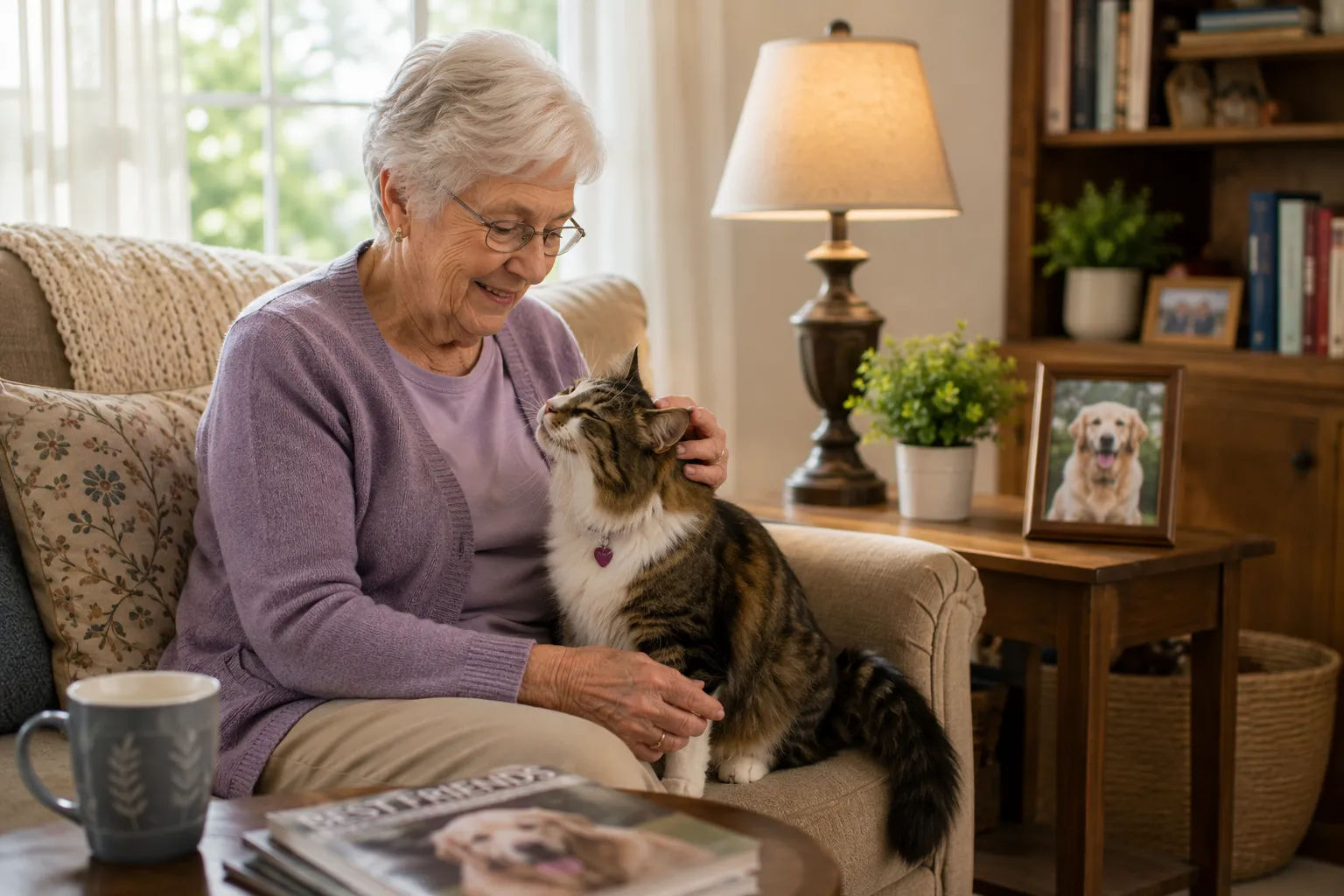
Cats generally require less physical exertion than dogs — no daily walks, less demanding exercise needs — while still offering real companionship and, per some research, cardiovascular benefits of their own. For a parent with limited mobility or energy, a cat can provide much of the emotional benefit of pet ownership with a lower physical demand.
Cats do still require daily feeding, a clean litter box, and occasional veterinary care, so "low-maintenance" doesn't mean "no responsibility" — it's worth being realistic about whether even this level of care is sustainable for your parent's current situation.

Smaller Pets and Alternatives
For parents who want companionship without the responsibility of a cat or dog, birds, fish, or small caged pets can offer some structure and interest with a lower care burden. These aren't a substitute for the documented emotional benefits of a cat or dog, but they can be a reasonable middle ground for a parent hesitant about full pet ownership.
Robotic companion pets — increasingly sophisticated and designed specifically for seniors, including some designed for dementia care — have also shown promise in research settings for reducing loneliness and agitation, without requiring any of the physical care a living pet needs.
These questions are worth writing down and discussing as a family before visiting a shelter or breeder, since it's far easier to think clearly about them in advance than in the moment, faced with an appealing animal at an adoption event.
Questions to Ask Before Getting a Pet for an Aging Parent
- Can your parent physically handle daily care — walking a dog, cleaning a litter box, filling a water bowl?
- What happens if your parent is hospitalized or their mobility declines further — who is the backup caregiver for the pet?
- Is your parent financially prepared for ongoing costs — food, veterinary care, grooming?
- Does your parent's living situation allow pets — this matters especially if a move to assisted living may be on the horizon?
- Would fostering or pet-sitting be a better first step than a long-term commitment?
This kind of planning tends to feel unnecessary right up until it's urgently needed — a sudden hospitalization gives a family no time to figure out pet care from scratch, and the stress of scrambling for an emergency solution adds to an already difficult situation.
A Backup Care Plan Matters More Than Families Realize
One of the most overlooked parts of getting a pet for an aging parent is planning for what happens if the parent can't care for the pet temporarily or permanently — a hospitalization, a move to assisted living, or a decline in mobility. Having a family member, friend, or boarding arrangement identified in advance prevents a difficult decision from being made in a crisis.
Call the doctor now if: your parent is hospitalized unexpectedly and no backup pet care plan exists — many veterinary offices and animal shelters can provide emergency short-term boarding information.
It's also worth checking with a veterinarian about a specific pet's likely health needs as it ages — some breeds are prone to costly chronic conditions, which is worth factoring into the decision for a senior owner on a fixed budget.
Considering a Senior Pet Instead of a Puppy or Kitten
Adopting an older pet from a shelter is often a better match for an older adult than a young animal. Senior pets typically have calmer temperaments, are usually already house-trained, and require less intensive supervision than a puppy or kitten — while shelters frequently have older pets waiting longer for adoption simply because they're less in demand. Many shelters also offer reduced adoption fees or senior-to-senior programs specifically pairing older pets with older adopters, which can make this option more accessible.
The Cost of Pet Ownership on a Fixed Income
Food, routine veterinary care, grooming, and unexpected medical costs add up, and many seniors live on fixed incomes where an unplanned vet bill can be a genuine financial strain. Before adopting, it's worth budgeting realistically: a healthy small dog or cat typically costs a meaningful amount annually in food and routine care alone, before factoring in emergencies. Pet insurance is worth considering, particularly for a young or medium-sized dog with a long expected lifespan, since it can convert unpredictable emergency costs into a manageable monthly premium. For seniors on a very tight budget, some community organizations and veterinary schools offer reduced-cost care specifically for elderly pet owners — it's worth researching what's available locally before ruling out pet ownership on cost alone.
Physical Safety Considerations With Pets
An excitable or large pet can itself become a fall risk for a senior with balance concerns — jumping up, weaving underfoot, or pulling hard on a leash during a walk. This isn't a reason to avoid pets altogether, but it is a reason to think carefully about size, training, and temperament rather than choosing based on appearance or breed popularity.
A well-trained, calm pet, or specific accommodations like a no-pull harness for a dog, can mitigate much of this risk. For parents already managing mobility issues, it's worth prioritizing temperament and training over breed novelty when selecting a pet.
Pets and Social Connection
Beyond the direct companionship a pet offers, dog ownership specifically tends to create incidental social opportunities — conversations with neighbors during walks, connections at a local dog park, or simply more reasons to be outside and visible in the neighborhood. For an isolated senior, these small, repeated social interactions can meaningfully counter the isolation that's a well-documented risk factor for declining health in older adults.
"My dad's never been much of a talker, but since he got his dog, he actually chats with neighbors on his walks now. It's given him more social contact in a year than he'd had in the two years after my mom passed."
When a Pet Isn't the Right Choice Right Now
Not every situation calls for a pet, and it's worth being honest about that rather than assuming a pet is always a good idea for an isolated or grieving parent. A parent in the middle of a health crisis, transitioning to a new living situation, or clearly not physically able to provide even minimal daily care is not a good candidate for a new pet, however much company might genuinely help them. In these situations, alternatives — a robotic companion pet, regular visits from a companion caregiver, or simply more frequent family contact — can address the same underlying need for connection without adding the responsibility of a living animal's care. Recognizing when the timing isn't right doesn't mean it never will be — a parent going through a difficult transition now may be an excellent candidate for a pet once things stabilize. It's a timing question as much as a suitability question.
Involving the Whole Family in the Decision
Adopting a pet for an aging parent often affects more than just that one household — adult children may end up providing backup care, covering costs during a health setback, or helping with veterinary appointments. It's worth having this conversation openly with siblings or other family members before the adoption, rather than assuming responsibilities will simply be shared when needed. Some families find it helpful to designate one adult child as the primary backup contact for the pet, similar to how a family might designate a healthcare proxy, so there's no confusion about who steps in if the parent can't care for the animal temporarily.
How In-Home Care Can Support Pet Ownership
For seniors whose mobility has declined but who still want the companionship of a pet, a home care aide can help bridge the gap — assisting with dog walks, refilling food and water, or helping with a litter box — allowing your parent to keep the emotional benefit of pet ownership without the full physical burden of daily care falling entirely on them or on family.
Dee, Morning Star's founder: "I've had clients who were on the verge of giving up a beloved pet because the physical care had become too much, and a small amount of help with walks and feeding meant they got to keep their companion. That's a meaningful difference in someone's quality of life."
A Real Family Scenario
After Karen's mother passed away, her father Walt grew noticeably quieter and less active. Rather than getting a puppy, which Karen worried would be too much for him, they visited a local shelter and adopted a calm, six-year-old dog. The daily walks gave Walt a reason to get outside, and the dog's company noticeably lifted his mood within weeks — without the demands of house-training or a young animal's high energy.
Therapy Animals and Visiting Pet Programs
For seniors not ready for full pet ownership — or living somewhere pets aren't allowed — visiting therapy animal programs offer some of the emotional benefit without the responsibility. Many senior centers, assisted living communities, and even some home care agencies coordinate regular visits from trained therapy dogs, giving seniors the chance to interact with an animal on a scheduled basis. These programs are worth asking about specifically if your parent misses having a pet but genuinely isn't in a position to take on full-time care — it's a meaningful middle ground rather than an all-or-nothing choice.
Introducing a New Pet Gradually
Even when a pet is a good match on paper, the transition period matters. Bringing a new animal into a senior's home works best when introduced gradually — starting with short visits before a full adoption, if possible, to gauge how both the pet and your parent adjust to each other. It's also worth having a specific plan for the first few weeks: who will help with initial training or litter box setup, who will accompany early walks if balance is a concern, and how quickly to expect a new routine to feel normal rather than disruptive.
Grief and Pet Loss in Later Life
It's worth acknowledging directly: pets have shorter lifespans than people, and the loss of a beloved companion animal can hit an older adult especially hard, sometimes compounding grief from other losses like a spouse or close friends. This is a real consideration, not a reason to avoid pet ownership, but a reason to think about it honestly rather than treating pet loss as a minor concern. Choosing an animal with a lifespan reasonably aligned to what a family expects, and being prepared to support a parent emotionally through an eventual loss, is part of responsible planning around pet ownership in later life.
One Last Consideration: Timing With Other Life Changes
Adopting a pet at the same time as another major life transition — moving, a new caregiving arrangement, a recent loss — can add stress rather than relieve it. Spacing out major changes, where possible, gives both your parent and a new pet a better chance of settling in successfully.
A Final Thought
A well-matched pet can genuinely improve an aging parent's quality of life — offering companionship, structure, and a reason to get up and move each day. The key word is well-matched: taking the time to consider your parent's actual mobility, energy, and living situation, rather than choosing based on sentiment alone, makes the difference between a source of joy and a source of stress.
Connecticut Resources for Senior Pet Adoption
- Connecticut Humane Society — adoption programs and resources
- 211 Connecticut — statewide resource and referral line
References
- American Psychiatric Association — How Pets Can Protect Cognitive Health in Older Adults
- UC Davis Health — Health Benefits of Pets
- Pets for the Elderly Foundation — Health Benefits Research
This article is for general information and isn't a substitute for medical, legal, or financial advice. If you're concerned about a specific issue, talk to your parent's doctor or an elder law attorney.
Written by
Morning Star Care Team
Morning Star Home Care — Caregiver-Founded and Locally Owned in Bristol, CT.