
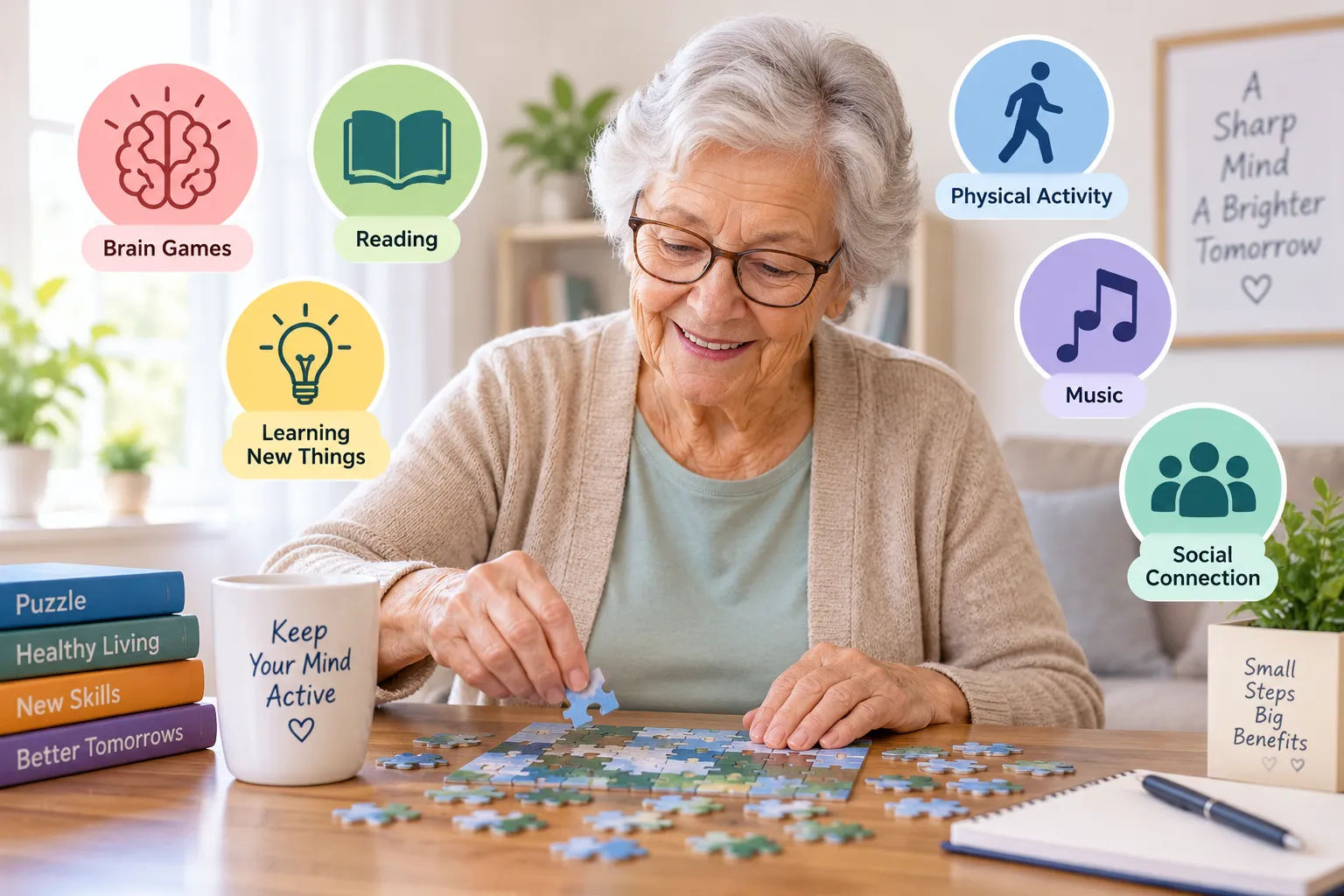
Brain exercises for seniors have moved well beyond crossword puzzles and sudoku, and current research supports a more varied, engaging approach than many families realize. One particularly striking study found that older adults who learned multiple new skills simultaneously, a language, drawing, and music, showed cognitive performance improvements reaching levels similar to middle-aged adults after just a few weeks of consistent practice. This points to a broader principle worth understanding: novelty and variety appear to matter more than repeating the same familiar puzzle day after day.
This guide covers what the research actually supports, the most effective types of cognitive activity, and how to build brain exercise into daily routines that stick.
Key Takeaways
- Learning multiple new skills simultaneously has been shown to improve cognitive performance to levels similar to middle-aged adults within weeks.
- Novelty and variety matter more than repetition — the same familiar puzzle provides diminishing cognitive benefit over time.
- Game-based cognitive training programs have shown measurable benefit in reducing mild cognitive impairment in structured research settings.
- Physical exercise combined with cognitive training appears more effective than either approach alone.
- Frequent cognitive activity is associated with reduced dementia risk, according to research published in the New England Journal of Medicine.
Understanding that novelty, not just repetition, drives cognitive benefit reshapes how families should think about choosing and rotating brain exercise activities.
It is genuinely encouraging that this kind of adaptability, often called neuroplasticity, persists throughout life, meaning it is never too late to start engaging in new, cognitively demanding activities.
What the Research Actually Supports
Brain exercise research has evolved considerably, and current evidence points to specific, well-supported approaches rather than any single miracle activity.
- Learning entirely new skills, rather than practicing familiar ones, appears to provide the strongest cognitive benefit, since the brain works harder to master unfamiliar tasks.
- Multisensory engagement, activities involving multiple senses at once, may help strengthen cognitive function more than single-sense activities.
- Structured, game-based cognitive training programs have shown measurable results in research settings, particularly for older adults with mild cognitive impairment.
- Frequent cognitive activity broadly is associated with reduced dementia risk in longitudinal research, reinforcing the value of consistent engagement over any single activity type.
This growing body of research supports a genuinely optimistic message: the brain retains meaningful capacity to strengthen and adapt well into later life.
None of this requires formal instruction or significant expense either, informal learning through free online resources, library programs, or a knowledgeable friend can provide much of the same genuine cognitive challenge.
Learning New Skills: The Strongest Evidence
Among all brain exercise approaches studied, learning genuinely new skills, rather than practicing existing ones, shows some of the most compelling research support.
- Learning a new language engages multiple cognitive systems simultaneously, memory, attention, and executive function, making it a particularly demanding and beneficial mental workout.
- Learning to play a musical instrument combines physical coordination with auditory processing and memory, another multisensory activity linked to cognitive benefit.
- Drawing or other new visual arts skills engage spatial reasoning and fine motor coordination in ways that differ meaningfully from more passive cognitive activities.
- Combining multiple new skills at once, as shown in recent research, appears to produce a stronger effect than focusing on just one.
The common thread across these activities is genuine novelty and challenge, not simply staying "busy" with a familiar hobby.
Balance and coordination exercises deserve specific mention too, since activities like tai chi combine physical movement, mental focus, and often a social class setting, checking several beneficial boxes simultaneously.
Physical Exercise and Cognitive Health
Physical activity plays a surprisingly significant role in cognitive health, and research increasingly points to combining physical and cognitive exercise for the strongest effect.
- Aerobic exercise increases blood flow to the brain, supporting the delivery of oxygen and nutrients that cognitive function depends on.
- Exercise combined with cognitive training appears more effective for cognitive outcomes than either approach practiced separately.
- Activities requiring both physical coordination and mental engagement, like dancing or certain sports, may provide a particularly strong combined benefit.
- Even moderate, regular physical activity, not necessarily intense exercise, appears to meaningfully support cognitive health over time.
This connection reinforces that brain health and physical health aren't separate goals, they're genuinely intertwined and best pursued together.
Group settings, in particular, layer social benefit on top of cognitive benefit, making a class or club often more effective than a solitary activity pursued alone, even if the solitary version is technically more challenging.
Social Engagement as Cognitive Exercise
Social interaction itself functions as a genuine form of cognitive exercise, engaging memory, language, and social reasoning simultaneously in ways that solo activities don't replicate.
- Conversation requires rapid cognitive processing, following a discussion, formulating responses, and reading social cues, more demanding than many realize.
- Group activities and classes combine social engagement with structured learning, potentially offering benefits beyond either element alone.
- Isolation is associated with faster cognitive decline, making social connection a meaningful protective factor in its own right, not just a pleasant addition to a cognitive health plan.
Dee, Morning Star's founder: "The best brain exercise often doesn't look like an exercise at all, a lively conversation, a group card game, planning a family visit. Engagement matters more than the specific format."
Recognizing social interaction as a legitimate form of cognitive exercise helps families build brain health into everyday life rather than treating it as a separate task.
Practical Activities to Build Into Daily Life
Translating research into a sustainable daily or weekly routine matters more than any single activity, since consistency drives the actual benefit.
- Rotating activity types regularly, alternating puzzles, reading, a new hobby, and social time, provides the variety research suggests matters most.
- Setting a specific, low-pressure goal, like learning ten new words in a new language each week, makes a new skill feel achievable rather than overwhelming.
- Pairing cognitive activities with existing routines, like a puzzle over morning coffee, increases the odds of genuine consistency.
- Choosing genuinely enjoyable activities over activities chosen purely for perceived cognitive benefit improves long-term adherence significantly.
"Dad started a beginner watercolor class mostly for something to do, and I've noticed his conversations have gotten sharper and more animated since. It clearly wasn't just about the painting itself."
Building brain exercise into activities a person genuinely enjoys, rather than treating it as an obligation, is what makes the habit sustainable long enough to matter.
None of this means digital brain-training apps are without value, many people genuinely enjoy them and find them motivating, which itself contributes to the consistency that makes any cognitive activity worthwhile.
Puzzles, Games, and Apps: What They Can and Can't Do
Traditional brain games, crosswords, sudoku, and cognitive training apps remain popular, and understanding their realistic role helps set appropriate expectations.
- These activities do provide genuine engagement and can be a valuable, accessible part of a broader routine, particularly for those who enjoy them.
- Improvement tends to be most pronounced on the specific task practiced, with more limited evidence that skill transfers broadly to other cognitive domains or everyday function.
- Variety matters even within this category, rotating between different puzzle types provides more benefit than years of the same daily crossword.
- These tools work best as one part of a varied routine, not a complete cognitive health strategy on their own.
Enjoying a daily crossword is a perfectly reasonable habit to keep, just not one to rely on as a sole or primary cognitive health strategy.
Consistency in a daily routine also supports cognitive health more broadly, since the brain benefits from predictable structure alongside the novelty of new activities, an intentional balance rather than a contradiction.
Sleep, Stress, and Cognitive Health
Brain exercise doesn't happen in isolation, and two often-overlooked factors, sleep quality and stress levels, significantly influence how well the brain benefits from any cognitive activity.
- Quality sleep supports memory consolidation, the process by which the brain solidifies what was learned during the day, making sleep itself a form of cognitive maintenance.
- Chronic stress and elevated cortisol can impair memory and concentration, potentially undermining the benefits of cognitive exercise if left unaddressed.
- Relaxation practices, like meditation or gentle breathing exercises, may support cognitive health both directly and by improving sleep quality.
- Addressing sleep problems or chronic stress alongside cognitive activities, rather than pursuing brain exercise in isolation, produces a more complete approach to cognitive health.
A well-rested, less stressed brain is simply better positioned to benefit from any cognitive exercise, making these foundational factors worth addressing first.
A brief note on alcohol is also worth including here, since heavy or regular alcohol use is associated with negative cognitive effects, while the evidence around light to moderate consumption remains more mixed and worth discussing individually with a doctor given other health factors.
Nutrition's Role in Cognitive Health
Diet plays a supporting role in cognitive health alongside brain exercise, with certain eating patterns showing consistent association with better cognitive outcomes.
- The Mediterranean and MIND diets, emphasizing vegetables, fish, nuts, and olive oil, are among the most researched dietary patterns linked to cognitive health.
- Omega-3 fatty acids, found in fatty fish and certain nuts, support brain cell structure and function.
- Managing cardiovascular risk factors through diet, including blood pressure and cholesterol, indirectly supports cognitive health given the close relationship between vascular and brain health.
- Adequate hydration directly affects concentration and mental clarity, making it a simple, foundational piece of any cognitive health approach.
Diet, sleep, and cognitive activity work together rather than independently, making a holistic approach more effective than optimizing any single factor alone.
It is also reasonable to expect some activities to simply not resonate, and that is fine. The goal is finding something genuinely engaging for a specific individual, not forcing adherence to any particular activity simply because research supports its category in general.
Setting Realistic Expectations
It's worth approaching brain exercise with realistic, evidence-based expectations rather than either dismissing it entirely or expecting it to prevent all cognitive decline.
- Brain exercise is one modifiable factor among several, not a guaranteed way to prevent dementia or reverse existing cognitive decline.
- Benefits tend to be most noticeable in overall engagement, mood, and quality of life, alongside more subtle cognitive effects that build gradually over time.
- Starting cognitive activity earlier, rather than waiting until concerns arise, appears to offer more protective value than beginning after decline is already noticeable.
- The enjoyment and social connection that often accompany these activities provide real value independent of any measurable cognitive benefit.
Approaching brain exercise as one valuable piece of a broader healthy lifestyle, rather than a standalone solution, reflects what the current evidence most accurately supports.
A Real Family Scenario
Frank had grown fairly sedentary after retirement, mostly watching television and doing the same crossword puzzle app daily. His daughter Karen suggested trying a beginner guitar class at the local senior center, partly for something new and partly for the social aspect. Frank was initially reluctant, but within a few months, family members noticed he seemed sharper in conversation and more engaged during visits, a change he himself attributed to "finally learning something new again."
Frank's experience reflects the broader research pattern: genuine novelty, not simply staying occupied with a familiar activity, appears to be what drives meaningful cognitive benefit.
How an In-Home Caregiver Supports Cognitive Engagement
A consistent in-home caregiver can provide regular conversation, encourage participation in cognitively engaging activities, and help introduce new hobbies or games tailored to a parent's specific interests and current ability level. This kind of steady, personalized engagement often accomplishes more than an app or program used sporadically alone.
Dee, Morning Star's founder: "We try to build genuine conversation and mental engagement into every visit, not just companionship in the background. A good discussion about the news or a shared puzzle does real cognitive work."
This consistent, relationship-based engagement often provides exactly the kind of sustained, enjoyable cognitive stimulation that research suggests matters most.
Brain Exercise for Someone With Existing Cognitive Impairment
For a parent already diagnosed with mild cognitive impairment or early-stage dementia, cognitive activity remains valuable but benefits from a somewhat adjusted approach.
- Structured, game-based cognitive training programs have shown particular research support for adults with mild cognitive impairment specifically, more so than for the general senior population.
- Activities should be adjusted to remain achievable, avoiding excessive frustration, which can be counterproductive and discouraging rather than beneficial.
- Familiar, well-practiced activities may become more comforting and appropriate than entirely new, unfamiliar ones as cognitive impairment progresses, a shift from the general "novelty is best" principle.
- A doctor or occupational therapist can help tailor a cognitive activity plan to a specific diagnosis and current ability level.
The core principle of staying engaged remains valuable throughout, but the specific activities and expectations reasonably shift as cognitive ability changes over time.
A Final Thought
Brain exercises for seniors work best as a varied, genuinely enjoyable part of daily life, not a chore performed out of obligation. Learning new skills, staying physically active, and maintaining social connection together provide the kind of consistent, meaningful cognitive engagement that current research most strongly supports.
Choosing activities a parent genuinely looks forward to, rather than optimizing purely for perceived cognitive benefit, tends to produce the most sustainable, and ultimately most effective, results.
Starting small also matters. A single weekly class or a short daily habit is far more sustainable, and ultimately more beneficial over time, than an ambitious plan that proves too demanding to maintain past the first few weeks.
A Note for Connecticut Families
Senior centers and community education programs throughout the Bristol and Greater Hartford area offer classes in art, music, language, and other new-skill learning opportunities specifically designed for older adults.
Families exploring new activities with a parent may find that joining in themselves, rather than simply suggesting an activity from the sidelines, adds a valuable social dimension while making the new skill genuinely more enjoyable to pursue together.
References
- Optoceutics — Brain Exercises For Seniors (15 Games For Cognitive Training)
- PMC — Effectiveness of a Brain Exercise Program Using Game-Based Cognitive Enhancement to Reduce Mild Cognitive Impairment Among Older Adults
- Frontiers — Optimal Exercise Interventions for Enhancing Cognitive Function in Older Adults: A Network Meta-Analysis
Written by
Morning Star Home Care
Morning Star Home Care — Caregiver-Founded and Locally Owned in Bristol, CT.