
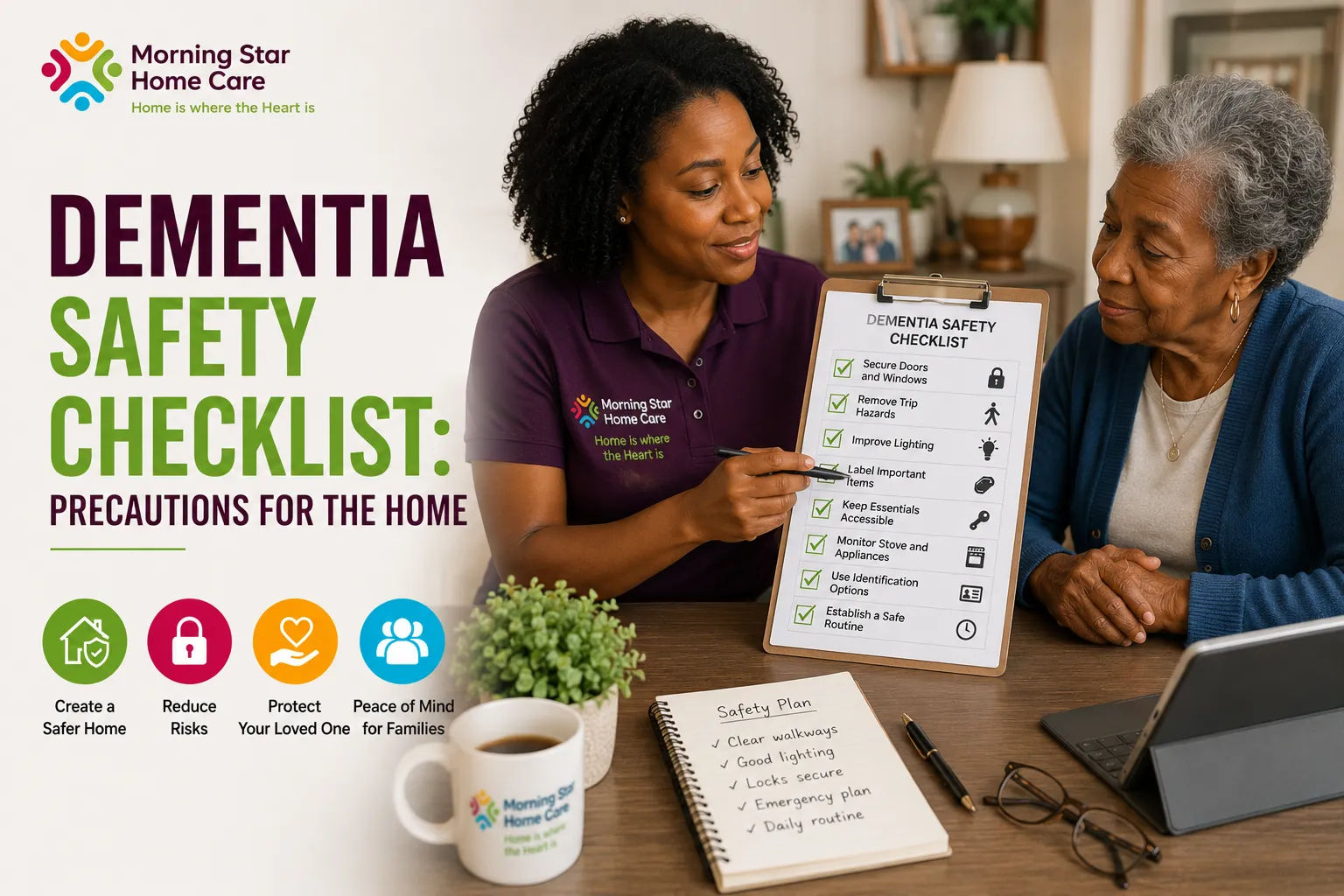
A dementia safety checklist looks different from a general senior home safety checklist, because the hazards themselves are different. Cognitive decline doesn't just affect memory — it affects judgment, hazard recognition, and impulse control, which means risks that a cognitively intact older adult would recognize and avoid (a hot stove burner, a bottle of cleaning fluid that looks like a drink, an unlocked door) become genuine dangers for someone with dementia.
Falls, in particular, are roughly twice as likely for seniors living with dementia compared to those without, according to research cited by fall prevention organizations — a reminder that dementia-specific safety planning isn't optional extra caution, it's addressing a measurably higher risk profile.
Key Takeaways
- Dementia safety hazards differ from general senior safety hazards — judgment and impulse control matter as much as physical mobility.
- The kitchen and bathroom carry the highest concentration of dementia-specific risks — stoves, medications, cleaning products, water temperature.
- Fall risk roughly doubles for people with dementia compared to cognitively intact older adults.
- Safety measures should be revisited as dementia progresses — what's safe today may not be safe in six months.
- Removing hazards works better than relying on reminders or willpower since judgment itself is impaired, not just memory.
Why Dementia Changes the Safety Equation
The core difference between general senior home safety and dementia-specific safety is that dementia affects the ability to recognize danger, not just the ability to remember or move safely. A cognitively intact older adult with mobility limitations knows not to touch a hot stove or drink from an unlabeled bottle; someone with moderate dementia may not reliably make that judgment, which shifts the safety strategy from "reduce physical difficulty" toward "remove the hazard from reach entirely."
Dee, Morning Star's founder: "The mistake families make most often is safety-proofing for mobility, the way you'd help any aging parent, and stopping there. Dementia safety means asking a different question: not 'can they physically do this safely,' but 'would they recognize this as dangerous right now.'"
This shift in approach applies across every room in the home, which is why the sections below are organized by hazard type rather than by general fall-prevention categories alone.
Kitchen Safety
- Stove knob covers or a gas shutoff valve to prevent unsafe stove use, especially once someone can no longer reliably remember to turn a burner off.
- An automatic shutoff device for the stove or oven, available as an add-on for many models, reducing fire risk if a burner is left on.
- Removing or securing sharp knives and small appliances not needed for daily use.
- Clearing the counter and table of vitamins, seasonings, and sugar substitutes that can be mistaken for food or misused.
Medication Safety
Medication mix-ups are a significant risk once dementia affects the ability to track dosing schedules or recognize which pills are which.
- Store medications in a locked drawer or cabinet, not left out on a counter or nightstand.
- Use a pre-filled pill organizer managed by a caregiver, rather than relying on the person to self-manage from original bottles.
- Keep a written log or app-based tracker to confirm doses were actually taken, since dementia can cause someone to forget they already took a dose and take it again.
Bathroom Safety
Bathrooms combine fall risk with dementia-specific hazards like water temperature control and cleaning product storage.
- Set the water heater to a safe maximum temperature (generally 120°F or below) to prevent scalding if someone can't reliably judge water temperature.
- Store cleaning products, razors, and medications out of the bathroom entirely if possible, or in a locked cabinet.
- Non-slip mats and grab bars, combined with supervision or standby assistance for bathing, address the doubled fall risk associated with dementia.
Chemical and Household Hazard Safety
Cleaning products, alcohol, and other household chemicals need to be stored with dementia-specific judgment in mind — not just "out of easy reach," but genuinely secured, since a container that looks like a beverage can be mistaken for one.
| Hazard Category | Precaution |
|---|---|
| Cleaning products (bleach, detergent pods) | Store in a locked cabinet, never left under the sink accessible |
| Alcohol | Secure or remove, especially if combined with medications |
| Matches and lighters | Remove from common areas entirely |
| Small tools and sharp objects | Store in a locked space, not just a drawer |
Wandering-Adjacent Home Modifications
While wandering prevention deserves its own dedicated planning (covered in depth in our dementia wandering prevention guide), a few home safety basics overlap directly: securing exterior doors with alarms, and removing or securing car keys if driving is no longer safe, both belong on a comprehensive dementia safety checklist even though they're primarily about exit-seeking behavior rather than in-home hazards.
Fall Risk and Dementia
Fall risk roughly doubles for people with dementia compared to cognitively intact older adults, driven by a combination of impaired judgment about physical limitations, visual-perceptual changes that affect depth perception, and reduced ability to problem-solve around obstacles. Clearing walkways of clutter, ensuring consistent lighting (especially at night), and removing loose rugs matter even more in a dementia-affected home than in a general senior safety context.
"I used to think Dad's dementia safety and his fall risk were separate problems to solve. They're really the same problem — confusion makes him more likely to trip, and instability makes a confused moment more dangerous."
Outdoor and Entryway Safety
Home safety planning tends to focus indoors, but entryways, garages, and yards carry real risk too, especially in a Connecticut climate where icy steps and uneven walkways are a fall hazard for months at a time.
- Deadbolts or door alarms on all exterior doors, positioned at a height or style the person is less likely to fumble with, help slow unsupervised exits.
- Outdoor lighting on motion sensors improves visibility for evening trips to a mailbox or car without requiring someone to remember to flip a switch.
- Handrails on both sides of exterior steps, plus non-slip treads or salt during winter months, reduce the single most dangerous outdoor task most older adults still do themselves.
- Garage and shed doors that lock separately from the house keep access to tools, chemicals, and vehicles more controlled.
- A visible, no-code house number helps first responders find the home quickly in an emergency, something families often overlook until it matters.
Reassessing Safety as Dementia Progresses
A safety setup that works well in early-stage dementia often needs meaningful revision as the disease progresses, since abilities and judgment continue to change. A stove knob cover that was sufficient six months ago may need to be replaced with a full gas shutoff as impulse control declines further; a pill organizer managed independently may need to shift to fully caregiver-administered medication.
- Reassess the home safety setup every few months, not just once at diagnosis.
- Watch for near-misses — a burner left on, a wrong-day pill taken — as signals that current precautions need to tighten.
- Involve whoever spends the most daily time in the home in reassessment, since they notice changes family visiting occasionally would miss.
When Home Precautions Aren't Enough
There's a point in dementia progression where no amount of home modification fully addresses the safety risk of someone being alone for extended periods, and recognizing that point matters as much as the specific precautions themselves.
Call the doctor now if: If a loved one with dementia has left a stove burner on, taken medication incorrectly more than once, or shown a pattern of judgment lapses that home modifications aren't fully addressing, it's worth discussing increased in-home supervision or care with their doctor rather than adding more precautions to a setup that's already reaching its limits.
Bedroom Safety
The bedroom carries risks that are easy to overlook because it feels like the safest room in the house — but nighttime confusion, medication timing, and mobility challenges getting out of bed all concentrate there.
- A motion-sensor nightlight or hallway light that activates automatically, addressing both fall risk and nighttime disorientation.
- A bed positioned away from windows or exterior walls if wandering or exit-seeking behavior has been observed.
- Keeping a phone or medical alert device within reach of the bed, not across the room.
Technology and Monitoring Considerations
Simple monitoring technology adds a layer of safety that pure home modification can't provide alone — the ability to check in remotely, or receive an alert if something unusual happens, particularly overnight or when a family member can't be physically present. Door sensors, motion sensors in key rooms, and stove-monitoring devices that alert a phone if a burner has been left on unusually long all extend the protection of physical home modifications with real-time awareness.
It's worth noting that monitoring technology works best as a complement to, not a replacement for, the physical safety measures already covered — an alert that a stove was left on still requires someone available to respond to it.
Involving the Person With Dementia in Safety Decisions
Where possible, involving the person with dementia in safety conversations — even in early stages, when insight may still be relatively intact — tends to produce better cooperation than implementing changes unilaterally. Framing changes around comfort and ease ("this new stove makes cooking simpler") rather than around decline ("this is because you can't be trusted with the stove anymore") preserves dignity while still accomplishing the safety goal.
Cost Considerations for Dementia-Proofing a Home
Families often assume dementia-proofing a home requires a major renovation budget, but most of the highest-impact changes are inexpensive. Stove knob covers, door alarms, cabinet locks, and non-slip bath mats typically run under $200 combined and can be installed in an afternoon. Bigger-ticket items, like grab bars professionally installed, a walk-in shower conversion, or a full monitoring system, matter more for some homes than others and are worth prioritizing based on the specific risks identified in a walkthrough rather than purchased as a default package.
- Low-cost, high-impact: outlet covers, cabinet and drawer locks, stove knob covers, non-slip mats, night-lights, door and window alarms.
- Moderate cost: professionally installed grab bars, raised toilet seats, improved lighting fixtures, smart locks.
- Higher cost, often worth it over time: walk-in shower or tub conversion, whole-home monitoring or sensor systems, stairlifts for homes where downsizing isn't an option.
Some home safety modifications, particularly those recommended by an occupational therapist as medically necessary, may be partially covered by Medicare Advantage plans, long-term care insurance, or veterans' benefits. It's worth asking before assuming a modification is out of reach.
A Real Family Scenario
Walt's dementia safety checklist started simple — a lockbox for medications, a stove knob cover. But six months later, Karen noticed he'd started leaving the stove cover off, having figured out how to remove it. Rather than treating this as a failure of the original plan, she saw it as a signal his needs had changed, and moved to a full gas shutoff valve alongside a conversation with his doctor about whether he needed more consistent daytime supervision. The checklist wasn't static — it evolved with him.
Common Mistakes Families Make With Dementia Home Safety
A few patterns show up again and again when families work through a dementia safety checklist for the first time, and knowing them in advance can save time and frustration.
- Treating it as a one-time project. The most common mistake is doing a single thorough safety pass and considering it done. Dementia changes over months, and a home that was safe six months ago may not be safe now.
- Over-modifying too early. Installing every possible safety device at the mild stage can feel infantilizing and create resistance. Matching modifications to actual current risk, and adding more as needed, tends to work better than front-loading everything.
- Underestimating kitchen and bathroom risk specifically. Falls and burns in these two rooms account for a disproportionate share of dementia-related home injuries, yet they're often the last rooms families address.
- Not looping in every caregiver. A safety plan only works if everyone who spends time with the person, family, friends, and any paid caregivers, knows and follows it consistently.
- Ignoring the person's own input for as long as it's safe to include it. Even in early-to-moderate stages, involving the person in safety decisions tends to produce better cooperation than presenting changes as decisions already made.
Alzheimer's Home Safety: A Note on Terminology
Families often search using slightly different terms depending on the specific diagnosis — Alzheimer's home safety, dementia proofing your home, or memory care safety at home. The underlying precautions covered in this guide apply broadly across dementia types, since the core risks (impaired judgment, wandering-adjacent behavior, medication mix-ups) stem from cognitive decline generally rather than from any single diagnosis. Families searching for Alzheimer's-specific safety guidance will find the same checklist applies.
Building a Safety Routine, Not Just a One-Time Setup
The most effective dementia safety checklists function as an ongoing routine — a monthly walk-through of the home checking for new hazards, expired precautions, or changes in the person's behavior that suggest a modification is needed — rather than a single setup completed once at diagnosis and left unchanged. Building this into an existing routine, such as a monthly bill-paying or grocery-planning session, makes it more likely to actually happen consistently.
Coordinating Safety With a Professional Caregiver
A professional in-home caregiver adds a layer of dementia safety that home modifications alone can not fully replicate — active supervision during the highest-risk parts of the day, hands-on assistance with bathing and medication that reduces reliance on the person's own judgment, and daily observation that catches emerging safety gaps before they become incidents. For families building out a dementia safety checklist, discussing it directly with a caregiver or care agency often surfaces practical considerations a family might not think of on their own.
Dee, Morning Star's founder: "We walk through a client's home with dementia-specific safety in mind on day one, and we keep reassessing as things change. It is not a checklist you fill out once and forget."
A Quick-Reference Dementia Safety Checklist
For families who want a condensed version to keep on the fridge or share with a caregiver, here is the short list pulled from every section above.
- Kitchen: stove knob covers or automatic shutoff, lock up knives and small appliances, remove or secure cleaning products.
- Medications: locked storage, pre-sorted pill organizer, someone else manages refills and doses once errors start happening.
- Bathroom: grab bars, non-slip mats, water heater set below 120°F, remove the lock or install one that opens from outside.
- Chemicals and hazards: locked cabinet for cleaning supplies, matches and lighters removed, firearms locked or removed from the home.
- Wandering: door and window alarms, ID bracelet or MedicAlert enrollment, recent photo kept on hand.
- Falls: clear pathways, secured rugs, adequate lighting including night-lights, non-slip footwear.
- Bedroom: night-light, bed rail or floor cushion if falls are frequent, phone or call button within reach.
- Outdoors: locked exterior doors, motion lighting, handrails and non-slip treads on steps.
- Ongoing: reassess every few months and after any fall, hospitalization, or noticeable change in behavior.
A Final Thought
A dementia safety checklist works best when it's treated as an evolving plan rather than a one-time fix — because dementia itself keeps changing, and yesterday's adequate precaution can become tomorrow's gap. Reassessing regularly, removing hazards rather than relying on reminders, and recognizing when precautions have reached their limit all matter more than any single item on the list.
References
Alzheimer's Association — Home Safety Checklist National Institute on Aging — Alzheimer's Caregiving: Home Safety Tips A Place for Mom — List of Safety Precautions for Seniors With Dementia
Written by
Morning Star Care Team
Morning Star Home Care — Caregiver-Founded and Locally Owned in Bristol, CT.