
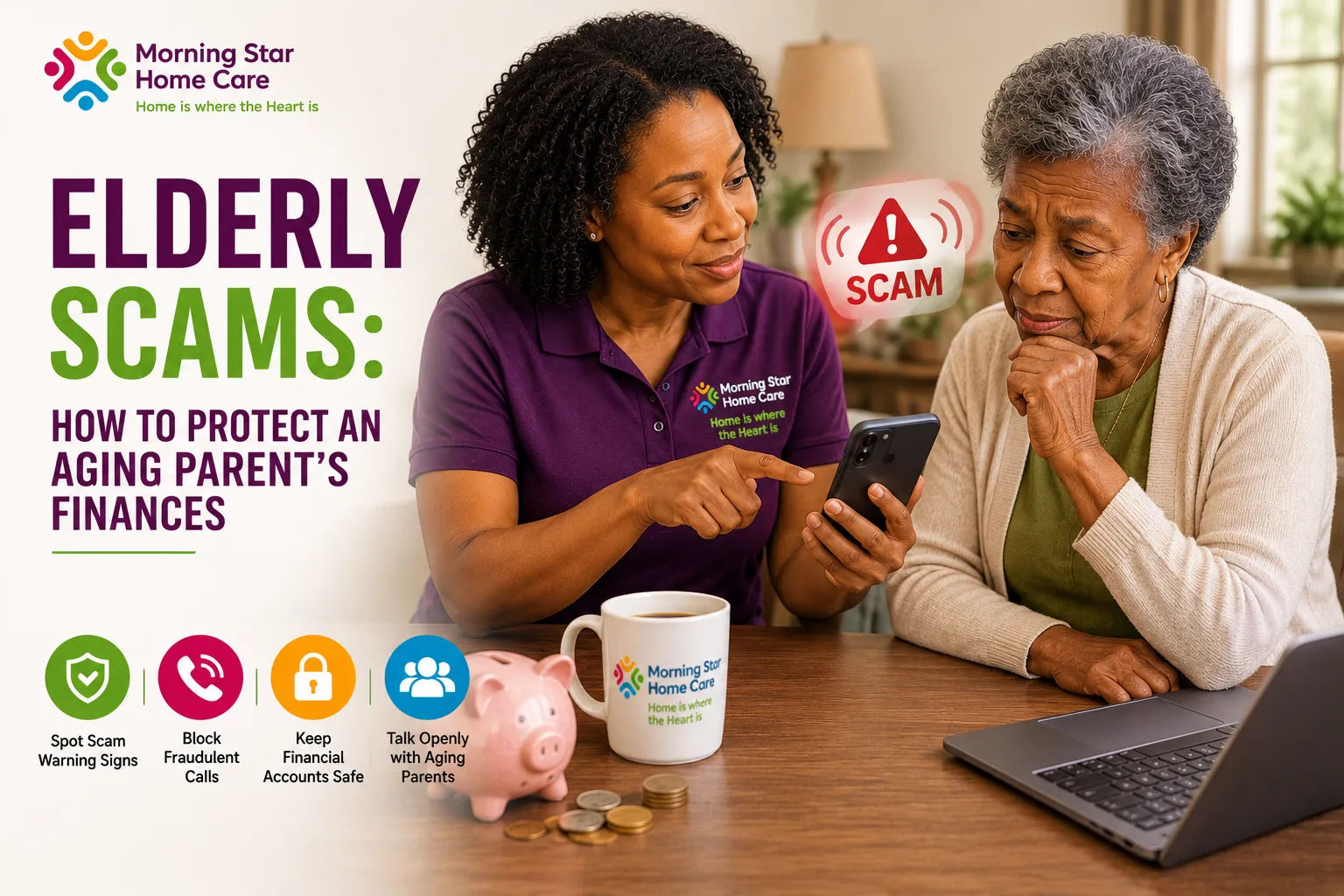
Elderly scams cost older Americans billions of dollars every year, and the numbers keep climbing. Adults 60 and older reported losing $7.7 billion to fraud in 2025 alone, a 59% jump from the year before, across more than 201,000 complaints. The average reported loss for an older victim topped $38,000, and more than 12,400 seniors lost $100,000 or more to a single scheme. Those figures almost certainly understate the real scope of the problem, since the FTC estimates fewer than 1 in 20 fraud victims ever file a report.
Elderly scams work because they're designed to. Scammers specifically target older adults using tactics built around trust, urgency, and isolation — and increasingly, they're using AI-generated voices and videos to make the deception more convincing than ever. Understanding how these scams actually operate, and putting a few concrete safeguards in place, meaningfully lowers the risk for an aging parent.
Key Takeaways
- Elderly scams cost seniors $7.7 billion in 2025 — and that's almost certainly a fraction of the real total, since most fraud goes unreported.
- Investment fraud is now the single largest category, followed by tech support scams, romance scams, and business email compromise.
- Isolation is a major risk factor — scammers often work to cut off a target from anyone who might question the story.
- AI-generated voices and videos are now being used to impersonate family members, adding a frightening new layer to old scam tactics.
- A few practical safeguards — a family password, account monitoring, and open conversation without judgment — meaningfully reduce risk.
Why Elderly Scams Target Older Adults Specifically
Scammers target seniors for reasons that are more calculated than most families realize. Older adults are more likely to own their homes outright, have retirement savings and good credit, and be reachable by phone during the day. Many grew up in an era with more social trust in institutions and less exposure to the kind of digital fraud tactics younger generations have been warned about repeatedly. Cognitive changes that come with normal aging, or with early-stage dementia, can also make it harder to spot inconsistencies in a scammer's story or to resist pressure tactics in the moment.
Dee, Morning Star's founder: "The families I talk to are often shocked that their parent, someone sharp and independent their whole life, fell for something. But these scams are run by professionals who do this full time. It's not a reflection of anyone's intelligence."
The Most Common Elderly Scams Right Now
Fraud tactics shift constantly, but a handful of categories account for the overwhelming majority of reported losses among older adults.
- Investment fraud — now the largest single category at roughly $3.5 billion in reported 2025 losses, often involving fake cryptocurrency platforms that show fabricated 'gains' to encourage larger deposits.
- Tech support scams — a pop-up or phone call claims a computer is infected or hacked, then asks for remote access or payment to 'fix' a problem that never existed.
- Romance scams — a scammer builds a long-distance relationship, often over months, before requesting money for an emergency, travel, or an investment opportunity.
- Government or business impersonation — a caller claims to be from the IRS, Social Security, Medicare, or a bank's fraud department, creating urgency around a fake unpaid bill or compromised account.
- Grandparent scams — a caller pretends to be a grandchild in trouble (arrested, in an accident, stranded abroad) and asks for money to be wired or sent via gift cards immediately, before the story can be verified.
- Recovery scams — a newer and fast-growing category, where someone poses as a lawyer, investigator, or government official offering to recover money from a previous scam, for an upfront fee. This cost prior victims $540 million in 2025.
How AI Is Changing Elderly Scams
One of the more alarming recent developments is the use of AI-generated voice and video to make impersonation scams dramatically more convincing. The FBI logged over 22,000 fraud complaints in 2025 that cited AI as a tool, with losses exceeding $893 million overall and $352 million specifically involving victims 60 and older. A scammer can now clone a grandchild's voice from a few seconds of audio pulled off social media, then call a grandparent sounding genuinely distressed and asking for emergency money — a version of the classic grandparent scam that is far harder to recognize as fake.
Because of this shift, verifying a story independently before acting matters more than ever, even when a voice sounds completely familiar. A callback to the family member's own known number, rather than any number provided during the call, is the single most reliable check.
Warning Signs of an Elderly Scam in Progress
Certain patterns show up across nearly every type of financial scam targeting older adults, regardless of the specific story being used.
- Urgency and pressure to act immediately, often paired with a claim that waiting will make the situation worse.
- Requests for unusual payment methods — gift cards, wire transfers, cryptocurrency, or cash sent by courier — which are difficult or impossible to reverse.
- Instructions to keep the situation secret from family, a bank, or the police, often framed as protecting the person or the outcome.
- Unsolicited contact claiming to be from a government agency, bank, or tech company, especially when it starts with a scary claim about compromised accounts or unpaid debts.
- A relationship that escalates quickly toward financial requests, particularly one that began online or over the phone with someone never met in person.
Financial Warning Signs Families Can Watch For
Beyond the scam tactics themselves, certain changes in an aging parent's financial behavior can signal that something is already underway, even before the family knows the details.
- Unusual or frequent bank withdrawals, wire transfers, or gift card purchases that don't match normal spending patterns.
- New, unfamiliar names appearing as authorized users, beneficiaries, or frequent contacts.
- Unpaid bills despite adequate income, suggesting money is being diverted elsewhere.
- Secrecy or defensiveness about finances that wasn't there before, especially when paired with a new phone or online relationship.
- Boxes of unopened merchandise or unusual purchases, sometimes tied to sweepstakes or prize scams that require ongoing 'fees' to claim a nonexistent winning.
Practical Safeguards That Actually Reduce Risk
A handful of concrete steps do more to reduce elderly scam risk than general warnings ever will, because they create friction at the exact moment a scam is trying to move fast.
- Set up a family verification password— a word or phrase only real family members know, to use if anyone calls claiming to be a relative in an emergency.
- Add a trusted contact to bank and brokerage accounts— most financial institutions allow this, and it lets them alert a designated family member if they notice suspicious activity, without giving that person account access.
- Set up transaction alerts for withdrawals or transfers over a certain amount, so unusual activity gets flagged in real time rather than discovered weeks later.
- Register phone numbers with the National Do Not Call Registry and consider a call-blocking service, since reducing the volume of scam calls reduces overall exposure.
- Agree in advance on a 'always call back' rule — any urgent financial request, from anyone, gets verified by calling a known number before any money moves.
Talking to an Aging Parent About Scams Without It Feeling Like an Accusation
Bringing up elderly scams with a parent can feel delicate, especially if there's any concern they've already been targeted. Framing the conversation around protecting shared family resources, rather than questioning their judgment, tends to go over better than a warning that implies they're vulnerable or naive.
"I didn't want Mom to feel like I was treating her like a child. So instead of warning her about scams in the abstract, I just told her about a scam that almost got me, and asked if we could set up a family password together. She was relieved someone brought it up first."
It also helps to normalize the topic well before any scam attempt happens, rather than only raising it after money has already been lost, since a parent who already knows the warning signs and has a verification habit in place is far less likely to be caught off guard.
What to Do If an Aging Parent Has Already Been Scammed
If money has already been sent, acting quickly meaningfully improves the odds of recovering some or all of it, particularly with wire transfers and certain payment platforms that have short reversal windows.
Call the doctor now if: If a scam is in progress or just happened, contact the bank or payment platform immediately to attempt to stop or reverse the transaction, then file a report with the FTC at reportfraud.ftc.gov and the FBI's Internet Crime Complaint Center (IC3) at ic3.gov. Local police should also be notified, especially for large losses.
- Contact all financial institutions involved immediately to flag the account and attempt to freeze or reverse any pending transactions.
- Change passwords on any accounts that may have been accessed or discussed during the scam.
- File reports with the FTC, FBI IC3, and local police — even if recovery seems unlikely, reports help track patterns and can support other investigations.
- Approach the conversation with compassion, not blame — shame and embarrassment are major reasons victims don't report scams or tell family, and that silence often allows the same scammer to target them again.
Recovery Scams: The Second Wave
A growing and particularly cruel pattern involves scammers specifically targeting people who have already lost money to a previous scam, posing as a lawyer, investigator, or government recovery specialist who can get the funds back for an upfront fee. This cost prior fraud victims $540 million in 2025 alone. Anyone who has already lost money to a scam should be especially cautious about unsolicited offers to help recover it, since legitimate recovery efforts, through a bank, the FTC, or law enforcement, never require an upfront payment.
Elder Financial Exploitation by Someone Known to the Family
Not every case of elderly financial exploitation involves a stranger. A meaningful share of cases involve a family member, caregiver, or someone the older adult trusts, gradually gaining access to accounts or exerting pressure around wills, power of attorney, or large gifts. These situations are often harder for families to recognize and address than a stranger-run scam, since they involve someone already inside the family's circle of trust, but the same safeguards — trusted contacts on accounts, transaction monitoring, and open conversation — help here too.
Reporting Elderly Scams: Where to Go
Reporting an elderly scam does more than create a paper trail for one family — it feeds databases that investigators use to identify patterns, freeze accounts, and occasionally shut down entire fraud operations. The FTC's reportfraud.ftc.gov and the FBI's IC3.gov are the two primary federal reporting channels, and most states also have an Attorney General's consumer protection division that accepts elder fraud complaints directly. Adult Protective Services is a separate, additional resource worth contacting when the scam involves ongoing exploitation rather than a single incident, since APS can investigate and intervene in ways a fraud report alone cannot.
Legal Protections Worth Understanding
Beyond day-to-day safeguards, a few legal tools give families more structured protection against elderly financial scams and exploitation. A durable power of attorney, set up while a parent is still able to make that decision themselves, designates someone to manage finances if the parent later becomes unable to. Many states also have specific elder financial exploitation statutes that give banks and financial institutions legal cover to briefly delay a suspicious transaction while it's investigated, rather than processing it immediately. An elder law attorney can walk a family through which of these tools make sense for their specific situation.
Elderly Scams and Prize, Sweepstakes, and Lottery Fraud
A long-running category of elderly scams involves fake sweepstakes, lottery winnings, or prize notifications that require the victim to pay a 'processing fee,' 'tax,' or 'customs charge' before the prize can be released. Real sweepstakes and lotteries never require a winner to pay anything upfront to claim a prize, which makes this one of the more reliably identifiable scam patterns once a family knows to watch for it. These scams often continue for months, with the same victim repeatedly asked for additional fees as the supposed prize gets closer to being released, sometimes draining tens of thousands of dollars over an extended period.
- A legitimate prize never requires payment first — any request for fees, taxes, or charges before receiving winnings is a scam.
- Repeat requests are a major red flag — a real sweepstakes doesn't come back asking for 'one more fee' multiple times.
- Unfamiliar sweepstakes are the biggest risk — winning a contest never entered is essentially always fraudulent.
A Real Family Scenario
Karen's father Walt had always managed his own finances without any trouble. Then a caller claiming to be from his bank's fraud department told him his account had been compromised and walked him through 'securing' his funds by transferring them to a new account — which was, of course, the scammer's own. Walt didn't mention it to Karen for nearly two weeks, embarrassed and hoping he could quietly fix it himself. By the time she found out, the money was gone, but reporting it immediately to the bank and filing an FTC complaint at least flagged the account pattern for other potential victims. What changed after that wasn't just tighter account monitoring — it was an agreement that any call about money, from anyone, got a callback to a known number first.
How a Professional Caregiver Adds a Layer of Protection
A consistent in-home caregiver, spending regular time with an older adult, is often positioned to notice early warning signs of a scam in progress that a family checking in occasionally might miss — a new unfamiliar name mentioned often, unusual stress about money, or unexplained changes in daily routine tied to answering calls at specific times.
Dee, Morning Star's founder: "Our caregivers get to know a client well enough to notice when something feels off — a new 'friend' who calls constantly, sudden secrecy about mail or bills, anxiety around a specific time of day. We're not financial advisors, but we can flag it to family early, before it becomes a bigger problem."
References
Written by
Morning Star Care Team
Morning Star Home Care — Caregiver-Founded and Locally Owned in Bristol, CT.