
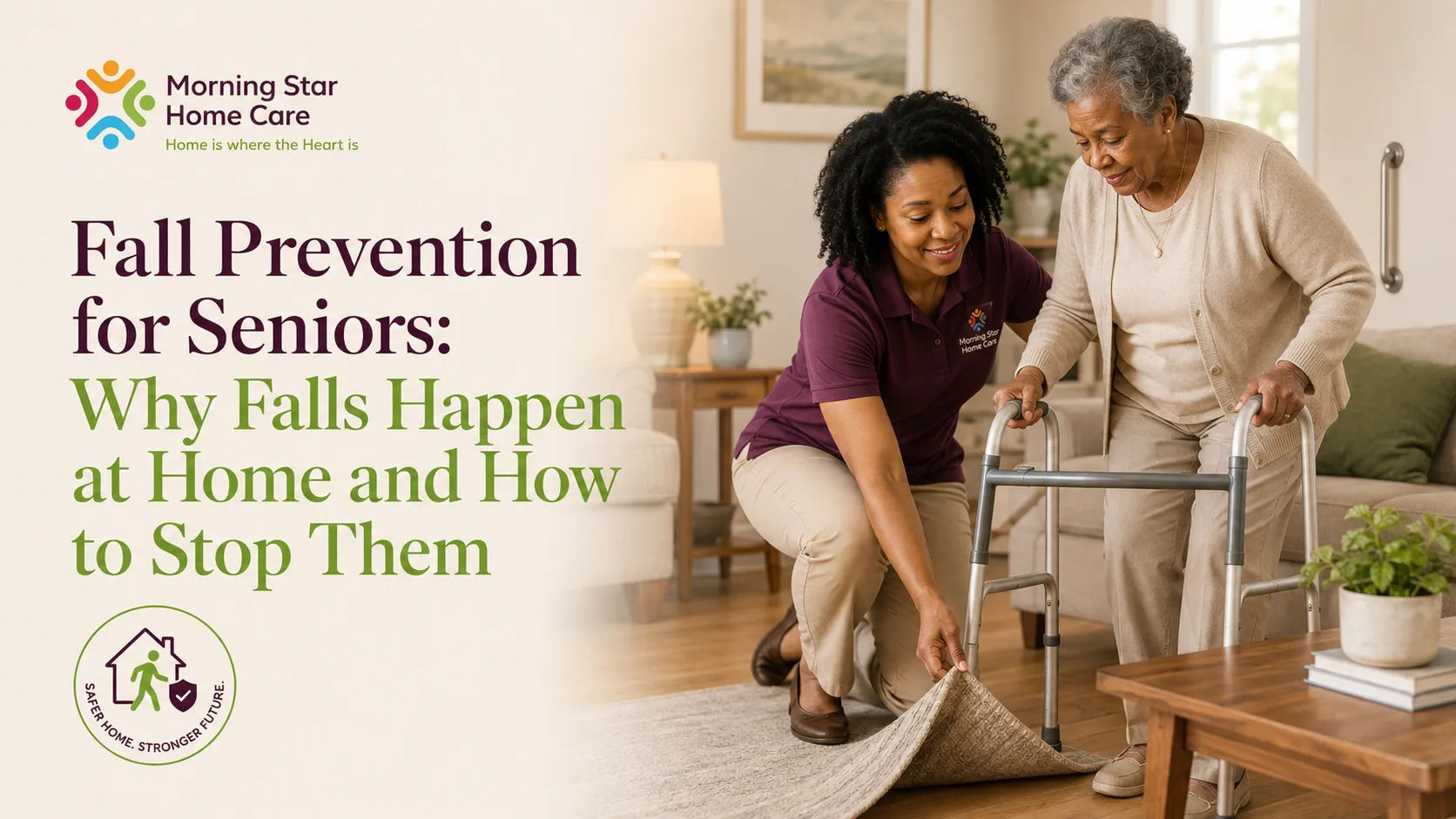
Fall prevention for seniors starts with understanding why falls happen in the first place — because the causes are rarely just "clumsiness" or bad luck. Falls are the leading cause of injury for adults 65 and older, and more than 14 million older adults, roughly 1 in 4, report falling every year, according to the CDC. About 37% of those falls result in an injury serious enough to require medical treatment or that restricts activity for at least a day.
The good news is that falls are also one of the most preventable risks in aging-at-home care. Understanding the real risk factors — not just "watch your step" advice — gives families a much clearer sense of what actually reduces risk, and what's mostly noise.
Key Takeaways
- Falls are rarely caused by one thing — they're usually the result of two or three risk factors combining at once.
- Medications are one of the most overlooked and most fixable fall risk factors,, yet families rarely think to review them specifically for this reason.
- The fall death rate among older adults has been rising ●— up 21% from 2018 to 2024, per CDC data — making prevention more urgent, not less.
- Strength and balance exercise programs have strong evidence behind them — more so than most home modifications alone.
- A fall risk conversation with a doctor is a legitimate, underused first step most families skip.
Why Falls Happen: The Real Risk Factors
Falls typically happen when several risk factors stack up at once, rather than from a single dramatic cause. Understanding these categories helps families figure out which ones actually apply to their specific parent, rather than trying to fix everything at once.
Physical Changes That Increase Risk
Age-related changes in muscle strength, balance, and reaction time all contribute to fall risk, often gradually enough that families don't notice the decline until a fall actually happens. Vision changes — reduced depth perception, slower adjustment to lighting changes, cataracts — are a major and underappreciated contributor, since so much of balance depends on visual input.
Medications: The Most Overlooked Risk Factor
Certain medications meaningfully raise fall risk, and this is one of the few risk factors that can often be addressed directly. Sedatives, sleep aids, blood pressure medications, and drugs that lower blood sugar are among the most commonly implicated. The more medications someone takes, the higher the interaction risk — a phenomenon sometimes called polypharmacy.
Dee, Morning Star's founder: "A medication review is one of the most underused tools in fall prevention. Families think about grab bars and rugs, but a five-minute conversation with a pharmacist about what's actually in the medicine cabinet can matter just as much."
Home Environment Hazards
Loose rugs, poor lighting, clutter in walkways, and stairs without secure handrails are the classic environmental fall risks, and they matter — but they tend to compound existing physical risk factors rather than cause falls on their own in someone with otherwise strong balance and vision.
Chronic Health Conditions
Conditions like Parkinson's disease, arthritis, diabetes (through nerve damage or blood sugar swings), and previous stroke all raise fall risk independently, and often in combination with the medications used to manage them.
The Real Cost of Falls — By the Numbers
The scale of this problem is worth understanding, both because it explains why prevention matters and because it helps families take it seriously before a fall happens rather than after.
| Statistic | Source |
|---|---|
| 1 in 4 older adults falls each year — over 14 million people | CDC, 2026 |
| About 37% of falls result in an injury requiring medical care | CDC |
| Fall death rate rose 21% (64.7 to 78.4 per 100,000) from 2018-2024 | CDC National Vital Statistics System |
| Falls are the leading cause of injury-related death among adults 65+ | CDC |
Families sometimes assume a fall risk conversation needs to wait for a dedicated appointment, but it fits naturally into a normal annual physical or medication check-in — it simply requires someone to bring it up, since it isn't always part of a standard visit unless specifically requested.
Fall Risk Screening: An Underused First Step
The CDC's STEADI initiative (Stopping Elderly Accidents, Deaths, and Injuries) provides a structured approach doctors can use to screen for fall risk, assess specific contributing factors, and recommend targeted interventions. Most families never ask their parent's doctor for this kind of screening, simply because they don't know it exists — but it's a legitimate, evidence-based starting point that costs nothing extra beyond a normal appointment.
- Ask directly: "Can we do a fall risk screening?" at the next primary care visit.
- Bring a full medication list, including over-the-counter drugs and supplements, since these interactions are often missed.
- Mention any near-falls, not just actual falls — near-misses are a meaningful predictor of future risk.
Common Myths About Fall Prevention
A few widely held beliefs about fall prevention don't hold up well against the evidence, and clearing them up helps families focus effort where it actually matters. The idea that falls are simply an inevitable part of aging discourages people from pursuing genuinely effective interventions like exercise and medication review. The assumption that a cane or walker is the fix once fall risk is identified skips over the more fundamental question of why the risk developed in the first place, and whether an underlying cause is treatable. And the belief that a fall-proofed home is enough on its own overlooks how much fall risk originates in the body — strength, balance, medication, vision — rather than the environment.
What Actually Reduces Fall Risk
Not every fall prevention strategy carries equal weight. Some interventions have strong evidence behind them; others are more common-sense than proven.
Strength and Balance Exercise
Structured exercise programs specifically targeting balance and lower-body strength — such as Tai Chi, or physical therapy-led balance training — have some of the strongest evidence behind them for reducing fall risk, often more effective than home modifications alone. Many senior centers and community programs offer low-cost or free balance classes.
Medication Review
A pharmacist- or doctor-led review specifically focused on fall-risk medications can identify opportunities to reduce dosages, switch to lower-risk alternatives, or simplify a complex medication schedule.
Vision Care
An annual eye exam, updated prescriptions, and treating cataracts promptly all meaningfully reduce fall risk, since so much of balance depends on accurate visual input.
Home Modifications
Grab bars, improved lighting, removing loose rugs, and securing stair railings all help — particularly for someone who already has other risk factors — but tend to work best as one layer of a broader strategy rather than the only intervention.
Footwear: A Small Detail That Matters More Than Expected
Poorly fitting shoes, worn-out slippers with no grip, or walking in socks alone are all significant, easily overlooked fall risks. Supportive, well-fitting shoes with non-skid soles — worn consistently, including around the house — are a low-cost, high-impact intervention that's often the last thing families think to check.
How Caregivers Reduce Fall Risk Day to Day
Beyond home modifications, a professional caregiver present in the home regularly can meaningfully reduce fall risk in ways that are harder to achieve through occasional family visits alone — noticing early changes in gait or balance, providing steady hands-on assistance during the highest-risk moments (getting up from a chair, navigating stairs, getting in and out of the shower), and simply reducing the amount of time a parent spends alone attempting difficult movements unassisted.
"After my dad's first fall, what actually made the difference wasn't just fixing up the house — it was having someone there in the mornings, which is when he was most unsteady getting up. That's when most of his near-falls had been happening."
Rebuilding Confidence After a Fall
Beyond the physical recovery, a fall often leaves a lasting psychological effect — a fear of falling again that can lead someone to move less, which paradoxically increases fall risk further by weakening strength and balance over time. This pattern, sometimes called post-fall syndrome, is common and worth addressing directly rather than assuming reduced activity is simply appropriate caution. Physical therapy specifically aimed at rebuilding confidence, alongside reassurance and gradual re-engagement with normal activity, tends to be more effective than encouraging someone to simply "be more careful."
What to Do Immediately After a Fall
Even a fall that seems minor is worth taking seriously, both for the injury itself and because a first fall significantly raises the risk of a second one. A conversation with a doctor after any fall — even one without obvious injury — helps identify whether an underlying, fixable cause contributed.
Call the doctor now if: If a parent falls and shows confusion, can't get up, has significant pain, or hit their head, treat it as a medical emergency and seek immediate care rather than waiting to see if symptoms resolve.
Fall Risk Assessment Tools Families Can Use at Home
Beyond a formal doctor visit, a few simple at-home checks can give families a rough sense of fall risk between appointments. The "Timed Up and Go" test — timing how long it takes a parent to stand from a chair, walk 10 feet, turn around, walk back, and sit down — is one that physical therapists commonly use; taking longer than about 12 seconds is generally considered a signal worth discussing with a doctor. Watching for hesitation or unsteadiness during ordinary transitions, like standing up from a low chair or turning around in a narrow hallway, often reveals more than asking someone directly whether they feel unsteady, since many older adults underreport their own instability.
None of these home checks replace a professional assessment, but they give families a concrete, specific observation to bring to a doctor rather than a vague sense that "something seems off," which tends to get taken more seriously in a short appointment.
Fall Prevention for Seniors With Dementia
Fall risk compounds significantly for seniors also managing dementia or other cognitive decline, since judgment about physical limitations, hazard recognition, and impulse control around movement all decline alongside memory. A parent with dementia may forget they need a walker, attempt to get up unassisted despite a known mobility issue, or become disoriented in a familiar space at night — all of which raise fall risk independent of the physical factors covered above.
For families managing dementia-related fall risk specifically, environmental cues (clear pathways lit at night, furniture kept in consistent locations, reducing background clutter that can look like navigable floor space to someone with visual-perceptual changes) tend to matter more than they would for a cognitively intact older adult, since the ability to problem-solve around a temporary obstacle is often reduced.
Footwear and Clothing Considerations
Beyond the specific footwear guidance already covered, clothing choices play a quieter role in fall risk than most families realize. Long robes or nightgowns that can be stepped on, loose slippers without a back strap, and pants that pool around the ankles all create tripping hazards that have nothing to do with balance or strength — they're purely mechanical risks that a simple wardrobe adjustment can eliminate.
Seasonal Fall Risk: Ice, Snow, and Connecticut Winters
For families in Connecticut, winter introduces a seasonal fall risk layer on top of everything else — icy walkways, wet entryway floors from tracked-in snow, and the temptation to rush across a slippery surface rather than take the extra time a safer pace requires. Keeping entryways salted and shoveled, using a boot tray to reduce wet floors indoors, and having a sturdy pair of ice-grip attachments for outdoor footwear are all seasonal additions worth building into a broader fall prevention plan each winter.
Working Fall Prevention Into Everyday Routines
The most sustainable fall prevention habits are the ones woven into a daily routine rather than treated as a separate task — pausing for a moment of balance before standing from a chair, always turning on a light before walking through a dark hallway, keeping a phone within reach rather than across the room. None of these require special equipment or significant effort, but consistency matters more than intensity when it comes to actually reducing risk day after day.
A Real Family Scenario
When Karen's father Walt had a near-fall reaching for something in a high kitchen cabinet, she almost dismissed it — he hadn't actually fallen, after all. But she mentioned it to his doctor at his next appointment, who flagged that one of his blood pressure medications was likely contributing to occasional dizziness. A simple medication adjustment, paired with reorganizing the kitchen so frequently used items were within easy reach, addressed the issue directly — no fall required to prompt the fix.
Fall Prevention Devices Worth Considering
Beyond the core strategies covered above, a handful of devices can add an extra layer of protection, particularly for a parent who lives alone or spends significant time unsupervised. A medical alert pendant with fall detection can automatically call for help if a fall does happen and the wearer can't press the button themselves. Motion-sensor nightlights that activate automatically when someone gets up at night address one of the highest-risk moments — nighttime bathroom trips — without requiring the person to remember to turn on a light.
None of these devices prevent a fall from happening, but they meaningfully reduce the time between a fall and help arriving, which research shows matters significantly for outcomes, especially when a fall happens while someone is alone.
Building a Fall Prevention Plan With Professional Support
A professional in-home caregiver adds a layer of fall prevention that's difficult to replicate through occasional family visits or devices alone — steady, hands-on assistance during the specific moments when fall risk is highest (transfers, stairs, bathing), along with the kind of daily observation that catches subtle changes in gait or balance before they become a crisis. For families who've identified meaningful fall risk through a doctor's screening, adding even a few hours of in-home support around the highest-risk parts of the day can be one of the most effective interventions available.
Written by
Morning Star Home Care
Morning Star Home Care — Caregiver-Founded and Locally Owned in Bristol, CT.