Grocery delivery for seniors solves a problem that's easy to underestimate until you've watched a parent struggle with it: getting to the store, navigating aisles, carrying bags, and managing the whole errand safely becomes genuinely difficult as mobility declines. This guide walks through the realistic options — delivery services, meal programs, and in-home support — and how families in the Bristol area can combine them.
Food insecurity among older adults is more common than most families realize — about 18% of older adults in the U.S. experience it, and nearly 7 million seniors faced hunger in a recent year, according to Feeding America. Mobility limitations are a major contributing factor: seniors who can't easily drive to a store or carry groceries home are at real risk of simply eating less, or eating less well, than they should.
The rest of this guide walks through each option in detail, along with practical signs to watch for and how families in the Bristol area have made this work in practice.
Key Takeaways
- Grocery delivery isn't just a convenience — for seniors with mobility limitations, it can directly address a real risk of food insecurity and poor nutrition.
- Several distinct options exist — standard delivery apps, senior-specific meal delivery, Medicare Advantage grocery benefits, and in-person errand support from a caregiver.
- Technology barriers matter as much as physical ones — a delivery app a senior can't navigate independently doesn't solve the problem.
- Combining delivery with in-home support often works better than either alone — a caregiver can order, receive, and put away groceries, closing the loop delivery services leave open.
- Nutrition and social connection are linked — isolated seniors are more likely to skip meals or eat poorly, which delivery alone doesn't fully address.
Why This Matters More Than It Might Seem
It's easy to assume grocery access is a minor logistical issue, but the health consequences of food insecurity in older adults are significant — increased risk of chronic conditions like diabetes and hypertension, and higher rates of depression and anxiety among seniors who struggle to access adequate food. For a parent managing mobility limitations, an ordinary errand most people take for granted can become a genuine barrier to good health.
Dee, Morning Star's founder: "I've seen clients quietly cut back on groceries not because of cost, but because getting to the store and carrying bags had simply become too hard, and they didn't want to ask for help. It's one of the more invisible risks families should watch for."
Reviewing this comparison with your specific parent's technology comfort, mobility level, and budget in mind will point toward the most realistic starting option far more reliably than a generic recommendation.
Grocery Delivery Options Compared
| Option | Best For | Considerations |
|---|---|---|
| Standard delivery apps (Instacart, grocery store apps) | Tech-comfortable seniors, or family ordering on their behalf | Requires a smartphone or computer and some setup |
| Medicare Advantage grocery benefits | Seniors enrolled in a qualifying plan | Benefit amounts and eligible retailers vary by plan |
| Meals on Wheels and similar meal delivery programs | Seniors needing prepared meals, not just groceries | Often income-based or has eligibility requirements |
| In-home caregiver grocery shopping and errands | Seniors who want groceries chosen and put away, not just dropped off | Requires arranging professional or family support |
Some retailers also offer designated senior shopping hours or in-store assistance programs, which can be a useful supplement for a parent who still enjoys getting out but appreciates a bit of extra support while there.
Standard Delivery Apps
Instacart, Amazon Fresh, and many grocery store apps now offer same-day or next-day delivery, and Instacart specifically has partnered with Medicare Advantage plans and health organizations to specifically address senior food insecurity. For families managing an account on a parent's behalf, these services can provide flexible, wide-ranging grocery access.
The barrier for many seniors isn't availability — it's the technology itself. Setting up an account, navigating a shopping app, and managing payment can be genuinely difficult for someone unfamiliar with smartphones or computers. A family member managing the ordering remotely, or a simplified setup done once with ongoing use afterward, can bridge this gap.
Medicare Advantage Grocery Benefits
Some Medicare Advantage plans now include a grocery or healthy food allowance as a supplemental benefit, often loaded onto a card usable at approved retailers or through delivery partners like Instacart. Eligibility and benefit amounts vary significantly by plan, so it's worth checking your parent's specific plan details or calling their insurer directly to understand what's available.
This is a benefit many seniors don't realize they have, since it's not always prominently advertised — it's worth a direct call to confirm whether a parent's current plan includes this kind of support.
It's worth applying for these programs even if eligibility seems uncertain — income thresholds and specific criteria vary, and many families are surprised to learn a parent qualifies for support they assumed was only for more financially constrained households.

Meal Delivery Programs
For seniors who need prepared meals rather than groceries to cook themselves, programs like Meals on Wheels deliver nutritionally balanced meals directly to the home, often with the added benefit of a friendly, regular check-in from the delivery volunteer — itself a valuable point of social contact for isolated seniors. Many of these programs are income-based or have specific eligibility requirements, so it's worth contacting a local Area Agency on Aging to understand what's available in the Bristol area.
- Meals on Wheels: regularly delivered meals, often with eligibility based on age, income, or need.
- Senior center congregate meal programs: meals served on-site, combining nutrition with social connection for seniors able to get there.
- Medically tailored meal delivery: increasingly available through insurance partnerships, for seniors managing specific health conditions.
For families weighing whether this level of support is worth the cost, it's helpful to think about it not just as grocery help, but as one part of a broader relationship that provides regular in-person check-ins, an opportunity to catch other emerging needs early.
In-Home Caregiver Support for Groceries and Errands
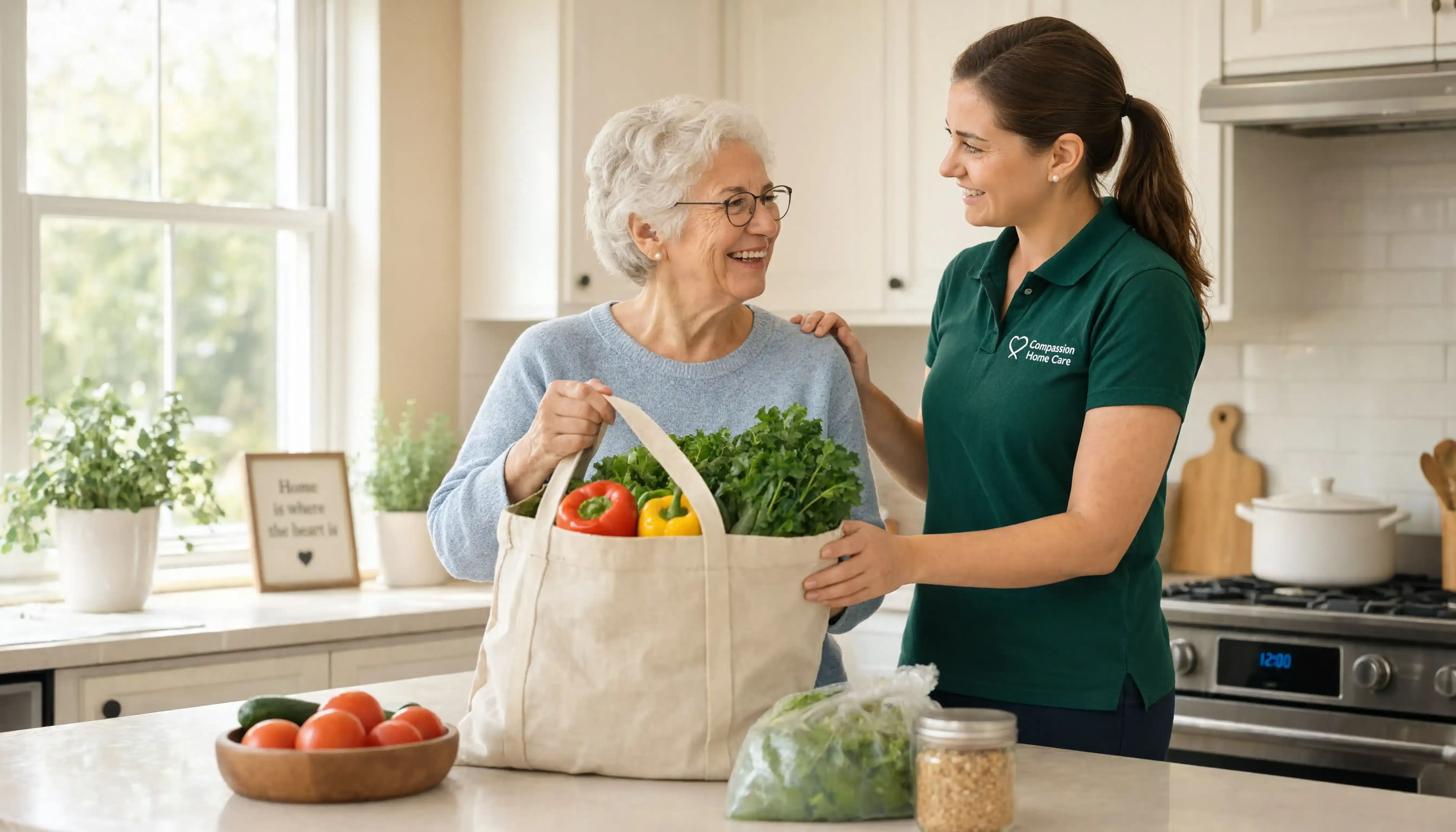
Delivery services solve the "getting groceries to the house" problem, but they don't address everything — someone still needs to plan meals, choose appropriate items, put groceries away, and prepare food. A professional caregiver providing homemaker support can handle the full loop: planning a grocery list with your parent, doing the shopping in person, and preparing simple meals, which combines the benefits of delivery with actual meal planning and preparation support.
"We tried grocery delivery apps for my dad, but he'd still end up with things he didn't really need or forget things he did, because ordering online just wasn't intuitive for him. Having a caregiver go shopping with an actual list we made together each week solved that completely."
It's worth mapping out the specific combination that fits your own family's situation rather than assuming a single service, however well-reviewed, will fully solve the problem on its own.
Combining Approaches for the Best Result
Many families find the best solution isn't choosing one option, but combining them — a Medicare Advantage grocery benefit covering cost, an in-home caregiver handling the actual shopping trip and list-making, and a meal delivery program filling in for days when cooking isn't feasible. This layered approach addresses both the logistical and nutritional gaps more thoroughly than any single service alone.
Signs a Parent May Be Struggling With Food Access
These signs are worth watching for even when a parent insists everything is fine — pride and a reluctance to ask for help often mean the practical reality doesn't match what a parent reports during a phone call or brief visit.
- A consistently empty or sparse refrigerator during visits.
- Weight loss without an obvious medical cause.
- Reliance on the same few easy-to-prepare foods repeatedly, suggesting shopping trips have become rare or difficult.
- Expired food in the pantry or fridge that hasn't been replaced.
- Reluctance or excuses about grocery shopping trips that weren't previously a source of difficulty.
Call the doctor now if: your parent shows signs of significant weight loss or an empty refrigerator during a visit — this may warrant a conversation with their physician alongside addressing the practical grocery access issue.
It's also worth checking whether a parent's specific supplemental insurance, veteran status, or local community organization offers cost assistance for any of these options before assuming full retail price is unavoidable.
Cost Considerations Across Options
Costs vary widely across the options available. Standard delivery apps typically charge a delivery fee plus the cost of groceries themselves, sometimes with a membership option that reduces per-order fees for frequent users. Meal delivery programs like Meals on Wheels are often free or low-cost for eligible seniors, funded through a combination of government programs and donations. In-home caregiver support for grocery shopping is typically billed as part of an hourly home care rate, alongside other homemaker services. For families managing a fixed budget, it's worth comparing the true cost of each option honestly — a delivery service's convenience fees can add up over months, while a caregiver's shopping trip might be more cost-effective if it's bundled with other needed support rather than purchased as a standalone service.
Setting Up a Sustainable, Long-Term System
A one-time fix — a single grocery order, a single conversation about needs — rarely solves this problem long-term, since needs and circumstances change over time. Building a repeatable system, whether that's a standing weekly delivery order, a regular caregiver shopping schedule, or a combination, tends to hold up far better than an ad hoc, reactive approach revisited only when a problem becomes obvious again.
It's worth revisiting the system periodically — every few months, or after any change in a parent's mobility or health — to confirm it still matches actual needs, rather than assuming a system set up a year ago is still the right fit.
Involving Your Parent in the Decision
Grocery shopping is often more than a chore for older adults — it can be one of the last remaining errands that feels like independent adult life, and taking it over entirely without discussion can feel like a loss of autonomy, even when the intent is purely helpful. Involving your parent in choosing which parts of the process they want to keep doing themselves, and which parts they're happy to hand off, tends to produce a solution they're more likely to actually use.
Dee, Morning Star's founder: "Some clients want to keep picking out their own produce and just need help getting to the store and carrying bags. Others are relieved to hand off the whole process. It's worth asking directly rather than assuming what a parent wants."
A Real Family Scenario
Karen noticed her father Walt's refrigerator looked increasingly bare during her weekly visits to Farmington, and when she asked, he admitted the walk to and from the grocery store had become tiring, and the trip felt like more trouble than it was worth. Rather than a single fix, they set up a combination: Karen ordered a standing weekly grocery delivery for staples, and Walt's home care aide took him on a shorter, in-person trip every other week for fresh items he preferred to pick out himself. Within a month, his refrigerator — and his energy — both looked noticeably better.
Nutrition Beyond Just Getting Food in the House
Solving the delivery problem is only the first step — what actually gets eaten matters just as much. Older adults sometimes gravitate toward the same easy, familiar foods repeatedly, which can lead to nutritional gaps even when groceries are plentiful. A caregiver or family member involved in meal planning, not just delivery logistics, can help ensure variety and balanced nutrition rather than just calories. It's also worth being aware that appetite naturally changes with age, and a diminished appetite isn't automatically a red flag — but a significant, sustained drop, especially combined with weight loss, is worth discussing with a physician rather than assuming it's a normal part of aging.
Local Farmers Markets and Community Food Resources
Beyond delivery services, many Connecticut towns have farmers markets, food pantries, and community meal programs specifically welcoming to seniors, some offering senior-specific discount days or delivery of market items. These local resources can supplement formal delivery services and provide fresh, local produce along with a chance for social interaction if a parent is able to attend in person or with assistance.
References
- Feeding America — Facts About Senior Hunger in America
- Elder Law Answers — Instacart to Help Older Adults Address Food Insecurity
- ACL Administration for Community Living — Food Insecurity
This article is for general information and isn't a substitute for medical, legal, or financial advice. If you're concerned about a specific issue, talk to your parent's doctor or an elder law attorney.
Written by
Morning Star Care Team
Morning Star Home Care — Caregiver-Founded and Locally Owned in Bristol, CT.