
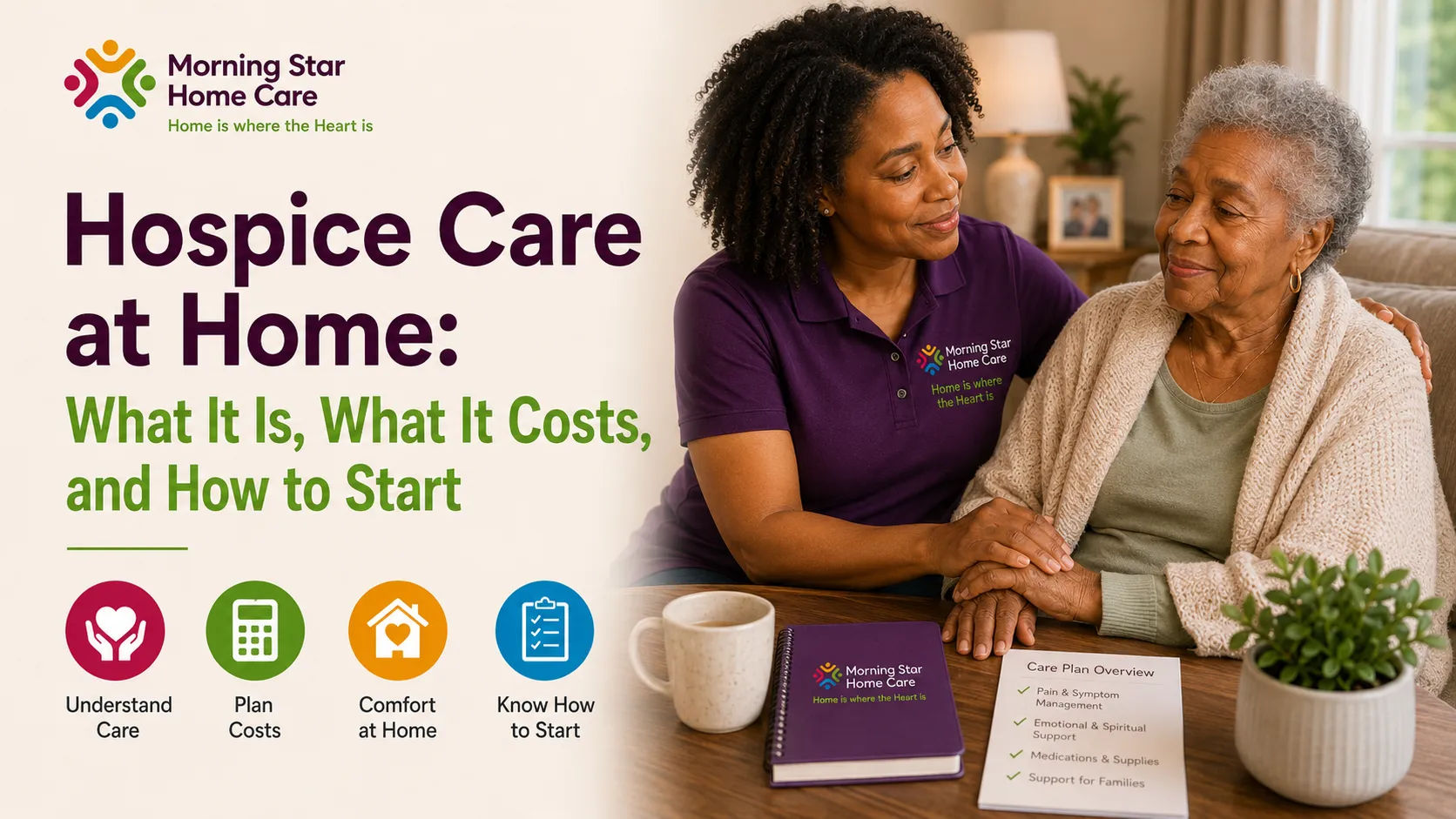
Hospice care at home has become the most common way Americans receive end-of-life care — in 2024, 1.91 million Medicare beneficiaries used hospice, and for the first time, more than half (53.1%) of all Medicare decedents received hospice care before they died. Yet many families still reach the point of needing it without a clear picture of what it actually involves, what it costs, or how to start the process, often during one of the most stressful moments they'll face. This guide walks through exactly what hospice care at home includes, who qualifies, what Medicare covers, and the practical steps to get it started, so families can make this decision with clarity rather than confusion.
Key Takeaways
- Hospice care at home is for a prognosis of six months or less, focused on comfort and quality of life rather than curing the underlying illness.
- Medicare covers hospice care at home in full for eligible beneficiaries, including nursing visits, equipment, and medications tied to the terminal diagnosis.
- More than half of Medicare decedents in 2024 used hospice, making it the norm rather than the exception for end-of-life care.
- A hospice team, not a single provider delivers care — nurses, aides, social workers, chaplains, and volunteers all play a role.
- Starting hospice doesn't mean giving up — it means shifting the goal of care toward comfort, and families can revoke it at any time if circumstances change.
What Hospice Care at Home Actually Includes
Hospice care at home is delivered by a coordinated team, not a single visiting nurse, and understanding the full scope helps families know what to expect and what to ask for.
- Nursing visits for pain and symptom management, medication oversight, and monitoring changes in condition.
- Home health aide support for bathing, dressing, and other personal care needs.
- Medical equipment and supplies, including hospital beds, wheelchairs, and oxygen, typically delivered directly to the home.
- Medications related to the terminal diagnosis, particularly for pain and symptom control.
- Social work support for care coordination, emotional support, and connecting families to additional resources.
- Chaplain and spiritual care, available regardless of specific religious affiliation, for those who want it.
- Volunteer support for companionship, respite, and practical help.
- Grief and bereavement support for the family, typically continuing for up to 13 months after the death.
Dee, Morning Star's founder: "Families are often surprised by how much is actually included. It's not just a nurse checking in, it's a whole team built around keeping someone comfortable and supporting the family through it."
Who Qualifies for Hospice Care at Home
Eligibility centers on prognosis rather than a specific diagnosis, and understanding this distinction helps families know when it's appropriate to ask.
- A physician certifies a prognosis of six months or less if the illness runs its normal course — this doesn't mean death is expected within exactly six months, only that it's a reasonable medical expectation.
- The person chooses comfort-focused care over curative treatment for the terminal condition, though treatment for unrelated conditions can continue.
- Recertification is possible — hospice can continue beyond six months if a physician recertifies continued eligibility, and many patients receive hospice care for longer than the initial prognosis suggested.
- Hospice can be revoked at any time if the person's condition improves or the family decides to pursue curative treatment again — it is not a one-way, irreversible decision.
What Medicare Covers
The Medicare Hospice Benefit is comprehensive, and Medicare spent $27.5 billion on hospice in 2024, reflecting how central this coverage is to end-of-life care in the U.S.
- All services listed above — nursing, aide support, equipment, medications related to the diagnosis, social work, chaplain care, and bereavement support — are covered at no cost to the beneficiary.
- A small copay may apply for medications (typically no more than $5) and for inpatient respite care (typically 5% of the cost, capped).
- Room and board are generally not covered if hospice is provided in a nursing home or assisted living community rather than a private home, an important distinction for families weighing setting.
- Medicare pays hospice providers a daily rate regardless of how many visits occur on a given day, which is different from how many other home health services are billed.
Medicaid and most private insurance plans also cover hospice care, typically following similar eligibility and coverage structures to Medicare, though it's worth confirming specific plan details directly.
How to Start Hospice Care at Home: A Step-by-Step Guide
Knowing the concrete steps removes a real barrier, since many families aren't sure where to even begin.
- Step 1 — Talk to the treating physician. A doctor can help assess whether hospice is medically appropriate and provide the required certification.
- Step 2 — Choose a hospice provider. Families can research and select any Medicare-certified hospice provider serving their area; a hospital discharge planner or physician can often provide a list of local options.
- Step 3 — The hospice team conducts an initial assessment. This typically happens within 48 hours of a referral, sometimes the same day, and establishes the specific care plan.
- Step 4 — Equipment and medications are delivered. Hospital beds, oxygen, and other needed equipment are typically set up in the home within a day or two of admission.
- Step 5 — Ongoing visits begin according to the care plan. Visit frequency is based on need, ranging from a few times a week to daily, with 24/7 phone support always available for urgent concerns.
Hospice at Home vs. Hospice in a Facility
Hospice is a service, not a place, and it can be delivered in a private home, an assisted living community, a nursing home, or a dedicated hospice inpatient facility. Most hospice care happens in a private home, and Routine Home Care is overwhelmingly the most common level of care billed, since most people express a preference to remain in familiar surroundings during this time. Facility-based hospice, whether in a hospital or dedicated hospice house, is generally reserved for situations requiring more intensive symptom management than can be safely handled at home.
"We assumed hospice meant a facility, some separate place. Finding out it just meant a team coming to Dad's own house, where he wanted to be, changed how we felt about the whole decision."
The Role of Family Caregivers in Home Hospice
Even with a full hospice team involved, family caregivers typically remain the primary day-to-day presence in home hospice, since the hospice team visits on a schedule rather than staying continuously. This is an important, sometimes underappreciated reality: hospice supports family caregiving, it doesn't replace it entirely, and understanding this upfront helps families plan for the actual level of hands-on involvement expected.
- The hospice team trains family caregivers on medication administration, positioning, and recognizing signs that warrant a call to the hospice nurse.
- 24/7 phone support connects family caregivers to a hospice nurse for urgent questions or symptom changes outside of scheduled visits.
- Respite care is available and covered for short inpatient stays specifically to give family caregivers a break, an option many families don't realize is part of the benefit.
Choosing a Hospice Provider: Questions Worth Asking
Not all hospice providers operate identically, and families benefit from asking a few direct questions before selecting one, since quality and responsiveness can vary meaningfully.
- How quickly can you begin care after referral? Same-day or next-day admission is standard for a well-run hospice provider.
- What does after-hours support actually look like? Ask whether a nurse physically comes to the home for urgent overnight symptoms, or whether after-hours support is phone-only.
- How often will a nurse visit, and how is visit frequency adjusted? Visit frequency should flex based on need, increasing as symptoms intensify.
- Is the hospice Medicare-certified and accredited? Certification and accreditation (such as through The Joint Commission or CHAP) indicate a baseline of quality oversight.
- What is the process for switching providers if it's not a good fit? Families can change hospice providers, and knowing this in advance removes pressure to make a perfect choice on the first try.
Common Misconceptions About Hospice Care at Home
A few persistent misunderstandings keep families from considering or starting hospice sooner than they otherwise would, sometimes leading to a shorter hospice experience than could have been genuinely beneficial.
- "Hospice means giving up." Hospice is a shift in the goal of care toward comfort and quality of life, not the abandonment of care itself — many families describe it as some of the most attentive care their loved one received.
- "Hospice means death is imminent." The six-month prognosis is an estimate, not a deadline, and many patients live longer than initially expected while on hospice, with eligibility simply recertified.
- "Once you start hospice, you can't stop." Hospice can be revoked at any time if a family wants to pursue curative treatment again or if the person's condition improves.
- "Hospice is only for the final days." Hospice is most beneficial when started earlier in the eligible window, giving the team more time to manage symptoms well and support the family, rather than only being called in during a final crisis.
When to Start the Hospice Conversation
Families often wait longer than necessary to bring up hospice, worried about the emotional weight of the conversation or uncertain about timing. In practice, starting the conversation as soon as a prognosis of six months or less becomes medically plausible allows more time for symptom management, family support, and the kind of end-of-life planning that becomes much harder to do well under acute crisis conditions.
Call the doctor now if: If a loved one's condition has significantly declined, hospitalizations are becoming frequent, or a doctor has mentioned a terminal or life-limiting prognosis, it's worth asking directly about hospice eligibility rather than waiting for a doctor to raise it first.
Levels of Hospice Care
Medicare defines four distinct levels of hospice care, and understanding them helps families recognize that hospice can flex to meet changing needs rather than offering a single fixed service.
- Routine Home Care (RHC): the most common level, covering regular scheduled visits in the home for day-to-day symptom management.
- Continuous Home Care: more intensive, around-the-clock nursing care in the home during a period of acute symptom crisis, intended to avoid an unnecessary hospitalization.
- General Inpatient Care: short-term care in a hospital or inpatient hospice facility when symptoms can't be safely managed at home, typically for acute pain or symptom control.
- Inpatient Respite Care: short-term facility stays specifically to give family caregivers a planned break, generally up to five days at a time.
A Real Family Scenario
Karen and her father Walt put off the hospice conversation for weeks after his doctor mentioned it was an option, worried it meant they were giving up on him. When they finally called a local hospice provider, an assessment was scheduled within a day, and a hospital bed and oxygen were set up in his living room by the following afternoon. Walt spent his final two months at home, comfortable and surrounded by family, with a hospice nurse a phone call away at any hour. Karen later said her biggest regret wasn't starting hospice, it was waiting as long as she did to ask about it.
Coordinating the two proactively, rather than treating them as separate, uncoordinated services, tends to produce the smoothest experience for both the person receiving care and the family managing it.
How In-Home Caregivers Work Alongside Hospice
Home care and hospice care are complementary, not redundant, and many families use both together. Hospice provides medical management, symptom control, and periodic visits, while a private in-home caregiver can provide more consistent day-to-day companionship, personal care, and household support during the hours hospice isn't present, filling the gap between scheduled hospice visits.
Dee, Morning Star's founder: "We coordinate directly with a client's hospice team when both are involved. Our caregivers aren't providing medical care, that's hospice's role, but we're there for the consistent, hands-on presence throughout the day and night that rounds out what hospice alone can offer."
Understanding these logistics in advance, while they're still hypothetical rather than urgent, helps families feel more prepared rather than blindsided when the time comes.
What Happens After Death Occurs at Home
Knowing what to expect immediately after a death occurs at home, one of the aspects families ask about least but worry about most, can ease a genuinely difficult moment. A hospice nurse can be called at the time of death and will typically come to the home to formally pronounce death, so a family doesn't need to call 911. The hospice team coordinates with the funeral home directly, handles the removal of medical equipment, and provides grief support resources that continue for the family for up to 13 months, regardless of insurance status.
A Final Thought
Hospice care at home exists to make the end of life as comfortable and supported as possible, for both the person and the family around them, and understanding what it actually includes tends to replace fear of the unknown with a clearer, more confident decision. The families who look back with the fewest regrets are usually the ones who asked about it early, not the ones who waited.
A Note for Connecticut Families
For families in Bristol and the Greater Hartford area, several hospice providers serve Connecticut, and it's worth confirming both Medicare certification and specific service-area coverage before choosing one, since availability of same-day admission and after-hours nurse visits can vary by provider and by town.
References
Written by
Morning Star Care Team
Morning Star Home Care — Caregiver-Founded and Locally Owned in Bristol, CT.