
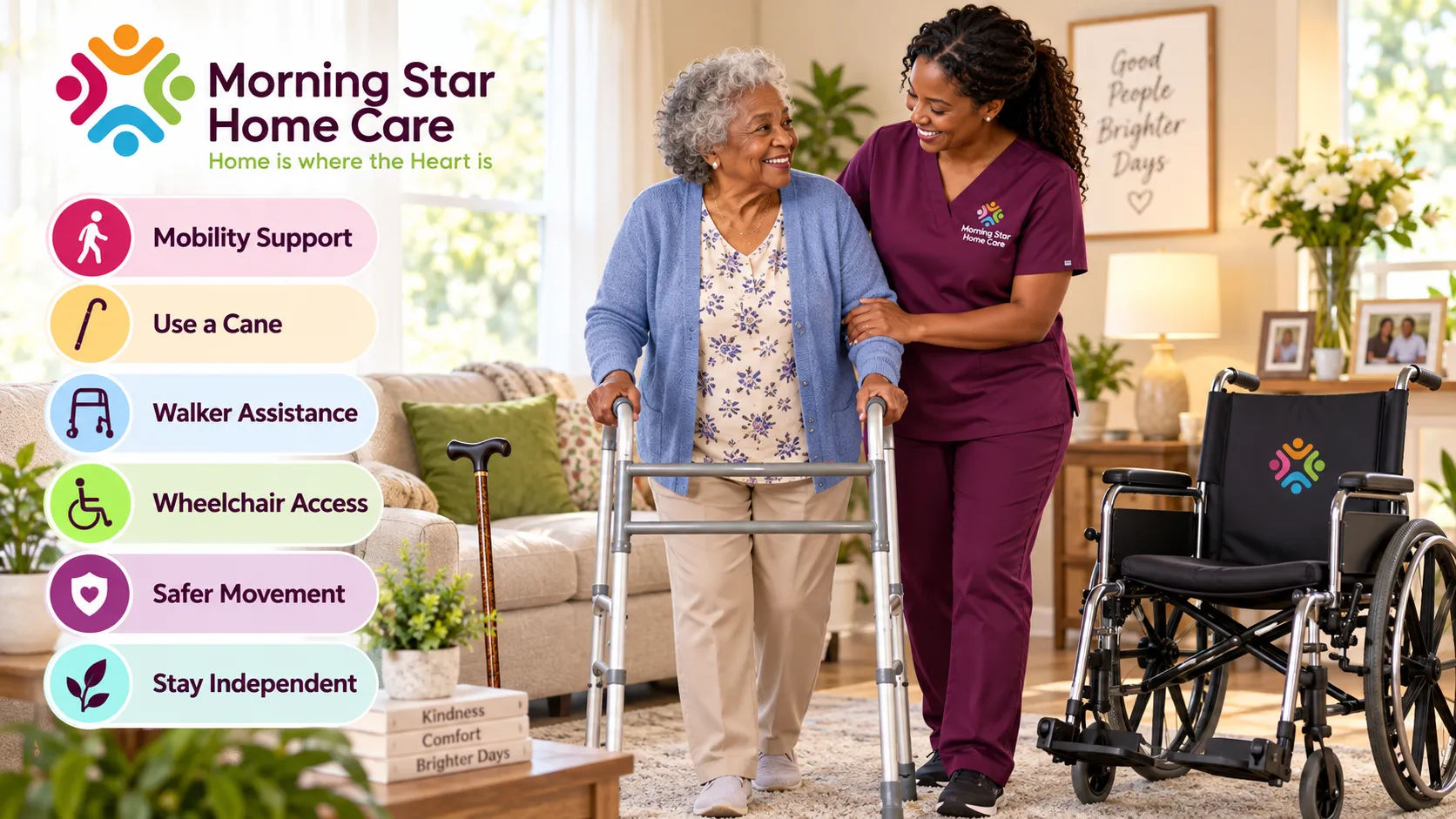
Mobility aids for seniors, canes, walkers, rollators, and wheelchairs, are among the most effective, evidence-backed tools for reducing fall risk, yet they're also among the most resisted, often tied up in a parent's sense of independence and self-image. The numbers show how common they already are: roughly 16.4% of seniors use a cane, 11.6% use a walker, 6.1% use a wheelchair, and 2.3% rely on a scooter. With 35-40% of adults 65 and older falling each year, choosing and properly using the right mobility aid is one of the more impactful, practical safety steps a family can take.
This guide covers the different types of mobility aids, how to choose the right one, and how to navigate a parent's resistance to using one.
Key Takeaways
- Roughly 16.4% of seniors use a cane and 11.6% use a walker, making mobility aids common and well-established tools, not a last resort.
- 35-40% of adults 65 and older fall each year, and the right mobility aid meaningfully reduces this risk when properly fitted and used.
- Different aids suit different needs — a cane for mild balance issues differs significantly from a walker for more substantial support needs.
- A physical therapist evaluation ensures proper fit and technique, since an improperly sized or used device can actually increase fall risk.
- Resistance to using a mobility aid is common and normal, and usually softens with the right framing and firsthand experience of the benefits.
Understanding which type of aid actually matches a parent's specific mobility challenge is the starting point for choosing effectively rather than guessing.
It also helps to understand that needing a mobility aid does not necessarily mean a permanent, one-way decline. Some people use one temporarily during recovery from surgery or illness, while others rely on one consistently for years, and both situations are entirely normal, appropriate uses of these tools.
Canes: Best for Mild Balance Support
Canes provide light, targeted support and work best for people with relatively mild balance issues or one-sided weakness.
- A standard single-point cane suits most people needing light balance support and improved confidence, particularly for longer walks.
- A quad cane, with four small feet at the base, offers more stability than a standard cane, useful for slightly greater support needs.
- Proper height matters significantly — the top of the cane should align with the wrist crease when the arm hangs naturally at the side.
- Canes are typically used on the stronger side of the body, opposite an injured or weaker leg, a detail many people get backward without guidance.
Because a poorly fitted cane can actually worsen posture and balance, a quick professional fitting is worth the extra step even for a seemingly simple device.
Storage and accessibility around the home also deserve thought, since a device left in a hard-to-reach corner or a different room is far less likely to be used consistently than one kept exactly where it's needed most.
Walkers and Rollators: More Substantial Support
Walkers and rollators provide significantly more stability than a cane and suit people with more substantial balance or strength limitations.
- Standard walkers, without wheels, offer maximum stability but require lifting with each step, which can be tiring for some users.
- Two-wheeled walkers combine stability with easier forward movement, a common middle-ground choice.
- Rollators, four-wheeled walkers with a seat and hand brakes, allow continuous walking without lifting and provide a built-in resting spot, popular for longer outings.
- Proper height fitting again matters, with handles typically set at wrist height when arms hang naturally at the sides.
Dee, Morning Star's founder: "We see a lot of walkers used at the wrong height, which actually makes balance worse, not better. A five-minute fitting check makes a real difference in how safely and confidently someone uses it."
Choosing between these options often comes down to the specific balance between stability needs and ease of use, which a physical therapist can help assess.
Maintenance also deserves brief mention, since a mobility aid in disrepair, a wobbly leg, worn-out rubber tips, or a squeaky wheel, can itself become a safety hazard. Periodic checks and simple replacement parts, widely available and inexpensive, keep a device functioning as safely as intended.
Wheelchairs and Scooters: For Greater Mobility Needs
Wheelchairs and mobility scooters serve people with more significant mobility limitations, whether from chronic conditions, severe balance issues, or limited stamina for walking longer distances.
- Manual wheelchairs work well for shorter distances or when a caregiver can assist with pushing, and are generally the most affordable and portable option.
- Power wheelchairs suit those needing independent mobility without the physical demand of self-propelling a manual chair.
- Mobility scooters work well for longer distances and outdoor use, particularly for people who can stand and transfer independently but tire quickly while walking.
- Home layout and doorway width should factor into the choice, since not every wheelchair or scooter fits comfortably through standard doorways.
A occupational therapist can help match the specific device to both the physical need and the practical realities of a person's home environment.
It is worth noting that many communities now offer mobility aid "loan closets" through senior centers or local nonprofits, providing a low-cost way to try a device, or bridge a temporary need, before committing to a purchase.
Getting the Right Fit and Training
A mobility aid only helps as much as it's properly fitted and correctly used, making professional guidance genuinely worthwhile even for seemingly simple devices.
- A physical therapist evaluation assesses the specific type of instability present and recommends the most appropriate device, rather than guessing based on general unsteadiness.
- Proper height and hand position affect both safety and comfort, and get overlooked more often than people expect.
- Technique training, how to navigate stairs, curbs, and uneven surfaces with the device, meaningfully reduces the risk of a fall involving the aid itself.
- Medicare and many insurance plans cover mobility aids when prescribed by a doctor, making a formal evaluation worth pursuing for cost reasons as well.
Skipping this step and simply purchasing a device without guidance is one of the more common, avoidable mistakes families make.
It also helps to remember that using a mobility aid earlier, rather than waiting until it feels unavoidable, tends to preserve more function over the long run, since consistent, confident movement helps maintain strength and balance that inactivity would otherwise erode.
Overcoming Resistance to Using a Mobility Aid
Resistance to mobility aids is extremely common, often tied to a parent's sense of independence, self-image, or fear of "looking old," and understanding this helps families respond more effectively.
- Framing the device as a tool for freedom, not limitation — a cane that allows continued walks and outings, rather than a symbol of decline, tends to land better.
- Letting a parent choose the specific device, including color and style options now widely available, increases their sense of ownership and willingness to use it.
- Sharing the fall statistics directly can help, since many people underestimate their own fall risk until it's framed in concrete terms.
- Modeling normalization — mentioning how common mobility aid use actually is among peers — can reduce the sense of being singled out.
"Dad resisted the walker for months until a bad stumble scared him. What actually got him to keep using it afterward was picking one with wheels and a seat, so it felt more like a helpful tool than a medical device."
Patience and repeated, low-pressure conversations tend to work better than a single ultimatum, especially since the shift in self-perception takes real time.
Two mobility aids for two settings is also a common and reasonable arrangement, a lighter cane for short trips around the house alongside a sturdier walker or rollator for longer outings, rather than forcing a single device to serve every situation equally well.
Home Modifications That Complement a Mobility Aid
A mobility aid works best alongside a home environment that supports its use, and a few common modifications significantly improve both safety and ease of movement.
- Clear, wide pathways free of clutter, loose rugs, and furniture in the way allow a walker or wheelchair to move through the home without obstruction.
- Grab bars near the toilet and in the shower provide additional support during transfers, complementing rather than replacing a mobility aid.
- Ramps or threshold reducers at doorways help wheeled devices like walkers, rollators, and wheelchairs move smoothly between rooms and in and out of the home.
- A designated "parking spot" for the device, like near the bed or a favorite chair, keeps it consistently within reach rather than left in another room where it won't be used.
These changes, often modest in cost and effort, meaningfully extend how effective and consistently used a mobility aid actually becomes in daily life.
Traveling and Going Out With a Mobility Aid
Many families worry that a mobility aid will limit outings and social activities, but with a bit of planning, most people find it actually enables more activity, not less.
- Foldable and lightweight designs make transporting a walker, rollator, or manual wheelchair in a car trunk manageable for most family members.
- Many public venues, restaurants, and medical offices are equipped to accommodate mobility aids, and calling ahead can confirm accessibility for a specific outing.
- Rollators with a built-in seat are particularly useful for longer outings, providing a resting spot when needed without requiring the trip to end.
- Airlines and many transportation services have established procedures for traveling with mobility aids, worth researching in advance of any trip.
Rather than restricting a parent's world, a well-chosen mobility aid frequently reopens activities and outings that had quietly become too difficult or risky to attempt alone.
A Real Family Scenario
Walt had fallen twice in six months but insisted he didn't need a cane, worried it would make him look frail in front of his grandchildren. His daughter Karen arranged a physical therapy evaluation, framed simply as a "balance check," and the therapist recommended a quad cane along with a few balance exercises. Walt agreed to try it for a week. Within that week, he noticed he could walk to the mailbox without the hesitant, shuffling gait he'd developed, and the cane became a normal part of his routine without further resistance.
Walt's situation reflects a common pattern: the actual experience of increased confidence and ease often overcomes resistance far more effectively than any argument or persuasion beforehand.
How an In-Home Caregiver Supports Mobility Aid Use
A consistent in-home caregiver can reinforce correct, consistent mobility aid use, provide encouragement during the adjustment period, and help identify when a device may need reassessment as needs change over time. Caregivers also provide an extra layer of physical support during higher-risk activities, like transfers or stairs, that a mobility aid alone doesn't fully address.
Dee, Morning Star's founder: "We often notice when a mobility aid isn't quite working anymore, when someone starts leaning on furniture instead of their walker, for example. That's usually a sign it's time for a reassessment, not just a habit to correct."
This kind of ongoing, attentive support helps ensure a mobility aid stays genuinely effective as a parent's needs evolve, rather than becoming outdated or underused over time.
When Needs Change: Progressing Between Devices
Mobility needs often evolve over time, whether gradually with a chronic condition or suddenly after a fall, surgery, or illness, and recognizing when a current device is no longer adequate matters as much as choosing the first one.
- Increased leaning on furniture or walls while using a cane can signal it's time to consider a walker for greater support.
- A recent fall or near-fall warrants a reassessment even if the current device seemed adequate before the incident.
- Recovery from surgery or a hospital stay often calls for a temporary step up in support, sometimes progressing back down to a lighter device as strength returns.
- A physical therapist can reassess periodically, not just at the initial prescription, ensuring the device in use still matches current ability rather than assuming it remains appropriate indefinitely.
Treating mobility aid selection as an ongoing, adjustable process, rather than a single one-time decision, keeps the device genuinely matched to a parent's current needs.
A Final Thought
Mobility aids for seniors are common, effective, and far less limiting than many people initially fear. Choosing the right device, getting it properly fitted, and approaching a parent's resistance with patience and the right framing gives families a genuine, practical way to reduce fall risk and preserve independence.
A mobility aid, chosen and fitted well, often extends independence rather than signaling its end, a reframe that benefits both the parent and the family supporting them.
Ultimately, a mobility aid is one part of a broader fall-prevention strategy, not a complete solution on its own. Combined with home safety modifications, strength and balance exercise, and regular medical follow-up, it plays a genuinely meaningful role in helping a parent stay active and independent longer.
A Note for Connecticut Families
Physical and occupational therapy practices throughout the Bristol and Greater Hartford area offer mobility aid evaluations and fittings, typically accessible through a primary care physician referral, with many also providing home-based assessments.
Families weighing whether a parent is ready for a mobility aid conversation should remember that starting the discussion early, before a crisis forces the decision, tends to produce a far smoother, less emotionally charged transition.
References
- Fall Prevention Foundation — Walking Aids to Prevent Falls: A Comprehensive Guide to Safe Mobility for Seniors
- GM Insights — Senior Mobility Aid Devices Market Size, Global Trends 2025-2034
- University of Iowa College of Public Health — Study Looks at Older Adults' Use of Mobility Devices, Incidence of Falls
Written by
Morning Star Home Care
Morning Star Home Care — Caregiver-Founded and Locally Owned in Bristol, CT.