
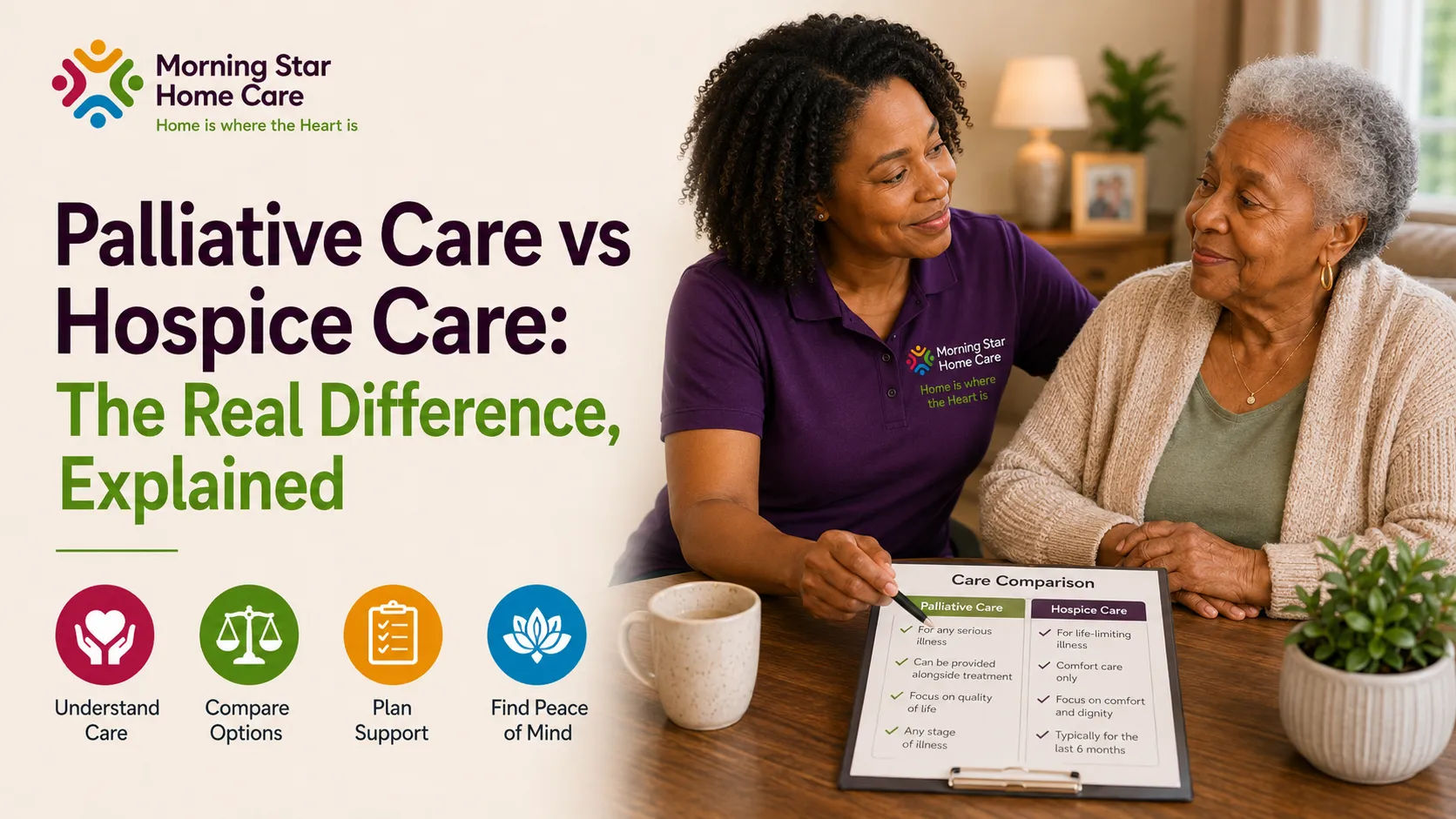
Palliative care vs hospice care is one of the most commonly confused pairs of terms in senior health, and the confusion has real consequences. Just over a third of adults 50 and older say they know much about palliative care specifically, even though understanding the difference can meaningfully affect when a family seeks support and how much benefit they get from it. The two are related but distinct, and most of the confusion clears up once the actual difference, timing and treatment goal, is explained clearly.
This guide breaks down exactly what separates palliative care from hospice care, who qualifies for each, and how to think through which one fits a specific situation.
Key Takeaways
- Palliative care can start at any stage of a serious illness, including alongside curative treatment like chemotherapy or dialysis.
- Hospice care is a specific form of palliative care for a prognosis of six months or less, once curative treatment has stopped.
- Both focus on comfort and quality of life — the key difference is timing and whether curative treatment continues alongside it.
- Only about a third of older adults understand the distinction well, which often delays families from accessing helpful support earlier.
- Transitioning from palliative care to hospice is a common, natural progression as an illness advances, not a separate, harder decision to make from scratch.
The Core Difference: Timing and Treatment Goal
The single clearest distinction between palliative care and hospice care is when each one applies relative to curative treatment.
- Palliative care can begin at diagnosis, at any stage of a serious illness, and works alongside treatments aimed at curing or controlling the disease.
- Hospice care begins after a decision has been made to stop curative treatment, for a prognosis of six months or less, with the sole focus shifting entirely to comfort.
Dee, Morning Star's founder: "The way I explain it to families: palliative care is 'let's manage how you feel while we're still treating this.' Hospice is 'we're no longer treating the disease, so let's focus completely on comfort.' Same philosophy, different point in the journey."
Side-by-Side Comparison
| Palliative Care | Hospice Care | |
|---|---|---|
| Who qualifies | Anyone with a serious illness, at any stage | Prognosis of 6 months or less |
| Curative treatment | Can continue alongside | Has stopped |
| Where provided | Hospital, clinic, or home | Almost always at home (or facility) |
| Team involved | Doctors, nurses, social workers | Full interdisciplinary hospice team |
| Typical duration | Can last months to years | Typically weeks to months |
| Insurance coverage | Covered under regular medical benefits | Fully covered under Medicare Hospice Benefit |
What Palliative Care Actually Involves
Palliative care is often misunderstood as being only for the end of life, but it's really a specialized layer of support focused on symptom management and quality of life at any point during a serious illness.
- Pain and symptom management — controlling pain, nausea, fatigue, and breathing difficulty, tailored and adjusted as the illness or treatment changes.
- Coordination alongside a treating specialist, such as an oncologist or cardiologist, rather than replacing that care.
- Emotional and practical support for both the patient and family, including help navigating complex treatment decisions.
- Telehealth availability has expanded significantly, with palliative consultations up over 20% in 2025, improving access for homebound or rural patients.
- Can be provided in multiple settings — a hospital, an outpatient clinic, or increasingly, at home.
Recognizing which category of support fits a given moment is the practical heart of this comparison, and it can change more than once as an illness progresses.
What Hospice Care Actually Involves
Hospice care, once curative treatment has stopped, shifts entirely to comfort, dignity, and quality of life for whatever time remains, delivered by a full interdisciplinary team.
- Comprehensive comfort-focused care — nursing, aide support, medication management, equipment, and 24/7 phone access to a nurse.
- Emotional and spiritual support for both the patient and family, including chaplain services and social work.
- Bereavement support for the family that continues after death, typically for up to 13 months.
- Fully covered by Medicare for eligible beneficiaries, one of the most comprehensive benefits Medicare offers.
How the Transition From Palliative Care to Hospice Typically Happens
For many families, palliative care and hospice aren't two separate, disconnected decisions, they're a continuum. A patient often starts with palliative care support while still pursuing treatment, and if the illness progresses to the point where curative treatment is no longer effective or desired, that same care team, or a closely coordinated one, often transitions the patient into hospice. Understanding this in advance removes some of the anxiety around the transition, since it's frequently a natural next step rather than an abrupt, difficult new decision made from a standing start.
"Dad had palliative care support for almost a year while he was still getting treatment. When his oncologist said treatment wasn't working anymore, moving to hospice didn't feel like starting over, it felt like the next chapter of care he was already getting."
When to Consider Palliative Care
Palliative care is worth asking about earlier than most families think to bring it up, since it's not contingent on a terminal diagnosis.
- A new diagnosis of a serious chronic illness — heart failure, COPD, kidney disease, cancer — even when the prognosis is uncertain or treatment is ongoing.
- Difficult-to-manage symptoms during active treatment, such as chronic pain, nausea, or breathing difficulty that a primary treatment team doesn't have bandwidth to fully address.
- Frequent hospitalizations related to a chronic condition, where added symptom management support could reduce the need for emergency care.
- A family feeling overwhelmed navigating a complex diagnosis, where the coordination and communication support palliative care offers can meaningfully ease the burden.
When to Consider Hospice
Hospice becomes appropriate once curative treatment is no longer the goal, and recognizing the signs helps families ask about it at the right time rather than too late.
Call the doctor now if: If a physician has indicated a prognosis of six months or less, or if curative treatment options have been exhausted or are no longer desired, ask directly about hospice eligibility rather than waiting for it to be raised.
- A doctor indicates a prognosis of six months or less if the illness follows its expected course.
- The person decides curative treatment is no longer worth pursuing, whether due to treatment burden, likelihood of success, or personal preference.
- Quality of life has become the clear priority over extending life through continued aggressive treatment.
Questions to Bring to a Palliative or Hospice Care Consultation
Whether meeting with a palliative care team for the first time or discussing hospice eligibility, a short list of prepared questions helps families get the most out of that first conversation.
- What symptoms or concerns should this team specifically address? Clarifying scope upfront prevents confusion about what palliative or hospice care will and won't cover.
- How often will the team visit, and how do we reach someone between visits? Understanding the actual cadence of support, not just the theoretical availability, sets realistic expectations.
- How does this team coordinate with our other doctors? Especially important for palliative care, which is meant to complement rather than replace a primary specialist.
- What would trigger a reassessment or a change in the level of care? Knowing this in advance helps a family recognize when it's time to revisit the plan rather than being caught by surprise.
Who Provides Palliative and Hospice Care
Both types of care are delivered by interdisciplinary teams, though the composition and involvement level differ somewhat between the two.
- Palliative care teams typically include a physician or nurse practitioner specializing in palliative medicine, a nurse, and a social worker, working alongside, not replacing, the primary treating specialist.
- Hospice teams are more comprehensive by design, including nurses, home health aides, social workers, chaplains, volunteers, and bereavement counselors, since hospice becomes the primary source of care once curative treatment stops.
- Both can involve family caregivers directly in day-to-day care, with the clinical team providing training, guidance, and scheduled or on-call support rather than continuous in-person presence.
There's no wrong time to start understanding these options, and no requirement to wait for a crisis before learning what's available.
How to Start the Conversation With a Doctor
Many families aren't sure how to bring up palliative or hospice care with a physician, worried it might seem like they're giving up too early or overstepping medical judgment. In practice, physicians generally welcome the conversation, and a few direct questions can open it naturally.
- "Would palliative care be helpful for managing symptoms right now?" This question works well early in a serious diagnosis, regardless of prognosis.
- "At what point would you recommend we consider hospice?" Asking this proactively, even when hospice doesn't feel imminent, gives a family a clearer sense of the trajectory ahead.
- "What would change about care if we shifted the goal to comfort?" This question helps clarify what's actually different about the hospice approach compared to current treatment.
Bringing up these questions doesn't commit a family to anything, it simply opens the door to information that helps with planning, regardless of which direction the illness ultimately goes.
A Common Misconception Worth Addressing Directly
A significant share of families believe choosing palliative care means giving up on treatment, which isn't accurate and sometimes prevents people from accessing genuinely helpful support earlier. Palliative care is specifically designed to work alongside curative treatment, and choosing it doesn't require any decision about stopping treatment at all. Separating this misconception from the actual definition often opens the door to earlier, more helpful symptom support.
Cost Differences Worth Understanding
Because palliative and hospice care are billed and covered differently, understanding the cost structure helps families avoid surprises.
- Palliative care is billed like other specialist medical care, subject to normal copays, deductibles, and coinsurance under Medicare Part B or private insurance, since it isn't a separate, all-inclusive benefit the way hospice is.
- Hospice care is covered comprehensively under the Medicare Hospice Benefit, with minimal out-of-pocket cost, typically limited to small copays for medications and inpatient respite care.
- Private insurance plans generally mirror this structure, though it's worth confirming specific plan details, since coverage terminology and cost-sharing can vary between insurers.
This cost difference is part of why understanding the distinction matters practically, not just conceptually — families sometimes delay hospice specifically because they assume it will be as costly as ongoing palliative or specialist care, when in fact it's typically far less expensive out-of-pocket once someone qualifies.
A Real Family Scenario
When Walt was diagnosed with advanced heart failure, his cardiologist mentioned palliative care almost immediately, and Karen initially resisted, assuming it meant giving up. After learning it simply meant an additional layer of symptom management support alongside his ongoing treatment, she agreed, and it made a real difference in his day-to-day comfort during the following year. When his condition eventually progressed to the point where his cardiologist recommended stopping aggressive treatment, the transition to hospice felt like a continuation of care he already trusted, not a jarring new decision.
Palliative and Hospice Care for Non-Cancer Diagnoses
While palliative and hospice care are often discussed in the context of cancer, both apply just as directly to other serious chronic conditions, including heart failure, COPD, kidney disease, and advanced dementia. In fact, non-cancer diagnoses now represent a majority of hospice admissions nationally, reflecting broader recognition that comfort-focused care benefits any serious, life-limiting illness, not only cancer. Families managing a loved one's heart failure or advanced dementia should feel just as entitled to ask about palliative or hospice support as those managing a cancer diagnosis.
How In-Home Caregivers Fit Alongside Either Type of Care
Whether a family is navigating palliative care during ongoing treatment or hospice care at the end of life, non-medical in-home care fills a distinct and valuable role: consistent daily support, companionship, and household help that neither palliative teams nor hospice teams are designed to provide continuously, since both operate on scheduled visits rather than ongoing presence.
Dee, Morning Star's founder: "We work alongside both palliative and hospice teams regularly. Our role isn't medical, it's the steady, day-to-day presence, meals, companionship, help around the house, that supports whatever the medical team has in place."
Bringing questions like these into the conversation turns an intimidating meeting into a genuinely useful one, and helps a family walk away with a plan rather than more uncertainty.
The Growing Availability of Both Types of Care
Access to both palliative and hospice care has expanded meaningfully in recent years. The number of specialized palliative care teams worldwide was projected to reach 33,700 by 2025, a 32.7% increase from 2017, and hospice enrollment increased by 8% in 2025 compared to 2023. This growth reflects both increasing awareness among physicians and patients and a broader healthcare shift toward recognizing comfort and quality of life as legitimate, valuable goals of care at every stage of serious illness, not just at the very end.
A Final Thought
Palliative care vs hospice care doesn't have to be a confusing choice once the actual distinction, timing and treatment goal, is clear. Palliative care is worth asking about far earlier than most families realize, and hospice, when the time comes, is often a natural next step rather than a wholly separate decision. Understanding both in advance means a family is never caught without options when they need them most.
A Note for Connecticut Families
Palliative care programs and hospice providers both operate throughout the Bristol and Greater Hartford area, often affiliated with major regional hospital systems. Asking a treating physician directly about local palliative or hospice options is typically the fastest way to get connected to a program serving your specific town.
References
Written by
Morning Star Care Team
Morning Star Home Care — Caregiver-Founded and Locally Owned in Bristol, CT.