

Most families deal with this after something has already happened — a fall, a hospital stay, a diagnosis — which is exactly the wrong time to be setting up power of attorney for seniors for the first time. These documents work best arranged early, while your parent can still clearly make their own decisions and choose who represents them.
Below is a full rundown of the documents that matter most: what each one actually does, why it matters, the most common mistake families make with it, and where to start.
Key Takeaways
- Power of attorney has to be set up while your parent has legal capacity — once a dementia diagnosis is in place, it may be too late.
- Financial and healthcare power of attorney are separate documents, and often go to different people.
- A living will and a will are not the same thing — one covers end-of-life medical wishes, the other covers belongings after death.
- Beneficiary designations override a will — an outdated form can undo careful estate planning without anyone noticing until it's too late.
- HIPAA authorization is separate from healthcare power of attorney — useful for keeping siblings informed even if they aren't the primary decision-maker.
- An elder law attorney can set most of this up in one or two visits — it's rarely as complicated as families expect.
- Guardianship, the court-ordered alternative, is slower, costlier, and more adversarial than setting up power of attorney in advance.
Which Documents Does Your Family Actually Need?
| Situation | Documents to Prioritize First |
|---|---|
| Parent is healthy but wants to plan ahead | Financial POA, healthcare POA, will, beneficiary review |
| Parent has a new diagnosis (e.g., early dementia) | All documents immediately — capacity can be time-limited |
| Parent is already hospitalized or in crisis | HIPAA authorization first (fastest to act on), then POA if capacity allows |
| Siblings are sharing caregiving duties | HIPAA authorization for all involved, even if only one holds POA |
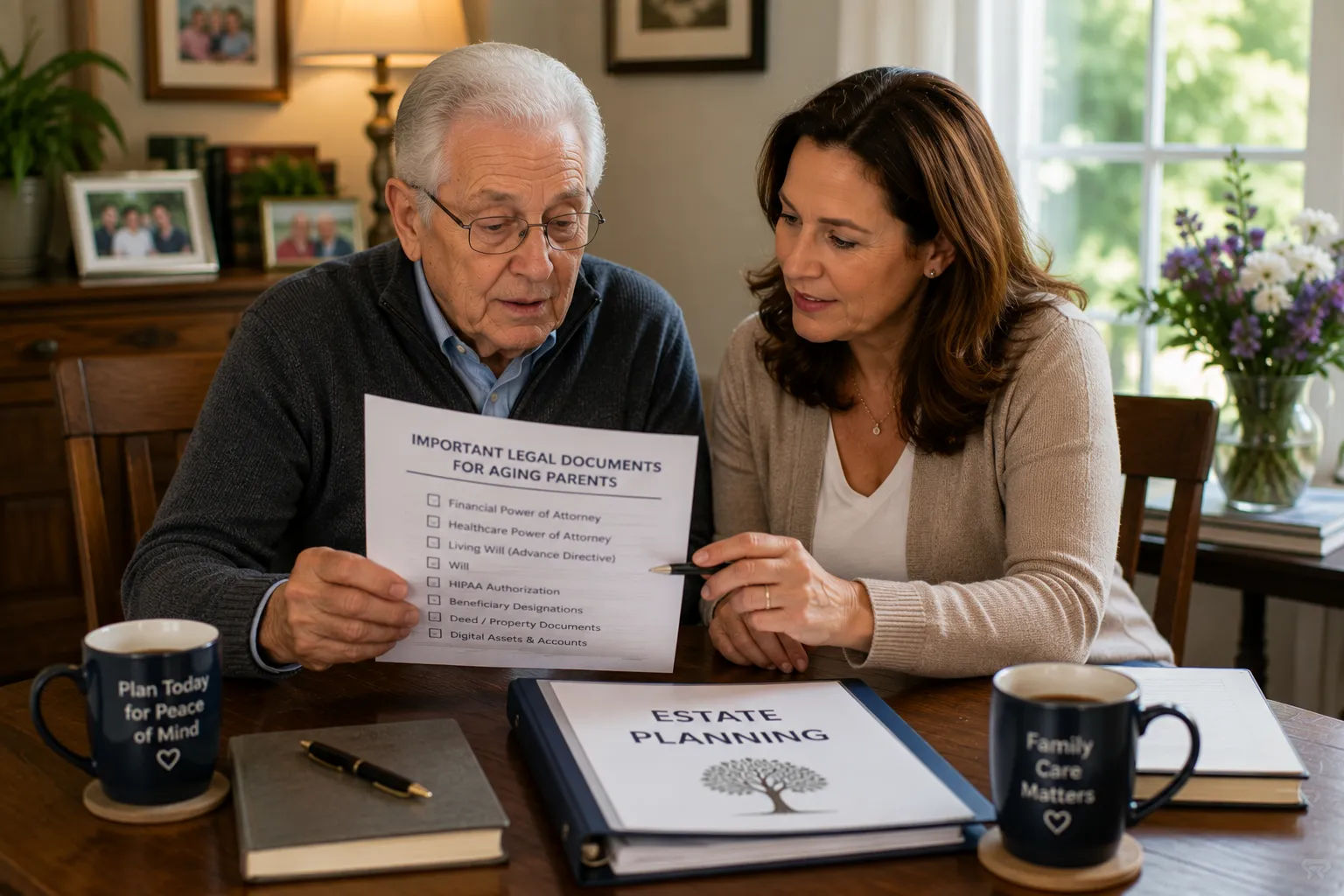
The Documents, In Detail
Durable Power of Attorney for Finances
What it does: Names someone — often an adult child — to make financial decisions if your parent becomes unable to. It can cover paying bills, managing bank accounts, filing taxes, handling property, and dealing with insurance.
Why it matters: Without it, something as routine as adjusting a payment plan or accessing an account to pay for care can turn into a genuine obstacle, requiring a court process instead of a signature.
Good to know: "Durable" is the key word — it means the document stays valid even after your parent becomes incapacitated, unlike a regular power of attorney, which doesn't.
Common mistake: Signing it, filing it in a drawer, and never telling the bank. Financial institutions often want their own copy on file before an agent can act.
Dee, Morning Star's founder: "Financial power of attorney is the one document I wish every family had before I show up for a first assessment. Without it, something as simple as adjusting a payment plan for care can turn into a real obstacle."
Durable Power of Attorney for Healthcare
What it does: Names a healthcare proxy — someone authorized to make medical decisions if your parent can't communicate their own wishes. It's a separate document from the financial version and doesn't have to go to the same person.
Why it matters: Without this, doctors and hospitals may default to state law to determine who can make decisions, which doesn't always match who your parent would actually choose.
Good to know: The person named should know your parent's values and general wishes, not just hold the paperwork — a real conversation matters more than the form itself.
Common mistake: Naming someone without talking to them first. The proxy should know they've been chosen, and ideally has already discussed what your parent would and wouldn't want.
Living Will (Advance Directive)
What it does: Spells out specific medical wishes — resuscitation, life support, feeding tubes — for situations where your parent can't speak for themselves.
Why it matters: It works alongside the healthcare proxy, giving that person actual guidance instead of a guess during one of the hardest moments a family can face.
Good to know: Requirements vary by state, so a Connecticut-specific form matters — a generic template found online may not meet state requirements.
A Will
What it does: Covers what happens to property, belongings, and assets after death — different from a living will, which covers medical decisions while still alive.
Why it matters: Dying without one, called dying "intestate," means state law decides how things are divided, which can create real conflict among family members at an already difficult time.
Good to know: Wills should be reviewed after major life events — a death, divorce, or new grandchild — not just written once and forgotten.

HIPAA Authorization
What it does: A short form authorizing doctors to discuss your parent's health information with specific family members.
Why it matters: Without it, a doctor may not be legally able to tell you anything about your parent's condition, even if you're the one who drove them to the appointment and are managing their care day to day.
Good to know: This is separate from healthcare power of attorney — you can have HIPAA access without being the decision-maker, which is useful for siblings who aren't the primary proxy but need to stay informed.
Beneficiary Designations
What it does: The named beneficiaries on life insurance policies, retirement accounts, and payable-on-death bank accounts — these transfer directly to the named person, regardless of what a will says.
Why it matters: This is one of the most commonly overlooked documents. A will can say one thing, but an outdated beneficiary form overrides it — an ex-spouse from decades ago can end up inheriting an account if the form was never updated.
Common mistake: Not checking these in years. Worth reviewing anytime a will is updated, since the two need to actually agree with each other.
A Letter of Instruction (Informal, but Useful)
What it does: Not a legal document, but a practical one — a written list of account numbers, passwords, insurance policies, and where physical documents are kept.
Why it matters: Legal documents grant authority; this document tells whoever holds that authority where to actually find anything, which matters enormously in the first confusing days after a health crisis.
Good to know: Keep it updated. An old list of passwords is nearly as unhelpful as no list at all.
DNR and MOLST/POLST Orders
What it does: A Do Not Resuscitate (DNR) order and a Medical Orders for Life-Sustaining Treatment (MOLST) form are medical orders, signed by a doctor, that translate a patient's end-of-life wishes into instructions paramedics and hospital staff must follow immediately — unlike a living will, which is more general guidance.
Why it matters: Without a signed medical order, emergency responders are generally required to attempt resuscitation, even if a family knows that's not what their parent wanted. The living will alone doesn't carry that same legal weight in an emergency.
Good to know: These require a conversation with your parent's doctor, not just an attorney — they're medical orders, not estate planning documents.
Revocable Living Trust (Situational)
What it does: A legal structure that holds assets during your parent's lifetime and passes them to beneficiaries afterward, often without going through probate court.
Why it matters: Not every family needs one — it adds complexity and cost — but it can be worth exploring for families with significant real estate, assets in multiple states, or a strong preference for privacy, since probate records are public and trust administration generally isn't.
Good to know: This is the one document on this list worth a dedicated conversation with an attorney about whether it's even necessary, rather than assuming it's required.
Read more: 18 Signs Your Aging Parent Needs Help at Home · 7 Signs Your Elderly Parent Needs Help With Finances
A Real Family Scenario
When Karen's father Walt had a minor stroke two years ago, the family discovered his power of attorney documents were nearly a decade old — technically still valid, but the bank's fraud department flagged them anyway and asked for updated paperwork before releasing funds to cover his hospital co-pay.
"We lost almost a week arguing with the bank over a document that was legally fine but just old enough to make them nervous. Now we redo everything every three years, whether it feels necessary or not. — Karen, Farmington, CT"
The documents themselves weren't the problem. The gap between having them and having current, bank-accepted versions was — a distinction that catches a lot of families off guard exactly when they can least afford the delay.
Where to Keep Everything
Documents scattered across drawers and old email accounts don't help anyone in an emergency. The National Institute on Aging recommends keeping originals in one place, and making sure at least one trusted person knows exactly where that is.
"We kept everything in a fireproof box at my parents' house for years and none of us knew where the key was. First thing we did after getting the POA set up was make copies and tell every sibling exactly where things live now. — Karen, Farmington, CT"
What an Elder Law Attorney Actually Does in the First Meeting
Families sometimes delay this step because the process feels mysterious or intimidating. In practice, a first meeting with an elder law attorney is usually straightforward: a conversation about your parent's family situation, assets, and wishes, followed by the attorney explaining which documents make sense and drafting them — often ready to sign within a couple of weeks. Bring a rough list of assets (accounts, property, insurance policies), the names of who your parent would want as POA and healthcare proxy, and any existing documents, even old or outdated ones. The attorney will tell you what to update and what's already sufficient.
Getting Started: A Realistic Timeline
This Month
- Have the conversation with your parent about setting these documents up, ideally before there's any health scare forcing the issue.
- Find an elder law attorney — the Connecticut Bar Association's Elder Law Section is a good starting point.
Next 60 Days
- Meet with the attorney to draft financial POA, healthcare POA, and a living will.
- Review beneficiary designations on all accounts and policies.
Ongoing
- Revisit documents after any major life event — a death, a diagnosis, a move.
- Confirm the bank and doctor's office have copies on file, not just a copy in a drawer at home.
Common Mistakes Families Make
- Waiting for a crisis to start the conversation. Capacity to sign these documents can change quickly and unpredictably — waiting for "the right time" often means waiting too long.
- Assuming a will covers everything. Beneficiary designations, jointly-owned accounts, and trusts all operate outside of a will, and can override it entirely if not kept in sync.
- Not telling the named agent they've been chosen. A power of attorney agent who doesn't know they hold that authority — or doesn't know your parent's wishes — can't act effectively when it matters.
- Using a generic online template for state-specific documents. Advance directive and POA requirements vary by state; a document that doesn't meet Connecticut's requirements may not be honored when it's needed most.
- Filing documents away and never mentioning them again. Banks, hospitals, and financial institutions all need their own copies on file — a document that exists only in a home filing cabinet doesn't help in an emergency.
If This Feels Overwhelming
It's a lot of paperwork, and it's fair to feel behind on it. Most of it can be set up in one or two meetings with an elder law attorney, not a drawn-out process — and having it in place is what makes everything afterward, including bringing in home care, considerably less complicated.
What Happens Without These Documents: Guardianship
If your parent loses capacity without power of attorney in place, the family's only remaining option is petitioning the probate court for conservatorship (Connecticut's term for guardianship) — a formal legal process where a judge decides who has authority to make decisions.
This process is slower, more expensive, and more public than setting up power of attorney in advance. It typically requires medical evidence of incapacity, court hearings, and sometimes a court-appointed attorney to represent your parent's interests independently — even from their own family. It can also become adversarial if family members disagree about who should serve, which POA, chosen directly by your parent, generally avoids.
Dee, Morning Star's founder: "I've seen families spend months and thousands of dollars in conservatorship proceedings for something that a single afternoon with an elder law attorney could have prevented years earlier."
Connecticut Resources for Families
- Connecticut Bar Association — Elder Law Section: attorney referrals and resources specific to elder law, POA, and estate planning in Connecticut. (ctbar.org)
- Connecticut Probate Courts: self-help resources and forms; an attorney isn't always required for uncontested matters. (ctprobate.gov)
- North Central Area Agency on Aging: serves Bristol, Farmington, and the rest of Morning Star's service area, with referrals for legal and financial planning support. (ncaaact.org)
Reviewing Documents After a Move to Connecticut
Families who relocate an aging parent to Connecticut from another state should have existing power of attorney and healthcare documents reviewed by a Connecticut attorney, even if they were properly drafted elsewhere. Most states honor documents from other states, but local hospitals, banks, and courts sometimes move faster and with less friction when the paperwork is drafted to Connecticut's specific requirements from the start.
A Quick Glossary of Terms You'll Hear
- Principal: the person granting authority (your parent).
- Agent (or attorney-in-fact): the person granted authority to act on the principal's behalf.
- Capacity: the legal and mental ability to understand and make one's own decisions; required to sign any of these documents.
- Incapacitated: a legal determination, usually requiring medical evidence, that someone can no longer make their own decisions.
- Conservatorship: Connecticut's term for guardianship, representing court-ordered authority granted after someone loses capacity without a POA in place.
Storing These Documents So They Can Actually Be Found
A perfectly executed power of attorney is useless in a crisis if no one can locate it. Keep originals in a fireproof, waterproof safe at home rather than a bank safe deposit box — those often require the account holder's own signature to access, which defeats the purpose in an emergency. Give copies to the named agent, the successor agent, the primary physician, and the elder law attorney who drafted them.
Consider a simple one-page "in case of emergency" summary listing where each document is stored, who holds copies, and key contact information — attorney, financial advisor, physician. Keep it updated as agents or storage locations change.
A Final Thought
None of these documents fix anything by themselves. What they do is remove friction at exactly the moment your family can least afford it — a hospital form signed in minutes instead of days, a bill paid on time instead of triggering a shutoff notice, a decision made by someone your parent actually chose instead of a judge who's never met them. That's the entire point of doing this early, while it's still simple.
References
- National Institute on Aging — Getting Your Affairs in Order Checklist
- National Institute on Aging — Legal and Financial Planning
- Connecticut Bar Association — Elder Law Section
- Connecticut Probate Courts
This article is for general information and isn't a substitute for medical, legal, or financial advice. If you're concerned about a specific issue, talk to your parent's doctor or an elder law attorney.
Written by
Morning Star Care Team
Morning Star Home Care — Caregiver-Founded and Locally Owned in Bristol, CT.