
A lot of family visits run on autopilot — how's the weather, how's your knee, what's for dinner. Good questions to ask elderly parents can turn a routine visit into an actual conversation, and there's real research behind why that's worth doing, not just sentiment.
A systematic review published through the National Institutes of Health found that reminiscence therapy significantly reduces depressive symptoms and improves life satisfaction in older adults — it's a genuine, evidence-backed intervention, not just a nice way to pass an afternoon. Below are 20 questions, grouped by theme, along with why each theme tends to matter and how to use them without turning a visit into an interview.
Key Takeaways
- Reminiscing has measurable psychological benefits — research links it to lower depression and higher life satisfaction in older adults, not just sentimental value.
- Specific questions outperform general ones — “what was your first job like” gets further than “tell me about your life.”
- Long-term memories are often more accessible than recent ones for people with early memory loss, which makes this especially useful even after a dementia diagnosis.
- A few questions per visit works better than a long session — this is a habit, not a one-time interview.
- Group reminiscence has shown even stronger effects than individual sessions in research, which is worth knowing if a sibling or grandchild can join in.
- Writing down what you learn matters — memories fade for everyone involved, not just the person answering.
How to Use These Questions to Ask Elderly Parents
- Parent is generally sharp and talkative: Pick 2-3 questions per visit, let the conversation wander naturally.
- Parent has early memory loss: Stick to childhood and early-adulthood questions — often more accessible than recent memories.
- Parent seems reluctant to open up: Start with light, low-stakes questions before moving to deeper ones.
- Multiple family members are visiting: Group settings have shown even stronger benefits in research than one-on-one.
Childhood and Early Life
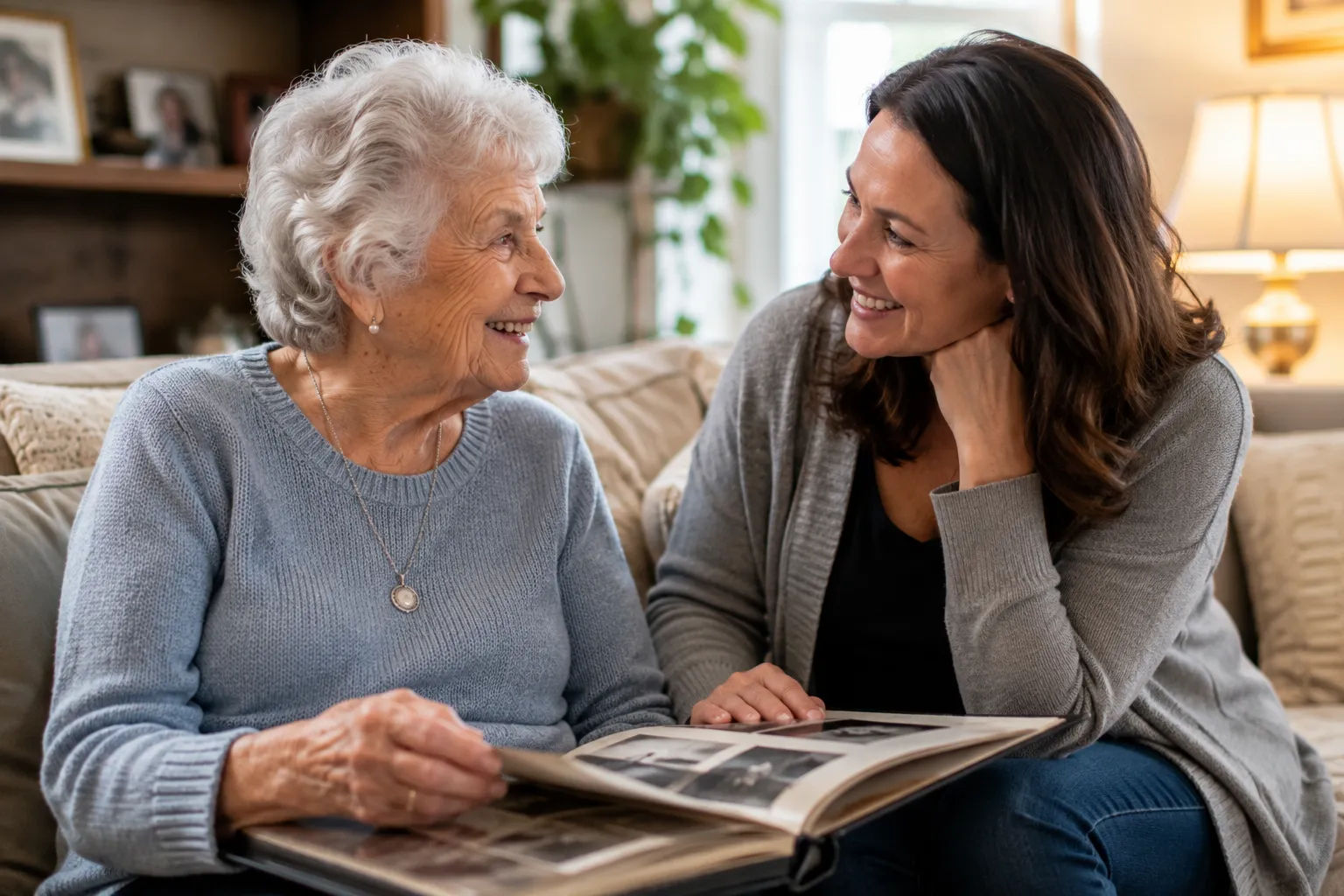
Childhood memories are often the most vivid and the easiest to access, even for parents who struggle with more recent recall — which makes this a good place to start, especially on a day when conversation feels harder than usual.
- What's your earliest memory?
- What was your childhood home like?
- Who was your best friend growing up, and what happened to them?
- What did you want to be when you grew up?
- What's a smell or sound that instantly takes you back to being a kid?
Love and Family
These questions tend to surface stories families haven't heard before, even within a family that talks often — the story of how two people actually met is rarely told the same way twice, and it's worth having it on record while you can.
- How did you meet [spouse's name]?
- What was your wedding day actually like?
- What's something about raising kids that surprised you?
- What's a family tradition you hope keeps going?
- What's a story about your own parents you don't want us to forget?
"I started asking my dad one question every Sunday instead of just talking about the Patriots. He told me a story about basic training I'd never heard in forty years." — Karen, Farmington, CT
Work and Achievement
Career questions tap into identity and pride in a way that's genuinely good for mood — research on reminiscence therapy points to exactly this mechanism, reviewing meaningful past experiences to build a more positive sense of self in the present.
- What was your first job, and what did it pay?
- What are you proudest of from your career?
- Was there a job or path you thought about but didn't take?
- Who was the best boss or mentor you ever had?
Life Lessons and Reflection
These are the deeper questions — best saved for a day when the conversation is already flowing, not as an opener. They tend to produce the answers families end up thinking about long after the visit is over.
- What's the best advice anyone ever gave you?
- What's something you changed your mind about over the years?
- What's a hard time you got through, and how?
- What are you most grateful for right now?
- What's something you want your grandchildren to know about you?
- If you could relive one ordinary day from your life, which would it be?
Home, Community, and Everyday Life
These questions ground the conversation in the practical texture of daily life — the kind of detail that fades fastest from family memory because it seemed too ordinary to write down at the time.
- What neighborhood did you live in that you loved most, and why?
- What was a typical Sunday like when you were raising a family?
- Who was a neighbor or community member who mattered to you?
- What's a place you always meant to visit but never did?
- What did people do for fun before everyone had a television?
Why Ordinary-Life Questions Matter
It's tempting to save reminiscence for the big milestones — weddings, career highs, major life events. But researchers studying autobiographical memory in older adults have found that recalling everyday routines and ordinary moments contributes just as much to a coherent sense of identity and well-being as the highlight-reel memories do. A Tuesday afternoon in 1975 is just as worth asking about as a wedding day.
Faith, Values, and What Mattered Most
These questions tend to reveal the throughline of a person's life — what they believed in, what guided their decisions — in a way that career or family questions alone don't always capture.
- What did your family believe in, growing up?
- Has your faith or outlook changed over your life, and how?
- What's a principle you tried to live by?
- Who in your life did you admire most, and why?
A Few Ground Rules Worth Knowing
Don't correct small errors
If a date is off by a few years or a name gets mixed up, it's rarely worth interrupting the story to fix it. The goal is connection and the feeling of being heard, not a fact-checked oral history.
Silence is fine
A pause after a question isn't a sign it failed. Older adults, especially those processing memory changes, may need more time to retrieve a memory than a younger person would. Resist the urge to fill the silence with a new question.
Watch for cues that a topic is painful, not just difficult
Some questions — about a spouse who's passed, a hard period, a regret — can open up real grief. That's not necessarily a reason to avoid the topic entirely, but it is a reason to follow your parent's lead rather than pushing further because you're curious.
Read more: 18 Signs Your Aging Parent Needs Help at Home · 10 Questions to Ask Aging Parents (That Actually Get Real Answers)
Questions That Work Especially Well Over the Phone
Not every family gets regular in-person visits. These particular questions tend to translate well to a phone or video call, since they don't rely on observing body language or physical surroundings the way some of the signs-of-decline questions do:
- What's the best advice anyone ever gave you?
- What was your first job, and what did it pay?
- How did you meet [spouse's name]?
- What's something you want your grandchildren to know about you?
Save the questions that benefit from being in the same room — looking through old photos together, visiting a childhood neighborhood — for when you can actually be there.
Making It a Habit, Not an Interview
This Visit
Pick one question before you go, and bring it up whenever it naturally fits — folding laundry, a car ride, over coffee. Don't force it if the moment doesn't come.
This Month
Try to hit one question from each theme above at least once, spread across a few visits. Notice which topics your parent lights up talking about, and lean into those more.
Ongoing
Keep a running note — in your phone, a notebook, wherever's easy — of what you learn. It becomes something to keep, and it also helps you track how your parent's memory and mood are doing over time, which ties back into noticing bigger changes early.
What This Can Look Like in an Actual Visit
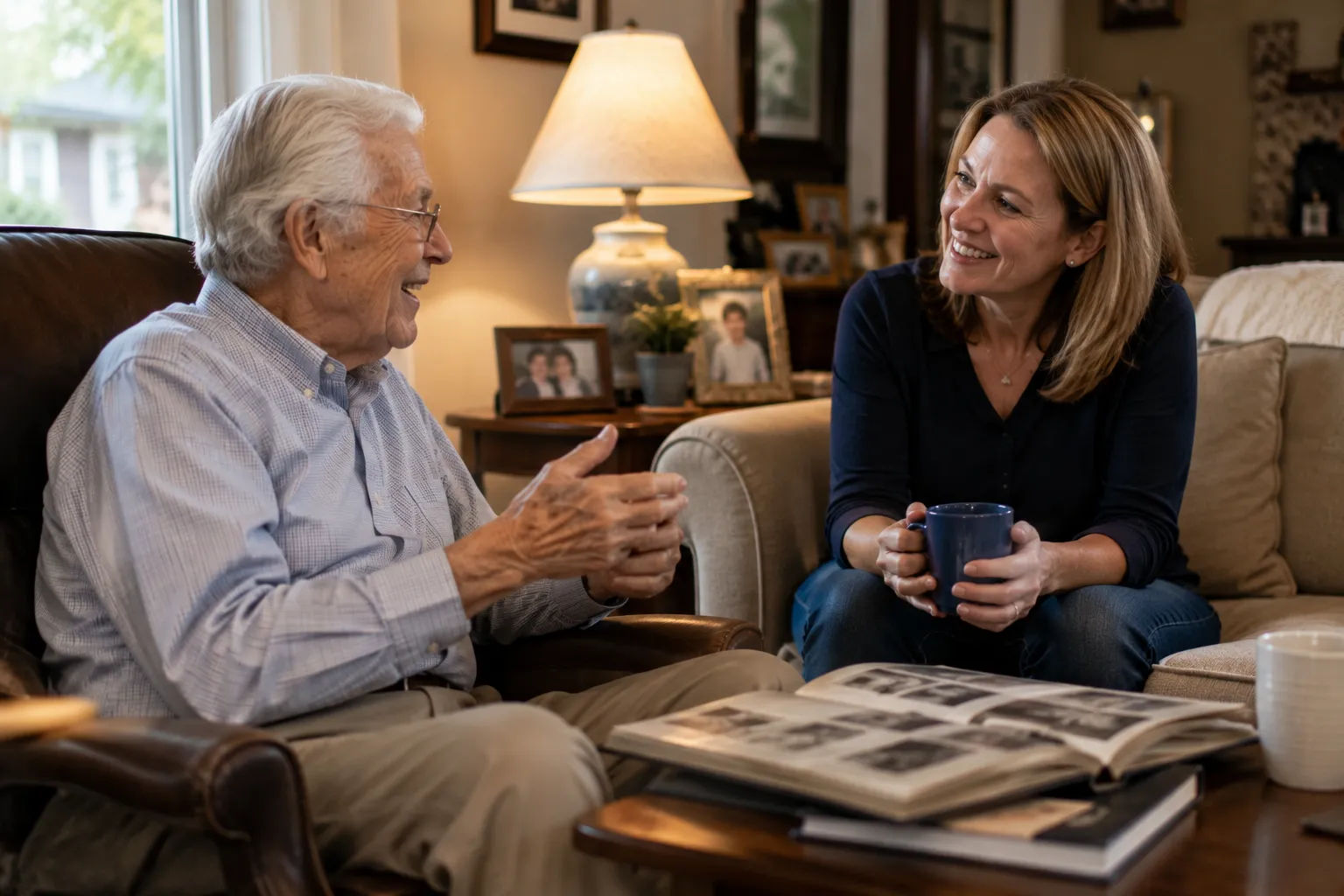
Karen started using these questions with her father Walt after noticing he'd grown quieter during their usual Sunday visits — less about the news, less about the neighbors, mostly silence over coffee.
"The first time I asked him about his first car instead of asking how he was feeling, he lit up in a way I hadn't seen in months. Twenty minutes later I knew things about 1962 I'd never heard in my whole life." — Karen, Farmington, CT
She didn't run through a list. She asked one question, let it lead wherever it went, and came back with another the following week. Six months in, Sunday visits changed from something to get through into something both of them looked forward to — not because the questions were clever, but because they were specific enough to actually go somewhere.
The Research Behind Why This Works
Reminiscence therapy has been studied specifically as a non-pharmacological intervention for older adults, meaning it works alongside or instead of medication for issues like mild depression and low life satisfaction. Multiple systematic reviews — pooling results across dozens of individual studies — have found consistent, measurable improvements in mood and psychological wellbeing.
The mechanism researchers point to isn't just nostalgia. Structured reminiscence prompts a person to actively construct a narrative about their own life — organizing scattered memories into a coherent story with meaning and continuity. That act of narrative-building is what's linked to the psychological benefit, which is part of why specific, story-inviting questions ("how did you meet") tend to work better than vague ones ("tell me about your life").
Group settings appear to have an edge over one-on-one in some of this research, possibly because they add social interaction and validation on top of the memory-recall benefit — worth keeping in mind if grandchildren or multiple family members can take part.
If Your Parent Doesn't Want to Talk About the Past
Some people genuinely don't enjoy reminiscing, and forcing it tends to backfire. If a question falls flat, it's fine to let it go — try switching to lighter, present-tense questions instead, like opinions on current events or a favorite recent meal, and circle back to reminiscence questions another day.
Dee, Morning Star's founder: "Not every parent wants to look backward, and that's okay. The goal is real connection, not checking a box — if a question isn't landing, a different one will."
Connecticut-Specific Ways to Preserve These Stories
A few local and national resources support exactly this kind of family storytelling and connection, beyond just informal conversation:
- Senior centers across Bristol and the surrounding towns often run reminiscence groups or storytelling programs — worth asking about through the North Central Area Agency on Aging.
- StoryCorps, a national nonprofit oral history project, provides free tools and prompts for recording family conversations, including a dedicated app designed for exactly this kind of interview.
- Local historical societies in many Connecticut towns collect oral histories from longtime residents — a meaningful way to have a parent's memories preserved somewhere beyond the family too.
What to Do With What You Learn
These conversations produce more than just a nice afternoon — they're worth capturing somewhere durable. A simple approach that works for a lot of families:
- Keep a running note. A notes app, a notebook, whatever's easiest — jot down the story or answer shortly after the visit, while it's still fresh.
- Share it with the family. A sibling who couldn't make the visit still gets the story, and it becomes a shared family record rather than something only you remember.
- Notice patterns over time. If your parent starts struggling with questions that used to be easy, or repeating stories more than before, that's genuinely useful information — not just for sentiment, but as an early signal worth mentioning to their doctor.
Some families eventually turn a collection of these answers into something more formal — a written memoir, a recorded oral history, even just a printed booklet for grandchildren. None of that has to be the goal starting out. It's a natural byproduct of asking good questions consistently.
Building This Into Family Gatherings
Holidays, birthdays, and other gatherings where extended family is already together are natural opportunities to use a few of these questions in a group setting — not as a formal activity, but woven into normal conversation, the way Karen and Walt use theirs on ordinary Sundays. A grandchild asking "what was your first job" over Thanksgiving dinner often gets a warmer, more detailed answer than the same question asked one-on-one, simply because the audience makes the story feel worth telling well.
Some families make this slightly more structured — one question rotated around the table, everyone listening, no phones. It doesn't need a name or a formal ritual to work. It just needs someone willing to ask a real question instead of defaulting to small talk.
Adapting These Questions for Different Relationships
A grandchild asking these questions often gets different answers than an adult child does — sometimes more candid, since the relationship carries less of the complicated history between parent and child. If grandchildren are able to take part, even remotely through a video call, it's worth actively including them rather than assuming these conversations are only for the immediate family.
In-laws, longtime family friends, and even a professional caregiver who's built real rapport can also be well positioned to ask some of these questions, especially the lighter, early-life ones — sometimes a friendly, slightly less emotionally loaded relationship opens a door that a direct child-parent conversation doesn't.
Turning Answers Into Something Lasting
A voice memo app on your phone is often the simplest way to capture these conversations — most parents relax once they realize you're not filming, just recording audio while you talk normally. Some families later turn a handful of recordings into a short audio keepsake, or transcribe the best stories into a simple printed booklet for grandchildren.
Whatever method you choose, the goal isn't a perfect archive. Even a phone full of unedited voice memos, labeled by date and topic, is a resource your family will be glad to have years from now.
A Final Thought
None of these 25 questions are complicated, and that's rather the point. The value isn't in clever phrasing — it's in the habit of asking at all, consistently, over months and years, instead of letting visits default to small talk because it feels easier in the moment. A parent's stories don't wait around forever for the perfect time to be asked. The best time is usually just the next ordinary visit.
References
- NIH — Effects of Reminiscence Therapy on Psychological Outcomes Among Older Adults (Systematic Review and Meta-Analysis)
- NIH — The Effectiveness of Reminiscence Therapy on Alleviating Depressive Symptoms in Older Adults
- NIH — The Impact of Reminiscence on Autobiographical Memory, Cognition and Psychological Well-Being in Healthy Older Adults
This article is for general information and isn't a substitute for medical, legal, or financial advice. If you're concerned about a specific issue, talk to your parent's doctor or an elder law attorney.
Written by
Morning Star Care Team
Morning Star Home Care — Caregiver-Founded and Locally Owned in Bristol, CT.