
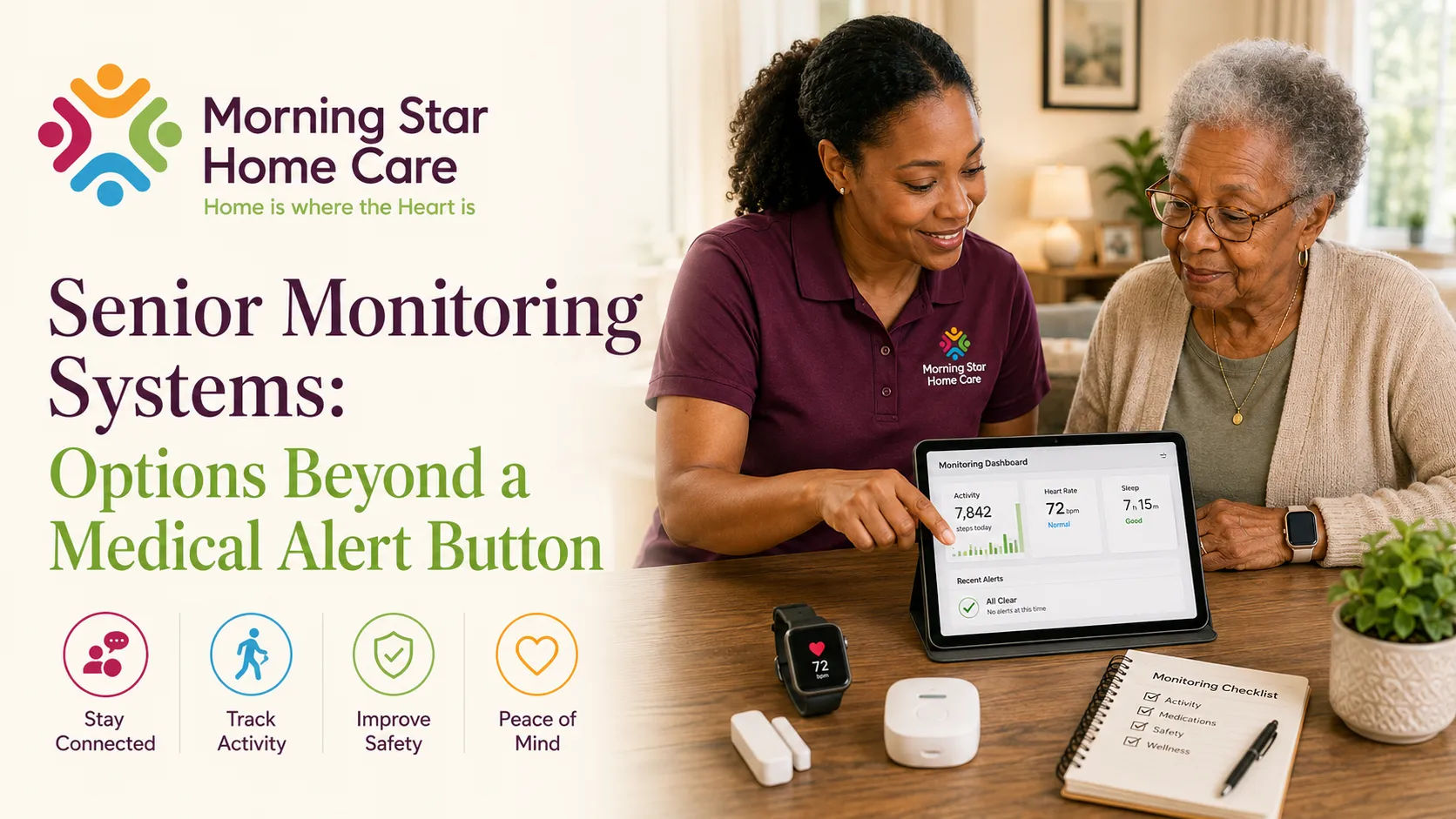
Senior monitoring systems have expanded well beyond the classic push-button pendant most families picture when they hear the term. Today's options range from automatic fall detection watches to passive sensors that quietly track daily activity patterns without any button-pressing at all. Every 11 seconds, an older adult is treated in an emergency room for a fall injury, and response speed matters enormously — automatic fall detection can summon help even when someone is unconscious or too disoriented to press a button.
With so many senior monitoring systems on the market, the challenge for most families isn't finding options, it's figuring out which type of monitoring actually fits their specific situation. This guide breaks down the real categories, what each one is actually good at, and how to think through the decision.
Key Takeaways
- Senior monitoring systems now span several distinct categories — medical alert buttons, automatic fall detection, passive activity sensors, video, and GPS — each solving a different problem.
- Automatic fall detection matters most for someone who could be knocked unconscious or too disoriented to press a button after a fall.
- Passive monitoring systems track daily patterns in the background and flag changes, useful for someone living alone whose routine a family can't observe directly.
- Response time is a critical factor — emergency operator connection averages under a minute, but the choice of system affects how quickly that connection happens.
- Most families end up combining more than one type rather than relying on a single device to cover every risk.
Why Senior Monitoring Systems Matter More Than Ever
The case for senior monitoring systems comes down to a simple, sobering statistic: an older adult is treated in an emergency room for a fall injury every 11 seconds in the United States. When someone lives alone, or spends significant time alone during the day even with family nearby, the gap between an incident happening and help arriving can be the difference between a manageable injury and a life-threatening one. Modern monitoring technology exists specifically to close that gap.
Dee, Morning Star's founder: "Families often think of monitoring as a last resort, something you add once things have already gotten bad. I'd encourage thinking about it earlier, as a safety net that buys time, not a sign that something's wrong."
Category 1: Medical Alert Buttons
The original and still most recognizable senior monitoring system: a pendant or wristband with a button that connects to a 24/7 monitoring center when pressed. The core value is simplicity and directness — press the button, talk to a real person, get help dispatched.
- Best for: someone cognitively sharp who will reliably press the button when needed, and who understands and accepts wearing the device.
- Limitation: provides no help if the person is unconscious, badly disoriented, or simply forgets or refuses to press the button after a fall.
- Typical cost: $20 to $45 per month for monitoring service, plus sometimes an upfront equipment fee.
Category 2: Automatic Fall Detection
A meaningful advance over a basic alert button: these devices use accelerometer and gyroscope sensors to detect the specific motion pattern of a fall, sudden downward movement followed by stillness, and automatically trigger an alert without requiring the wearer to do anything. Bay Alarm Medical's SOS Smartwatch, Medical Guardian, Lively, and LifeFone all offer fall-detection options within their broader senior monitoring system lineups.
- Best for: anyone at meaningful fall risk, especially someone who could be knocked unconscious, or who has cognitive decline that might prevent them from remembering to press a button.
- Limitation: automatic detection isn't perfect — it can occasionally miss a slow-motion fall or trigger a false alarm from vigorous activity, though accuracy has improved significantly in recent device generations.
- Response time: emergency operator connection typically averages 48 to 62 seconds from the fall event, with emergency services then arriving in roughly 8 to 15 minutes in urban areas.
Category 3: Passive Activity and Ambient Sensors
A newer category of senior monitoring systems that requires no button, no wearable, and no action from the person being monitored at all. Motion sensors placed around the home learn a person's typical daily patterns, when they usually get up, move to the kitchen, use the bathroom, and alert a designated caregiver when something deviates meaningfully from that pattern, such as no movement detected for several hours during typically active daytime periods.
- Best for: someone who resists wearing any device, or a family that wants a general sense of well-being and routine without constant check-in calls.
- Limitation: passive systems detect deviations from a pattern, not emergencies in real time the way a fall-detection wearable does — there's typically more of a delay before an anomaly is flagged.
- Privacy consideration: most modern passive systems use motion sensors rather than cameras, which tends to feel less invasive to the person being monitored than video.
Category 4: Video and Camera-Based Monitoring
The most direct form of monitoring, video systems let a family or caregiver check in visually, either live or through recorded alerts triggered by motion. This category tends to generate the most mixed reactions, since it offers the clearest picture of what's actually happening but also raises the most significant privacy concerns for the person being monitored.
"We tried a camera in the living room for a few weeks, and honestly, Dad hated it, and I felt uncomfortable watching him too. We switched to motion sensors instead and it felt like a better fit for both of us."
Cameras tend to work best in narrow, specific applications, such as monitoring a single high-risk area like a staircase or kitchen, rather than as blanket household surveillance, which most families and the seniors themselves find more comfortable.
Category 5: GPS and Location Tracking
Distinct from the in-home monitoring categories above, GPS-based senior monitoring systems track location outside the home, which matters specifically for wandering risk associated with dementia, or simply for peace of mind when an older adult still drives or walks independently. This overlaps with, but is a narrower category than, dedicated dementia-specific GPS trackers, which are covered in more depth in a separate guide.
How to Choose the Right Senior Monitoring System
With five distinct categories available, the decision comes down to matching the system to the specific risk that matters most for a particular person, rather than defaulting to whichever system is most heavily advertised.
- Fall risk without cognitive decline: a wearable with automatic fall detection is usually the strongest single choice.
- Cognitive decline or memory issues: passive sensors or a combination of fall detection plus GPS tends to work better than relying on the person to manage a button reliably.
- Living alone with an otherwise healthy routine: passive activity monitoring alone often provides adequate peace of mind without the cost or complexity of a full medical alert subscription.
- Recent hospitalization or high acute risk: a combination approach — medical alert with fall detection, plus more frequent in-person check-ins — tends to be appropriate during a higher-risk recovery window.
Setting Up a Senior Monitoring System the Right Way
Choosing the right category of senior monitoring system is only half the equation — how it's set up and introduced makes a real difference in whether it actually gets used consistently.
- Test coverage throughout the entire home, not just where the device was set up, since cellular or WiFi dead zones in a basement, garage, or far bedroom can leave gaps in protection.
- Involve the person in choosing the device, when possible, rather than presenting a monitoring system as a decision already made — buy-in significantly improves consistent use.
- Do a practice run, pressing the button or triggering a test alert, so the person knows what to expect and the family confirms the monitoring center actually responds correctly.
- Update emergency contacts and medical information on file with the monitoring service, including current medications and any relevant conditions, so responders have accurate information immediately.
- Revisit the setup periodically, especially after any health change, since a system that fit well a year ago may no longer match current risk.
Cost Comparison Across Senior Monitoring System Types
| System Type | Typical Monthly Cost | Best For |
|---|---|---|
| Basic medical alert button | $20–$30 | Cognitively sharp, will reliably press button |
| Automatic fall detection wearable | $35–$50 | Meaningful fall risk, possible unconsciousness |
| Passive activity sensors | $30–$60 | Living alone, resists wearables |
| Video/camera monitoring | $15–$40 per camera | Specific high-risk area monitoring |
| GPS tracking device | $25–$45 | Wandering risk, outdoor independence |
Rural and Coverage-Limited Areas
Families in more rural parts of Connecticut, or anywhere with inconsistent cellular coverage, should pay particular attention to connectivity when choosing a senior monitoring system, since a device that can't reliably reach a monitoring center provides a false sense of security. Testing signal strength throughout the home, including basements and bedrooms farthest from windows, before finalizing a purchase catches this problem early rather than discovering it during an actual emergency.
What Response Time Actually Looks Like
Understanding real-world response time helps set accurate expectations for any senior monitoring system. Emergency operator connection averages 48 to 62 seconds from the moment a fall is detected or a button is pressed, and emergency services then typically arrive within 8 to 15 minutes in urban environments, longer in rural areas including parts of the Bristol and Greater Hartford region. This means monitoring systems dramatically shorten the time before help is summoned, but families should still understand that arrival on scene isn't instantaneous even with the fastest system.
Common Mistakes Families Make Choosing a Senior Monitoring System
- Choosing based on price alone, without matching the system type to the actual risk — the cheapest option is a poor value if it doesn't address the real safety concern.
- Assuming a button-press system is enough for someone with any level of cognitive decline, when automatic detection or passive monitoring would provide meaningfully better protection.
- Not testing the device before relying on it, including checking cellular signal strength throughout the home and confirming the wearer actually keeps it on.
- Overlooking in-home WiFi or cellular reliability, which affects how quickly some systems, particularly camera and passive sensor systems, can send alerts.
Insurance and Coverage Considerations
Coverage for senior monitoring systems varies significantly depending on the type of plan and the specific device. Original Medicare generally does not cover the monthly monitoring fee for a basic medical alert system, but some Medicare Advantage plans include it as a supplemental benefit, particularly plans marketed toward members with chronic conditions or recent hospitalizations. Long-term care insurance policies more frequently cover monitoring costs, and veterans may have access to monitoring benefits through VA programs. It's worth checking specific plan documents or calling a plan directly, since coverage details change often and aren't always advertised clearly.
Questions to Ask Before Choosing a Provider
Beyond comparing device categories, a few direct questions to any senior monitoring system provider can reveal meaningful differences in service quality that aren't obvious from marketing materials alone.
- Where is the monitoring center located, and is it staffed 24/7 with U.S.-based operators? Response quality can vary between providers.
- What happens during a power or internet outage? Cellular-based systems with battery backup tend to hold up better than WiFi-dependent systems during outages.
- Is there a cancellation fee or long-term contract requirement? Some providers lock users into multi-year contracts, while others offer month-to-month flexibility.
- How is fall detection accuracy validated? Ask about false-alarm rates and missed-detection rates, since these vary meaningfully between devices and generations of technology.
A Real Family Scenario
Karen initially chose a basic medical alert pendant for her father Walt, assuming it would cover their safety concerns. After a fall where he was too disoriented to remember pressing the button, and ended up on the kitchen floor for nearly two hours before a scheduled check-in call caught it, she switched to a fall-detection watch that triggers automatically. The upgrade cost about $15 more per month, but it addressed the exact gap that had already caused a problem.
Signs It's Time to Add a Senior Monitoring System
Families sometimes wait for a specific crisis before considering a monitoring system, when a few earlier signals often justify acting sooner rather than later.
- A recent fall, even a minor one, since a first fall meaningfully raises the odds of a second one.
- Living alone with a chronic condition that could affect balance, cause fainting, or lead to sudden medical events.
- A recent hospital discharge, since the weeks following a hospital stay carry elevated risk for falls and complications.
- Family members who can't check in as often as they'd like, due to distance, work, or their own health limitations.
How a Professional Caregiver Complements a Monitoring System
Technology-based senior monitoring systems are strongest when paired with in-person care rather than used as a full substitute for it. A caregiver provides the direct supervision, companionship, and hands-on help a device simply can't, while the monitoring system covers the hours when a caregiver isn't present, creating overlapping layers of protection rather than a single point of failure.
Dee, Morning Star's founder: "A monitoring system tells you something happened. A caregiver in the home can often prevent it from happening in the first place, or catch it the moment it starts. The two work best together, not as alternatives to each other."
When a Single Device Isn't Enough
Some situations genuinely call for combining more than one senior monitoring system category rather than picking a single best option. A person with both fall risk and early cognitive decline, for example, may benefit from a fall-detection wearable for acute events plus a passive sensor system for detecting subtler pattern changes, like skipped meals or unusual sleep disruption, that a single wearable alone wouldn't catch. Cost is a real factor here, and most families find it reasonable to start with the single system addressing the most urgent risk, then add a second layer if a gap becomes apparent.
Trying Before Committing
Many senior monitoring system providers offer a trial period or month-to-month option before requiring a longer commitment, and it's worth taking advantage of this when available. A short trial reveals practical issues, cellular dead zones, a person's willingness to actually wear or accept the device, false-alarm frequency, that are hard to predict from a product page alone, and switching providers or device types early is far easier than realizing six months in that the chosen system doesn't fit the household's actual needs.
A Final Thought
Senior monitoring systems have grown into a genuinely useful, varied toolkit rather than a single one-size-fits-all product, and the right choice depends far more on the specific risk a family is trying to address than on any particular brand or feature list. Matching the system type to the real situation, and being willing to combine more than one category, tends to produce far better protection than defaulting to whichever option is most familiar.
References
- SafeHome.org — Best Medical Alert Systems of 2026
- Fall Detection — Accuracy, Sensors & Medical Alert Systems Guide
- U.S. News — 8 Best Medical Alert Systems 2026: Reviewed
Written by
Morning Star Care Team
Morning Star Home Care — Caregiver-Founded and Locally Owned in Bristol, CT.