
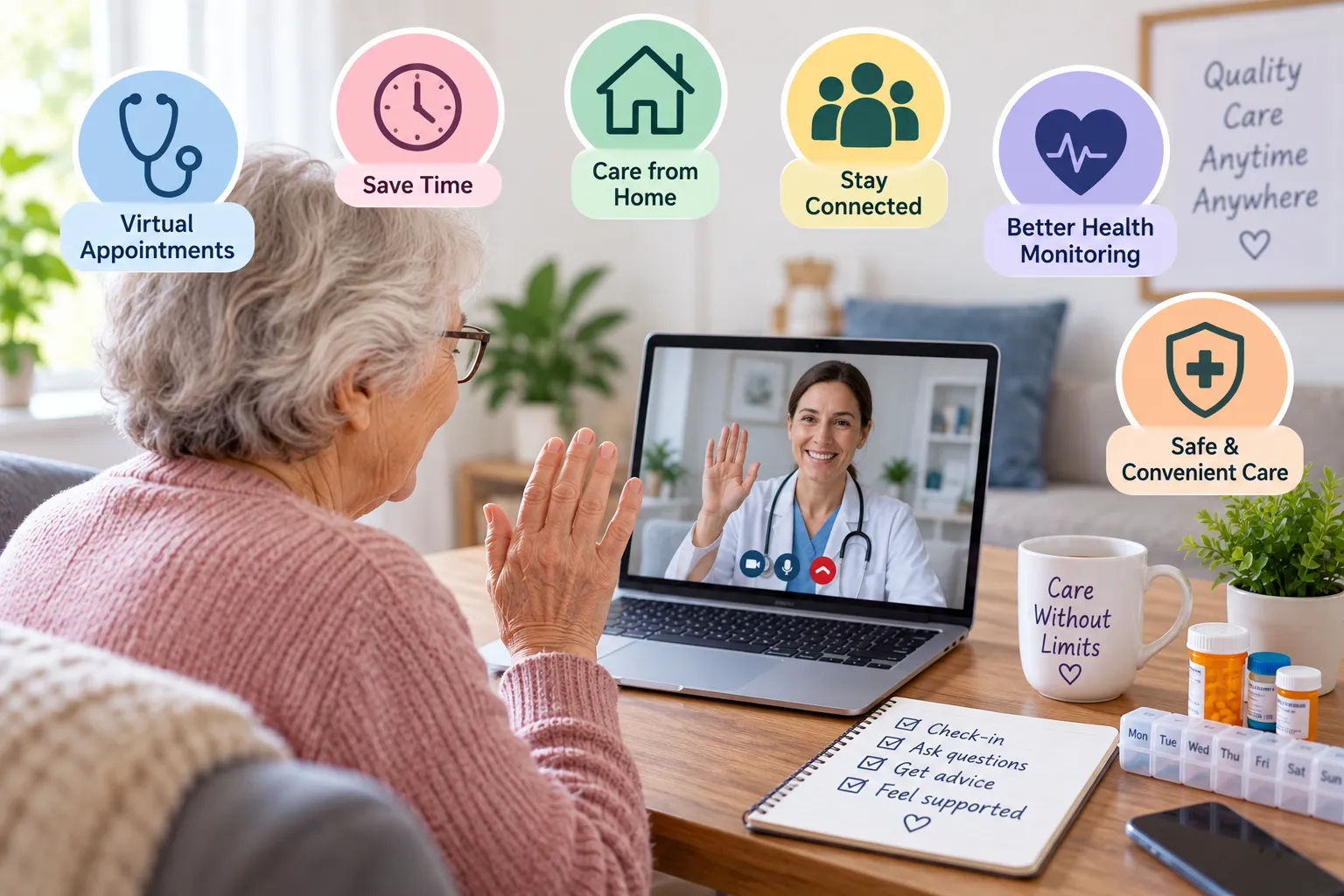
Telehealth for seniors offers real, well-documented benefits, yet adoption remains surprisingly low. Adults 65 and older consistently represent less than 10% of telehealth claims across most regions, suggesting older adults lag well behind younger populations in using virtual care, despite research showing measurable improvements in access, safety, and quality of care from telehealth for seniors specifically.
This guide covers how telehealth for seniors actually works, the genuine benefits it offers, and practical steps for helping a parent get comfortable using it.
Key Takeaways
- Adults 65 and older make up less than 10% of telehealth claims nationally, despite clear evidence of benefit for this age group.
- Telehealth for seniors removes the transportation barrier that's often a significant obstacle for rural residents or those with limited mobility.
- Avoiding waiting rooms reduces exposure to seasonal illness, a meaningful benefit for older adults with weaker immune systems.
- Internet access is the biggest predictor of telehealth use, making broadband access an equity issue as much as a technology one.
- Most first-time telehealth visits go more smoothly with a family member or caregiver helping set up the call rather than a parent navigating it alone.
Understanding both the genuine benefits and the real barriers helps families approach telehealth for seniors as a practical tool worth trying, not an intimidating replacement for in-person care.
How Telehealth for Seniors Actually Works
Telehealth for seniors typically takes one of a few forms, each suited to different situations and comfort levels.
- Video visits, conducted through a secure app or web link, allow a doctor to see and hear the patient much like an in-person visit.
- Telephone visits, a simpler option requiring no app or video, still widely covered by Medicare for many types of appointments.
- Remote patient monitoring, where devices track vitals like blood pressure or blood sugar and transmit the data to a care team between visits.
- Secure messaging with a care team, allowing questions or symptom updates without needing a scheduled call at all.
Most primary care practices now offer at least one of these options, and asking directly about telehealth availability is a reasonable first step for any parent managing ongoing health conditions.
The Real Benefits of Telehealth for Older Adults
The evidence supporting telehealth for seniors is substantial, particularly for those facing specific access challenges.
- Eliminating travel burden matters significantly for rural residents or anyone with mobility limitations that make transportation to appointments difficult.
- Reduced exposure to seasonal illness from crowded waiting rooms is a genuine safety benefit, particularly relevant for older adults with weaker immune systems.
- Increased access to timely care often means shorter wait times for an appointment compared to scheduling an in-person visit.
- Easier involvement of family caregivers, who can join a video visit remotely even if they don't live nearby, supporting better-informed care decisions.
Dee, Morning Star's founder: "Telehealth genuinely helps with the appointments that don't require a physical exam, medication check-ins, follow-ups, some mental health visits. It saves a whole day of travel and waiting for something that takes fifteen minutes."
These benefits are especially meaningful for older adults managing multiple chronic conditions, who often face a heavier appointment schedule than younger patients.
Why Adoption Still Lags Among Seniors
Despite these clear benefits, telehealth for seniors remains significantly underused, and the barriers are largely practical rather than related to willingness.
- Limited access to devices or reliable internet remains the single strongest predictor of low telehealth use among older adults.
- Unfamiliarity with video calling technology can create genuine anxiety about the first attempt, even when the underlying willingness is there.
- Hearing or vision changes can make video calls more difficult to navigate without some accommodation or assistance.
- Disparities by income, race, and geography mean access barriers fall disproportionately on already underserved populations.
Recognizing these barriers as solvable, practical obstacles, rather than a sign a parent simply isn't interested, opens the door to genuinely helping them access this option.
Privacy and Security in Telehealth Visits
Understandable concerns about privacy and technology security sometimes hold older adults back from trying telehealth, and addressing these concerns directly can ease hesitation.
- Reputable telehealth platforms use encrypted, HIPAA-compliant video connections, offering privacy protections comparable to an in-person visit.
- Choosing a private space for the call, away from shared living areas, helps maintain confidentiality during sensitive conversations.
- Confirming the platform being used is the one the doctor's office actually recommends avoids confusion with unofficial or less secure alternatives.
Understanding these safeguards can meaningfully ease privacy concerns that might otherwise discourage a parent from trying telehealth in the first place.
Discussing these protections openly, rather than assuming a parent already understands them, can meaningfully reduce hesitation rooted in legitimate but resolvable privacy concerns.
Helping a Parent Get Started With Telehealth
A few practical steps make a parent's first telehealth experience far less intimidating and much more likely to succeed.
- Do a practice run before the actual appointment, testing the video app and camera together so the first real visit isn't also the first tech lesson.
- Write down the appointment link and instructions in large, clear print, kept somewhere easy to find on the day of the visit.
- Offer to join the first few visits, either in person or remotely, to help troubleshoot and take notes.
- Ask the doctor's office about phone-only options if video technology remains a genuine barrier, since many visits don't require video at all.
"We did a test call with my dad the day before his first telehealth appointment, just to make sure the camera and sound worked. That five minutes made the actual appointment go so much smoother."
A little upfront preparation dramatically increases the odds that a parent's first telehealth experience feels manageable rather than frustrating, making them more likely to use it again.
Devices and Setup: What's Actually Needed
Getting set up for telehealth for seniors doesn't require expensive or complicated technology, most visits can happen with equipment many households already have.
- A smartphone, tablet, or computer with a camera and microphone covers most video visit requirements.
- A stable internet connection, ideally Wi-Fi rather than cellular data, to avoid dropped calls or lag.
- Larger tablets are sometimes easier for older adults to see and use than a smaller smartphone screen.
- Some libraries and senior centers offer device loaner programs or tech support for those without reliable access to their own equipment.
For families concerned about cost or access, checking with local senior centers or Area Agencies on Aging about device and internet assistance programs can uncover options that aren't always well advertised.
What Telehealth for Seniors Can and Can't Replace
Telehealth genuinely works well for many types of visits, but it isn't a complete substitute for in-person care, and knowing the difference helps set realistic expectations.
- Well-suited to telehealth: medication check-ins, follow-up appointments, some mental health visits, and reviewing test results.
- Still requires in-person care: physical exams, diagnostic imaging, procedures, and situations requiring hands-on assessment.
- A hybrid approach often works best, using telehealth for routine check-ins and reserving in-person visits for exams or new concerns.
Understanding this distinction helps families use telehealth for seniors where it genuinely adds value, without expecting it to replace all in-person medical care.
Telehealth for Mental Health Care
Telehealth has proven particularly valuable for mental health visits, an area where older adults have historically faced significant access gaps due to a shortage of geriatric mental health specialists.
- Video therapy sessions expand access to specialists who may not have an office located conveniently nearby.
- Some older adults find it easier to open up from the comfort of home rather than in an unfamiliar office setting.
- Consistency becomes easier to maintain, since eliminating travel reduces the barrier to attending sessions regularly.
For families exploring mental health support for a parent, asking specifically about telehealth availability can meaningfully expand the pool of specialists worth considering.
This expanded access is particularly valuable given the persistent shortage of geriatric mental health providers in many communities, making telehealth a genuinely practical solution rather than a lesser substitute.
Telehealth Etiquette: Getting the Most Out of a Virtual Visit
A few simple habits help older adults get the most out of a telehealth visit, making the conversation with a doctor as productive as an in-person appointment.
- Write down questions and symptoms beforehand, since it's easy to forget details once the call starts, just as with an in-person visit.
- Have the current medication list on hand in case the doctor needs to reference or update it during the call.
- Speak clearly and pause for the doctor's response, since slight audio delays are common on video calls and can cause talking over each other.
- Confirm next steps before ending the call, including any prescriptions, follow-up appointments, or referrals discussed.
These small habits help ensure a telehealth visit delivers the same quality of care and communication as an in-person appointment, just without the travel.
When to Choose In-Person Care Instead
Knowing when telehealth isn't the right fit is just as important as knowing when it is, and a few clear signals suggest an in-person visit is the better choice.
- New or worsening symptoms that require a hands-on physical exam to properly assess, like abdominal pain or a new lump.
- Situations requiring lab work, imaging, or in-office procedures that simply can't be conducted remotely.
- A first visit with a new specialist, where an in-person exam often helps establish a more complete baseline.
- Any time a parent or caregiver feels genuinely uncertain whether a symptom can be adequately assessed by video, erring toward an in-person visit is the safer choice.
When in doubt, calling the doctor's office and describing the symptom is a reasonable way to get guidance on whether a telehealth visit is appropriate or whether an in-person appointment makes more sense.
A Real Family Scenario
Ruth's arthritis made the drive to her rheumatologist's office increasingly difficult, a forty-minute trip each way that left her exhausted before the appointment even started. Her daughter helped set up telehealth visits for routine medication check-ins, reserving the in-person trips for periodic physical exams, cutting her total travel burden by more than half while maintaining the same quality of ongoing care.
Ruth's situation reflects how a hybrid approach, rather than an all-or-nothing choice between telehealth and in-person visits, often serves older adults with chronic conditions particularly well.
Her daughter also noted that having the video visits gave her direct visibility into her mother's care in a way phone updates never had, since she could join the call remotely from her own home and hear the doctor's recommendations firsthand.
How an In-Home Caregiver Supports Telehealth Use
A consistent in-home caregiver can provide genuinely valuable support for telehealth for seniors, including setting up the technology, staying present during the appointment to help communicate symptoms clearly, and following up on any instructions given afterward. This support directly addresses the technology-comfort barrier that keeps many older adults from using telehealth even when it would genuinely help them.
Dee, Morning Star's founder: "Having someone there for the video call makes a real difference, both for handling the technology and for making sure nothing important gets missed or forgotten afterward."
This kind of practical, hands-on support often makes the difference between a parent trying telehealth once and abandoning it, versus incorporating it as a genuinely useful part of their ongoing care.
Caregivers can also help schedule follow-up telehealth appointments and keep track of any at-home monitoring devices, ensuring the benefits of virtual care continue well beyond a single successful visit.
A Final Thought
Telehealth for seniors offers genuine, well-documented benefits that remain significantly underused, largely due to solvable barriers around technology access and comfort rather than a lack of interest or willingness. With a little preparation and support, telehealth can become a genuinely valuable part of a parent's ongoing healthcare.
Helping a parent take that first step, with patience and practical preparation, often opens the door to real, lasting benefit in both convenience and access to timely care.
As telehealth infrastructure continues to expand, older adults who become comfortable with virtual care today are likely to find even more of their healthcare needs served this way in the years ahead.
Insurance and Cost Considerations
Understanding coverage helps families and older adults use telehealth for seniors with confidence rather than uncertainty about potential cost surprises.
- Medicare covers many telehealth services, though coverage for certain visit types and technology-only telephone calls can vary and is worth confirming directly.
- Medicare Advantage and supplemental plans sometimes offer expanded telehealth benefits beyond original Medicare, worth reviewing during open enrollment.
- Confirming coverage before the visit avoids unexpected costs, particularly for newer telehealth service types still being incorporated into standard coverage.
A quick call to the insurance provider or doctor's billing office beforehand can prevent the kind of cost surprise that might otherwise discourage a parent from trying telehealth again.
A Note for Connecticut Families
Most primary care practices and specialists throughout the Bristol and Greater Hartford area now offer telehealth options, worth asking about directly when scheduling routine follow-up appointments.
Local senior centers and libraries in the region often provide free tech support sessions specifically geared toward helping older adults get comfortable with video calling and telehealth platforms.
Home care providers familiar with the region can also help set up and support telehealth visits, ensuring the technology doesn't become a barrier to consistent care.
References
Written by
Morning Star Home Care
Morning Star Home Care — Caregiver-Founded and Locally Owned in Bristol, CT.