
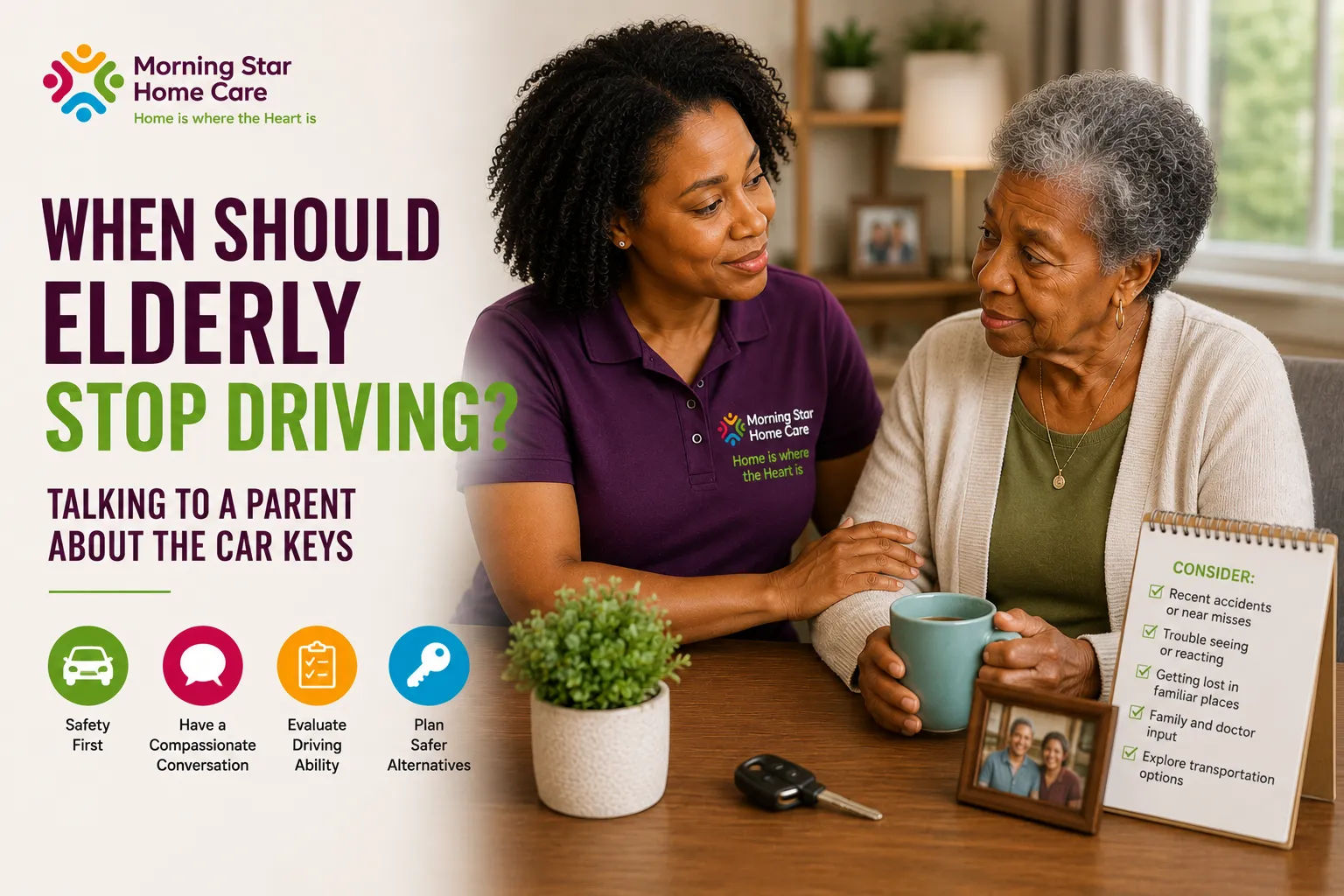
When should elderly stop driving is one of the most emotionally loaded questions a family can face, and there's no single right answer or magic age. There's no set age for stopping driving, and many people continue safely well into their 80s, but most seniors do reduce or stop driving by their mid-70s, and drivers 85 and older are the most likely to stop altogether, with about a third no longer licensed by that age. What matters far more than age alone is a combination of specific warning signs, honest self-assessment, and, when needed, a family conversation approached with care rather than confrontation.
This guide walks through the real warning signs worth watching for, how professional driving assessments work, and how to have the conversation in a way that preserves dignity while genuinely addressing safety.
Key Takeaways
- There's no single age that answers when should elderly stop driving — ability varies enormously and specific warning signs matter more than a birthday.
- About 48 million elderly drivers currently hold active licenses in the U.S., and that number continues to grow as the population ages.
- The NHTSA has identified specific, concrete warning signs — from lane drifting to sudden braking — that indicate declining driving safety.
- Professional driving assessments offer an objective, less emotionally charged alternative to a family making the call alone.
- A new October 2025 DOT policy shifts toward individualized license renewal assessment for drivers 70+, rather than blanket age-based restrictions.
There's No Magic Age — Here's What Actually Matters
The number of licensed drivers 70 and older more than doubled between 1997 and 2024, and the share of that age group holding a license rose from 73% to 87% over the same period. Age alone doesn't predict driving safety well, some people in their 80s drive perfectly safely, while some in their 60s develop conditions that meaningfully compromise their driving ability. What matters is a combination of vision, reaction time, cognitive processing, and physical mobility, all of which can decline gradually and unevenly.
Dee, Morning Star's founder: "I've met families ready to have the driving conversation with someone who's actually still a perfectly safe driver at 82, and families who've waited too long with someone whose reflexes had clearly slipped years earlier. Age is a terrible proxy on its own. The specific signs matter much more."
Concrete Warning Signs It May Be Time to Stop Driving
The National Highway Traffic Safety Administration has identified a specific set of behaviors that reliably signal declining driving safety, worth watching for directly rather than relying on a general sense that 'something feels off.'
- Drifting into other lanes or straddling lane markers, suggesting reduced attention or spatial awareness.
- Missing or ignoring stop signs and traffic signals.
- Braking or stopping abruptly without clear cause, or accelerating suddenly and unexpectedly.
- Increased confusion while driving in traffic, including difficulty navigating familiar routes.
- Difficulty seeing pedestrians, objects, or other vehicles, particularly at night or in low-visibility conditions.
- Driving significantly slower than the posted speed limit without a clear reason, sometimes a sign of anxiety compensating for reduced confidence.
- New dents, scrapes, or damage to the car that the driver can't fully explain.
- Increasing anxiety or visible stress while driving, sometimes voiced directly by the driver themselves.
Medical Conditions That Warrant Closer Attention
Certain health conditions raise driving risk more directly than age alone, and a new diagnosis or worsening of an existing one is often a more meaningful trigger for reassessment than reaching a particular birthday.
- Vision conditions — cataracts, macular degeneration, glaucoma, or any condition affecting depth perception or night vision.
- Cognitive decline or dementia, which affects reaction time, judgment, and the ability to process multiple inputs quickly — often the single most significant driving risk factor.
- Reduced mobility or reaction time, including arthritis, Parkinson's disease, or recovery from a stroke.
- New medications, particularly sedatives, certain pain medications, or anything causing drowsiness or dizziness as a side effect.
- Hearing loss, which can delay reaction to sirens, horns, or other auditory warnings.
Professional Driving Assessments: An Objective Alternative
For families uncertain whether concerns are warranted, or worried about the emotional weight of making the call unilaterally, a professional driving assessment offers a more objective path forward. These evaluations, often conducted by an occupational therapist certified as a driver rehabilitation specialist, typically assess vision, physical movement, reaction time, and cognitive processing, followed by an actual on-road evaluation.
- Cost typically runs $400 to $600 for a comprehensive assessment, and some Medicare Advantage plans or insurance policies may partially cover it.
- Results are objective and specific, identifying not just whether someone should stop driving, but sometimes specific limitations, no highway driving, no night driving, that allow continued limited independence.
- A neutral third party delivering the assessment often reduces the family conflict that comes with a adult child being the one to raise the concern directly.
"Having someone else, a professional, tell Dad it was time to stop driving took so much pressure off our relationship. It wasn't me being the bad guy. It was an evaluation, with real results he could see and understand."
The New 2025 DOT Policy for Senior Drivers
Starting in October 2025, a new U.S. Department of Transportation policy shifted the approach to senior driver license renewals for drivers 70 and older, moving toward individualized assessment based on actual ability rather than blanket age-based restrictions. This reflects a broader trend recognizing that driving safety for older adults is highly individual, and that fair, ability-based evaluation serves both safety and independence better than an arbitrary cutoff. Specific state-level implementation of renewal requirements varies, so it's worth checking Connecticut DMV requirements directly for the most current process.
Self-Assessment: Questions to Ask Honestly
Some seniors recognize declining driving ability themselves before family ever raises the topic, and a few honest self-assessment questions can prompt that recognition earlier, before an incident forces the issue.
- Have I had any near-misses or actual accidents in the past year, even minor ones I didn't report?
- Do I avoid certain driving situations, night driving, highways, left turns across traffic, because they feel harder or more stressful than they used to?
- Have family members or friends made comments about my driving, even in passing, that I dismissed at the time?
- Do I feel more anxious or fatigued after driving than I did even a few years ago?
- Has my doctor mentioned any new condition or medication that could affect reaction time, vision, or alertness?
Answering honestly, even privately, gives a starting point for deciding whether to proactively seek an assessment before family concern or an incident makes the decision for you.
Talking to a Parent About Driving Without It Turning Into a Fight
The driving conversation is consistently ranked among the hardest conversations adult children have with aging parents, since a car represents independence, identity, and freedom in a way few other possessions do. A few approaches tend to go better than others.
- Start the conversation before it's urgent, ideally when only minor concerns exist, rather than waiting for a serious incident to force the issue.
- Use specific, observed examples rather than general statements — 'I noticed you missed the stop sign on Elm Street twice last month' lands differently than 'I'm worried about your driving.'
- Frame it around safety for everyone, including pedestrians and other drivers, not just the parent's own risk, which can reduce defensiveness.
- Offer a professional assessment as a first step rather than an immediate demand to stop, giving the parent a sense of process and fairness rather than a unilateral decision.
- Have a transportation alternative ready to discuss, since losing driving without a concrete plan for getting around understandably feels like losing independence outright.
When the Conversation Needs to Happen Urgently
Sometimes there isn't time for a gradual, multi-conversation approach, and immediate safety takes priority.
Call the doctor now if: If a parent has had a recent accident, a near-miss involving a pedestrian or child, a new dementia diagnosis affecting judgment, or a specific dangerous incident reported by others, address driving safety immediately rather than waiting for a better moment — consider involving their doctor, who can sometimes have more authority on this topic than family.
- A doctor can sometimes make the case more effectively than family, since it comes across as medical guidance rather than a personal judgment.
- In some states, doctors can report a patient to the DMV for a mandatory reassessment if there's a documented medical concern affecting driving safety.
- Removing access to keys or the vehicle is sometimes necessary in urgent situations, though it should generally follow, not replace, an honest conversation whenever possible.
What the Data Says About Older Driver Crash Risk
It's worth putting driving risk in perspective, since the picture is more nuanced than headlines sometimes suggest. Per mile driven, crash rates do rise for drivers over roughly 70, largely due to increased fragility rather than worse driving, older drivers are more likely to be seriously injured or killed in a crash of the same severity that a younger driver might walk away from. At the same time, older drivers as a group tend to drive fewer total miles, avoid high-risk conditions like night driving and bad weather more often, and have lower rates of the specific risky behaviors, speeding, distracted driving, driving under the influence, that cause a disproportionate share of crashes among younger drivers. This nuance matters for framing the conversation: it's not that older drivers are simply 'worse,' it's that specific, individual functional decline is the real risk factor worth addressing directly.
Life Without Driving: Building a Transportation Plan
A meaningful part of making the driving conversation easier is having real alternatives ready to discuss, since the fear of losing all independence is often what makes the conversation so hard in the first place.
- Family and friend driving schedules for regular needs like grocery shopping and medical appointments.
- Rideshare services like Uber or Lyft, which many seniors adapt to well, sometimes with a family member helping set up the app initially.
- Local senior transportation programs, often available through a town's senior center or Agency on Aging, frequently at low or no cost.
- In-home caregivers who can provide transportation as part of their regular support, combining companionship with practical errands and appointments.
Alternatives to an All-or-Nothing Decision
The driving conversation is often framed as binary, keep driving or stop entirely, but a meaningful middle ground exists for many older adults, and exploring it first can reduce resistance to the broader topic.
- Restricted driving, limiting trips to daytime, familiar routes, and low-traffic conditions, while avoiding highways, night driving, and unfamiliar areas.
- A trial period, agreeing to revisit the decision after a set number of months rather than presenting it as permanent and final.
- Combining reduced driving with other transportation, using a car for short, familiar errands while relying on rideshare or family for longer or more demanding trips.
These middle-ground approaches sometimes serve as a natural bridge toward eventually stopping altogether, giving both the older adult and the family time to adjust gradually rather than facing an abrupt, all-at-once change.
A Real Family Scenario
Karen had put off the driving conversation with her father Walt for over a year, dreading his reaction. When she finally brought it up, gently, using two specific incidents she'd noticed rather than a general accusation, he admitted he'd actually been feeling more anxious behind the wheel himself and had started avoiding highway driving without telling anyone. They scheduled a professional driving assessment together, which recommended he stop driving at night and on highways but could continue with short, familiar daytime trips. It wasn't the all-or-nothing outcome either of them had feared, and having a professional's objective input made the transition feel collaborative rather than forced.
Legal and Insurance Considerations
A few practical, less-discussed logistics are worth addressing once a decision to stop driving has been made or is being planned for. Notifying the auto insurance provider, since removing a driver or the vehicle itself can reduce premiums, and formally surrendering or downgrading a driver's license, sometimes to a state ID rather than a full cancellation, preserves valid identification without maintaining driving privileges no longer being used. It's also worth checking whether a partially used insurance policy or registration can be adjusted or refunded once a vehicle is sold or no longer driven regularly.
How a Professional Caregiver Helps Fill the Transportation Gap
One of the most practical benefits of in-home care that families sometimes overlook is transportation support, a caregiver who can drive a client to medical appointments, the grocery store, or social activities fills exactly the gap that makes giving up driving feel less like losing independence and more like trading one form of it for another.
Dee, Morning Star's founder: "Transportation is one of the most requested parts of our care plans once driving becomes a concern. It's not just getting from one place to another, it's about a client still being able to get their hair done, see friends, go to church, the things that make life feel normal."
Every family's path through this decision looks a little different, but the underlying goal, keeping a loved one and everyone around them safe while preserving as much dignity and independence as possible, stays the same.
The Emotional Side Families Often Underestimate
Beyond the practical logistics, losing the ability to drive frequently triggers a genuine grief response for older adults, a loss of independence, identity, and spontaneity that shouldn't be minimized even when the safety reasoning is sound. Acknowledging this emotional weight directly, rather than only focusing on the practical transportation plan, tends to help a parent feel understood rather than simply managed. It's reasonable, and common, for someone to need real time to adjust even after agreeing the decision made sense.
A Final Thought
When should elderly stop driving doesn't have a universal answer, but it does have a clear process: watch for specific warning signs rather than relying on age alone, use a professional assessment as an objective resource when uncertain, and have the conversation early and specifically rather than waiting for a crisis to force it. Done this way, the transition away from driving becomes a managed change in independence rather than a sudden, painful loss.
A Note for Connecticut Families
For families in Bristol and the surrounding Greater Hartford area, the Connecticut DMV requires vision testing at every license renewal for drivers 65 and older, and offers voluntary options for family members or physicians to request a reassessment if there's a documented safety concern. Local senior centers throughout the region often coordinate group transportation and can be a useful first call when exploring alternatives to driving.
References
Written by
Morning Star Care Team
Morning Star Home Care — Caregiver-Founded and Locally Owned in Bristol, CT.