
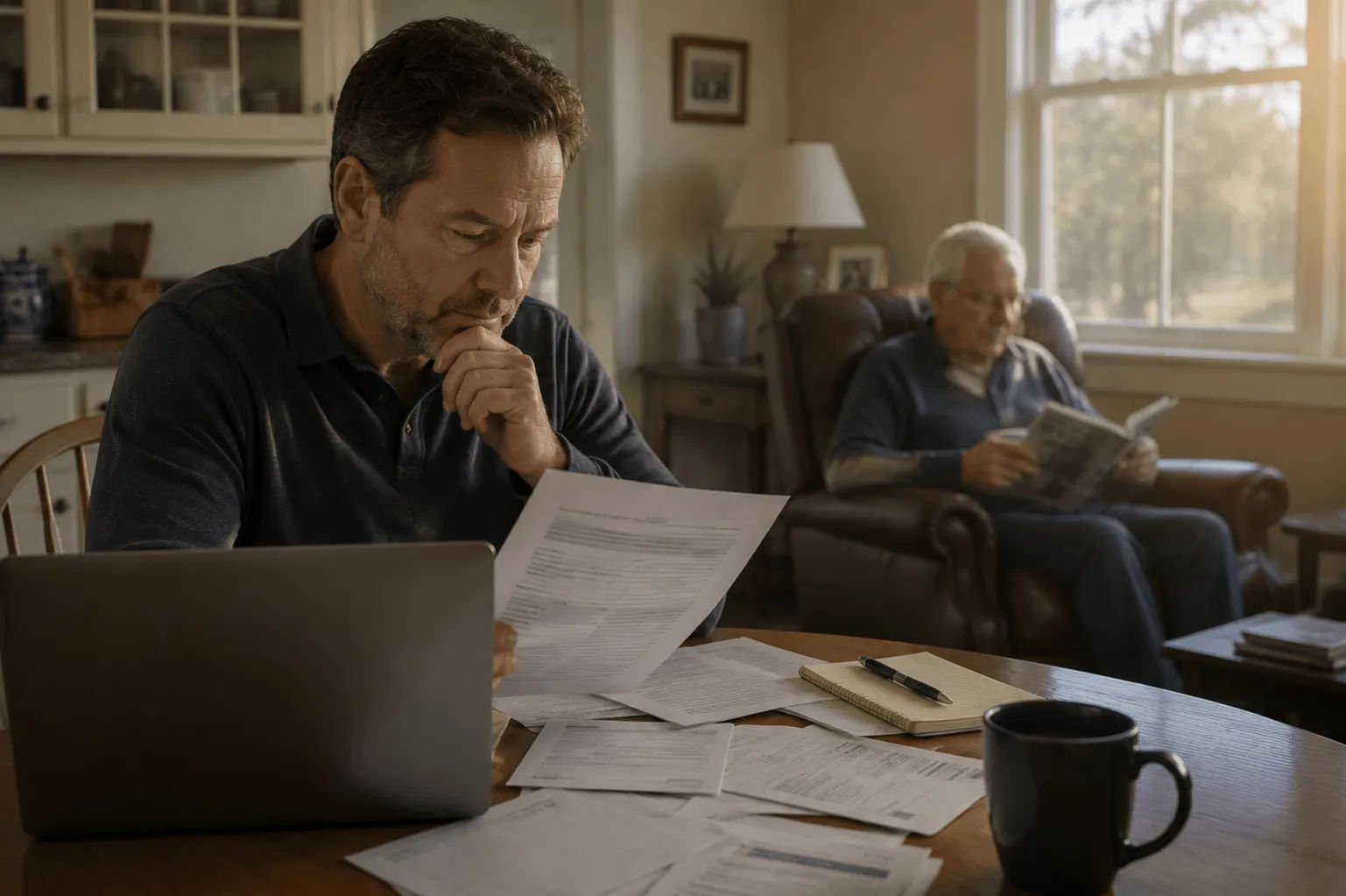
Your father says he does not need help. You have heard that before. But last month he missed two days of his blood pressure medication, and last week you noticed the freezer was full of food he had no memory of buying. You have started doing the math quietly, without telling him, because you know that the moment you bring it up, the conversation will turn into a debate about money.
So the question becomes: what is this actually going to cost? And is there a cheaper way to do it than going through a home health aide agency in Connecticut?
It is a fair question. Direct hire sounds appealing at first. You find a caregiver independently, agree on a rate, and skip the agency fee. On paper, the hourly number looks lower. But the full picture is more complicated, and for most Connecticut families, the apparent savings disappear quickly once you account for what agencies provide that private arrangements do not.

The Case for Direct Hire: What Makes It Seem Attractive
The appeal of hiring a caregiver privately is straightforward. You find someone through a referral, a community board, or a website. You negotiate a rate directly. There is no agency markup. The hourly cost is often lower than what an agency charges, sometimes noticeably so.
For families already stretched financially, that difference matters. And in some situations, direct hire works well. If you have a highly trusted referral, a clear and limited scope of care, and the time to manage the arrangement yourself, it can be a reasonable path.
But "highly trusted referral" and "limited scope" are the key phrases there. When the situation is more complex, or when the family does not have time to manage employment logistics, the lower hourly rate starts costing more than it saves.
Before committing to either path, it helps to understand what home care services actually include so you can match the option to the level of care your parent actually needs.
The True Cost of Direct Hire: What Families Often Miss
When you hire a caregiver as an individual, you are not just paying an hourly rate. In Connecticut and under federal law, you become an employer. That comes with real obligations that many families do not anticipate until they are already in the arrangement.
Here is what the true cost of direct hire includes:
- Payroll taxes: As an employer, you are required to withhold Social Security and Medicare taxes (FICA) and pay the employer portion as well. That adds roughly 7.65 percent to your labor cost on top of the agreed wage.
- State and federal unemployment taxes: Connecticut employers must pay into state unemployment insurance. If your caregiver ever files an unemployment claim, it can affect your rate.
- Workers' compensation insurance: If your caregiver is injured while working in your home, you may be liable without workers' comp coverage. In Connecticut, household employers with employees working more than 26 hours per week are generally required to carry this insurance.
- No backup coverage: If your caregiver calls in sick, takes a vacation, or quits without notice, finding a replacement falls entirely on you. Scrambling to cover care during a gap is stressful and can leave your parent without support at the worst time.
- No supervision or oversight: You are responsible for training, evaluating, and managing performance. If a problem arises with the quality of care, there is no agency structure to escalate to.
- No bonding or background screening infrastructure: You must arrange and pay for criminal background checks yourself, and there is no bonding protection if something is stolen or damaged.
When families add these costs together, the gap between direct hire and agency rates often narrows or disappears entirely. And the non-financial costs, such as the time and stress of acting as an employer, are harder to put a number on but very real.

What a Home Health Aide Agency in Connecticut Actually Covers
When you hire through a registered home health aide agency in Connecticut, the hourly rate is higher. That is not hidden. But that rate covers a set of services and protections that families often do not realize they are receiving until something goes wrong.
A reputable home care agency in Connecticut handles:
- Payroll, taxes, and all employer obligations: You pay the agency. The agency handles the rest. You are not the employer of record.
- Workers' compensation and liability insurance: If a caregiver is injured in your parent's home, the agency's insurance covers it. That protection alone can be worth a great deal in a state with high liability exposure.
- Criminal background screening and reference checks: Agencies conduct these before placing any caregiver. The vetting is built into the process.
- Backup coverage: If a caregiver is sick or unavailable, a quality agency will send a replacement. Your parent does not go without care because one person called in.
- Supervision and care management: Agencies monitor caregiver performance, conduct check-ins, and have a structure for escalating concerns. If the quality of care is not meeting expectations, there is someone to call.
- Compliance with Connecticut home care regulations: Registered agencies operate under state oversight. That accountability is part of what you are paying for.
Morning Star Home Care is nurse-owned and led, founded by a clinician with more than a decade of clinical experience. That background shapes how care is structured, supervised, and delivered. It is not just administrative oversight. It is clinical judgment applied to every care plan.
To review specific service offerings, visit our home care services page.
Home Health Aide Agency Connecticut: The Real Cost Comparison
To illustrate how the numbers actually work, consider a family arranging 20 hours of weekly care for an elderly parent in Bristol or Southington.
A direct-hire caregiver at a lower hourly rate appears to save money on its face. But once you add the employer portion of payroll taxes, workers' compensation insurance premiums, unemployment insurance, background check fees, and the cost of covering gaps in care with emergency arrangements, that margin shrinks considerably. In many cases it reverses.
And that math does not account for the time you spend managing the employment relationship. Time spent on payroll logistics, scheduling adjustments, and performance conversations is time taken from everything else in your life.
For families who already have full schedules, managing a private hire is a second part-time job. For families caring for a parent with more complex needs, like dementia or mobility challenges, the stakes of gaps in coverage are too high to gamble on.
When the Conversation Is Really About More Than Money
There is something else worth naming here. Sometimes the conversation about cost is not really about cost. It is about a parent who does not want to admit they need help, and a family trying to find an arrangement that feels less formal, less threatening, less like something is being imposed.
That was the situation for one family in Plymouth. Their mother, who had lived alone for more than a decade after her husband passed, flatly refused to discuss home care agencies. She did not want strangers in her house. She did not want anyone "checking up" on her. Her son eventually found a private caregiver through a neighborhood connection, thinking it would feel less clinical.
Six months in, that caregiver gave notice with two weeks of warning. There was no backup, no transition plan, and no agency to call. The family scrambled for coverage during a week when their mother had a scheduled medical appointment and could not drive herself. It was the exact kind of disruption they had been trying to avoid.
The experience is common. The desire to preserve a parent's independence and dignity is real and valid. But reliability is also a form of dignity. Knowing that care will be there tomorrow, and the day after, is part of what allows a senior to feel secure at home.
For seniors who are resistant to the idea of outside help, respite and companion care options can be a gentler introduction: regular visits that start as conversation and support before expanding as needed.
The Right Choice for Your Family
Morning Star Home Care serves Bristol, Southington, Plainville, Plymouth, and surrounding communities in Hartford County, Connecticut.
Choosing between a home health aide agency and a direct hire in Connecticut is not purely a financial decision. It is a question of reliability, protection, and peace of mind. For families who want to know that care will be there every day, that their parent is being looked after by someone screened and supervised, and that no one in the family has to become a part-time HR manager, the agency model delivers real value that the lower-looking hourly rate of direct hire rarely matches once the full picture is in view.
If you are in Bristol, Southington, Farmington, or anywhere in the surrounding area and trying to figure out which path makes sense for your family, the team at Morning Star Home Care is glad to walk through the options with you. There is no obligation and no sales pitch. You can contact Morning Star Home Care to schedule a free consultation and get honest answers to the questions you have been turning over on your own.
Written by
Morning Star Care Team
Morning Star Home Care — Caregiver-Founded and Locally Owned in Bristol, CT.